Digital health infrastructure in Pacific Island countries
Pacific Island countries have gone further with digital health than is often assumed: a 2025 environmental scan found that 12 of 14 Pacific Island countries and territories in the WHO Western Pacific Region run an electronic health record in at least part of the public health system [1]. Coverage, however, is concentrated in hospitals and reaches about 1.5% of primary care facilities, and the binding constraints are connectivity, workforce, governance and recurrent financing rather than ambition [1][2].
This guide summarises the published evidence on Pacific digital health, the constraints Pacific health leaders have identified, the regional frameworks that shape investment, and the design choices that hold up in island health systems.
Where Pacific digital health stands today
The most complete recent picture comes from an environmental scan of national electronic health record coverage, published in the Journal of Medical Internet Research in 2025 [1]. The authors reviewed government, bilateral, multilateral and philanthropic sources for the 14 Pacific Island countries and territories that are small island developing states in the WHO Western Pacific Region.
Their findings are encouraging at the top of the system and sobering at the base:
- 12 of the 14 countries (86%) use an electronic health record in at least part of the public health system.
- 8 (57%) run a single national system across more than one facility, compared with 57 of 122 countries (47%) globally.
- Among the 12 countries using a record, average facility coverage was 39%, but the median was only 16%.
- Coverage was positively associated with national income.
| Facility level | Facilities with an EHR | Coverage |
|---|---|---|
| Tertiary hospitals | 19 of 41 | 46% |
| Secondary facilities | 29 of 77 | 38% |
| Primary care facilities | 61 of 4,158 | 1.5% |
| All facilities | 108 of 4,267 | 2.5% |
Source: Porrello and colleagues, 2025 [1].
The scan also noted that some systems in the region were failing or could not scale, and that the extent to which health workers actually use the systems in place is unclear [1]. This matches an earlier regional picture. A 2019 paper to the Pacific Heads of Health meeting reported that all but four of the 22 Pacific Island countries had some form of electronic health information system, while describing many of those systems as standalone and fragmented [2].
For a ministry, the question is rarely whether to digitise. It is how to extend a working core from referral hospitals to the health centres where most contacts occur, without multiplying systems that cannot be supported.
Why island health systems are a distinct design problem
Pacific health systems serve small populations spread across many islands, often with a single referral hospital and a long tail of small facilities. Several conditions follow from this.
Connectivity is uneven and expensive
The International Telecommunication Union's 2024 report on small island developing states found that 67% of the population of those states was online in 2023, in line with the world average, but that the gap between town and village is wide [8]:
- 84% of urban residents used the internet, against 44% of rural residents.
- Only 43% of rural residents had access to 4G.
- 85% of the population was within reach of a mobile broadband network, against 95% globally.
- Data only mobile broadband cost almost twice the world median.
These figures cover all small island developing states, not only the Pacific, but they describe the conditions Pacific facilities report. The 2019 Heads of Health paper lists unreliable power, limited mobile signal and broadband concentrated in urban areas among the main infrastructure gaps [2].
The disease burden needs longitudinal records
WHO describes noncommunicable diseases as the single largest cause of premature mortality in the Pacific islands [10]. Diabetes, hypertension and cardiovascular disease are managed over years, across several facilities, with repeated laboratory monitoring and long term medication. That pattern depends on a record that follows the patient, not a register that stays in one clinic.
Workforce is thin at every level
Pacific health leaders report few trained ICT and health information staff to build, support and maintain systems [2]. A system that needs specialist administrators at every site will not survive the first staff rotation.
The constraints Pacific health leaders have identified
The 2019 Heads of Health paper, prepared through the Pacific Community, remains one of the clearest statements of the problem from within the region [2]. Its findings translate directly into design requirements.
| Constraint reported by Pacific health leaders [2] | Design implication |
|---|---|
| Weak strategies, legal frameworks and standards | Systems built on named international standards, with the ministry owning governance |
| Unreliable power and connectivity | Work saved on the device and synchronised when the connection returns |
| Few ICT and health information staff | Central administration, simple configuration, role based workspaces |
| Funding that ignores operating and upgrade costs | Recurrent costs planned from the start, not only the initial build |
| Reporting focused on aggregates, with paper burden on nurses | Reports generated from the clinical record rather than separate tally sheets |
| Hospital records and vertical programmes in separate systems | One patient record across departments and programmes |
| No unique health identifiers; several patient IDs per person | A master patient index and duplicate matching |
| Privacy risk from shared identifiers | Role based access, audit and consent for sharing |
The same paper reported that completeness of birth and death registration across the region ranged from about 15% to 90% [2], a reminder that health records and civil registration need to be linked if vital statistics are to improve.
A 2023 study in Pacific Health, which drew on interviews and consultation with members of the Pacific Health Information Network, framed the challenge in terms of universal health coverage [3]. It identified four broad problems: collecting and exchanging health data, barriers to quality care in rural areas, communication within the health system, and workforce training. Its proposed responses included electronic health and patient information systems, telehealth, digital supply chain management, population data linkage and digital clinical decision support. The authors were explicit that digital health complements, and cannot replace, a skilled workforce, supply chains, financing and governance [3].
The regional frameworks that now shape investment
Pacific ministries now work within a well defined set of global and regional frameworks.
- WHO Global strategy on digital health. Endorsed by the Seventy third World Health Assembly in decision WHA73(28) in 2020, the strategy asks every country to own, adapt and strengthen its digital health strategy, to build sustainable governance, and to place people at the centre of digital health [6].
- WHO Regional action framework on digital health in the Western Pacific. Endorsed by Member States in 2024 and published in October 2025, it sets five priority domains: governance, socio technical infrastructure, financing and economics, digital health solutions, and data, with recommendations for countries at different stages of adoption [5].
- Healthy Islands vision 2050. Pacific health ministers endorsed a renewed Healthy Islands vision in October 2025, thirty years after the original vision was set out at Yanuca Island, Fiji. One of its six pillars is inclusive, digitally connected health systems [9].
- Digital Health Implementation Guide for the Pacific. Published by the Asian Development Bank in 2021, the guide sets out an investment pathway for Pacific health managers and ICT teams, drawing on case studies from countries that have already invested [7].
- SCORE assessments. In January 2026 WHO reported that 19 countries covering 99% of the Western Pacific Region's population had completed SCORE health information system assessments. Over half showed lower maturity in routine health service and resource systems, and two thirds struggled to use data and evidence for policy, largely because of gaps in digital infrastructure, governance and legislation [4].
Regional peer learning matters as much as these documents. The Pacific Health Information Network supports member states on digital health and health information systems; its 2025 meeting and technical workshop in Fiji was co organised with the Pacific Community and CSIRO, with the Asia eHealth Information Network as its sister network [11].
What tends to work in island health systems
The evidence does not support any single architecture, but several patterns recur in the literature and in regional meetings.
Start where the record already pays for itself
Hospitals carry the highest coverage because they concentrate patients, staff and connectivity [1]. A national programme that consolidates the referral hospital first, with laboratory, pharmacy and radiology on the same record, creates the reference implementation and the trained staff that smaller facilities later rely on. The approach to whole hospital mapping is covered in implementing an EHR from workflow mapping to go live.
Match features to the facility
A nursing station does not need theatre scheduling. Matching the system to each facility's level of service keeps training short and screens relevant, and lets the same platform run from the referral hospital to the outer island clinic. This is the theme of scalable health information systems for small island states.
Design for the connection that exists
With rural 4G access at 43% across small island developing states [8], systems must keep working when the link drops and catch up when it returns. The engineering is set out in designing health systems for unreliable connectivity.
Build national reporting on routine care
The 2019 Heads of Health paper noted that data use in the region centres on aggregate reports, with paper collection adding to the burden on nurses [2]. Where the clinical record is coded at the point of care, national returns and surveillance can be produced from it. The Pacific Syndromic Surveillance System, established in 2010, already gives the region weekly syndromic reporting from 23 Pacific Island countries, with alert thresholds automated for each syndrome [12]. Coded clinical records can feed that kind of reporting without extra tally sheets, as described in disease surveillance from the clinical record.
Plan the recurrent cost
Pacific leaders have warned that investments often ignore operating, maintenance and upgrade costs [2]. Hosting, support, devices, connectivity and refresher training belong in the business case from the first year, as covered in total cost of ownership of an EHR.
How Moana approaches island health systems
Moana is built for the conditions this evidence describes. It is live across clinics in the South Pacific, where facilities run patient records, prescribing, laboratory orders and billing on one platform with one record per patient.
At ANGAU Memorial Provincial Hospital in Lae, Papua New Guinea, the regional referral hospital for the Momase region with a catchment of about 2.8 million people, every department has been mapped and configured in Moana with its Officer in Charge. The Consultation Clinic is already live in the Moana system, and hospital wide go live is expected in the coming weeks. ANGAU is the reference for how Moana maps a whole hospital before configuration, set out in the ANGAU case study.
The design choices follow from the constraints Pacific leaders have named:
- Designed for unreliable connectivity. Work is saved on the device and synchronised when the connection returns, and the same platform performs equally on stable networks. See how Moana works everywhere.
- One record across the hospital. MOANA EHR, MOANA LIS, the Moana Pharmacy Management System and MOANA PACS share one patient record, so vertical programmes do not need parallel systems.
- Facility service levels. Features are matched to a facility's level, so a referral hospital and a health centre run the same platform with different screens.
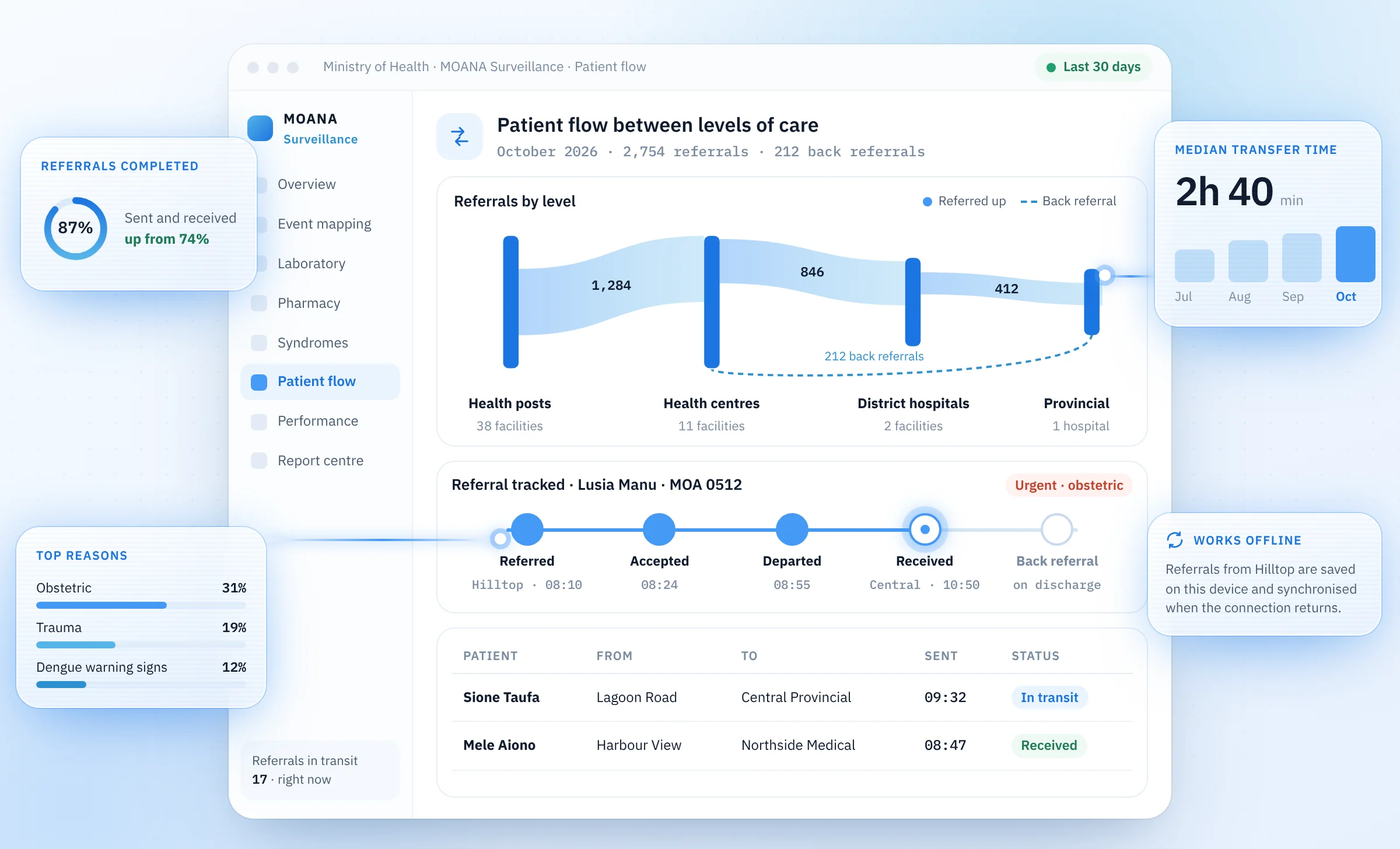
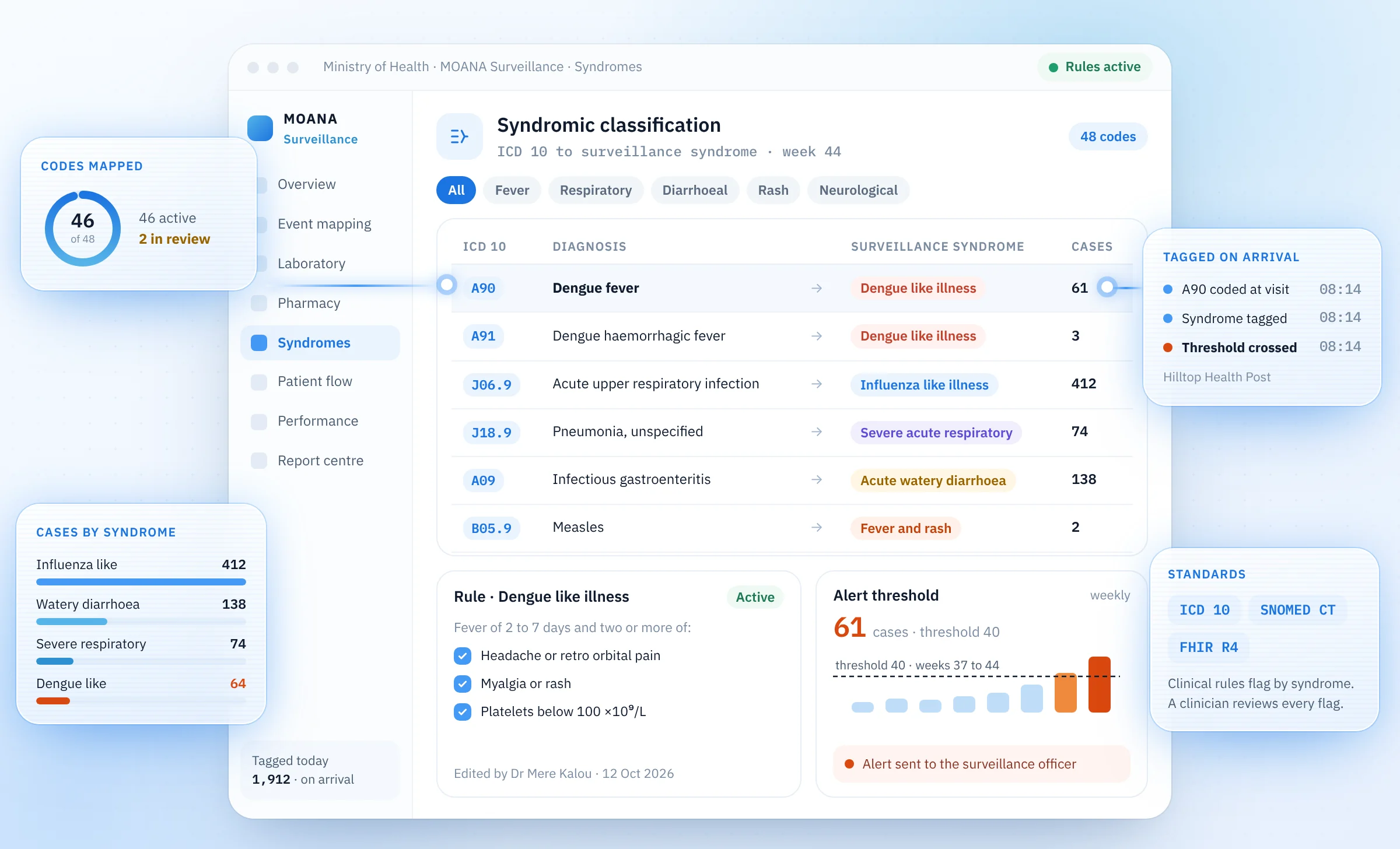
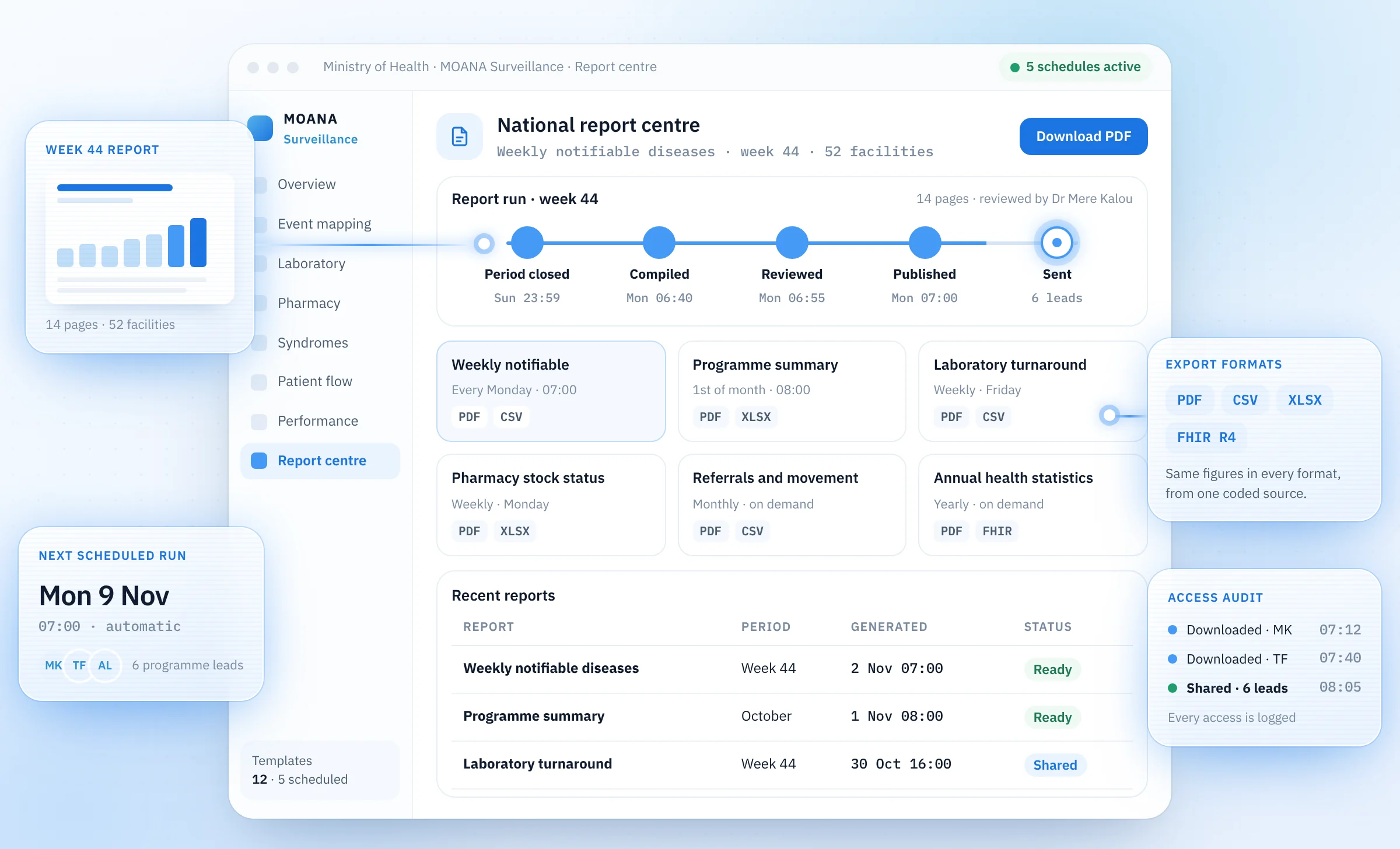
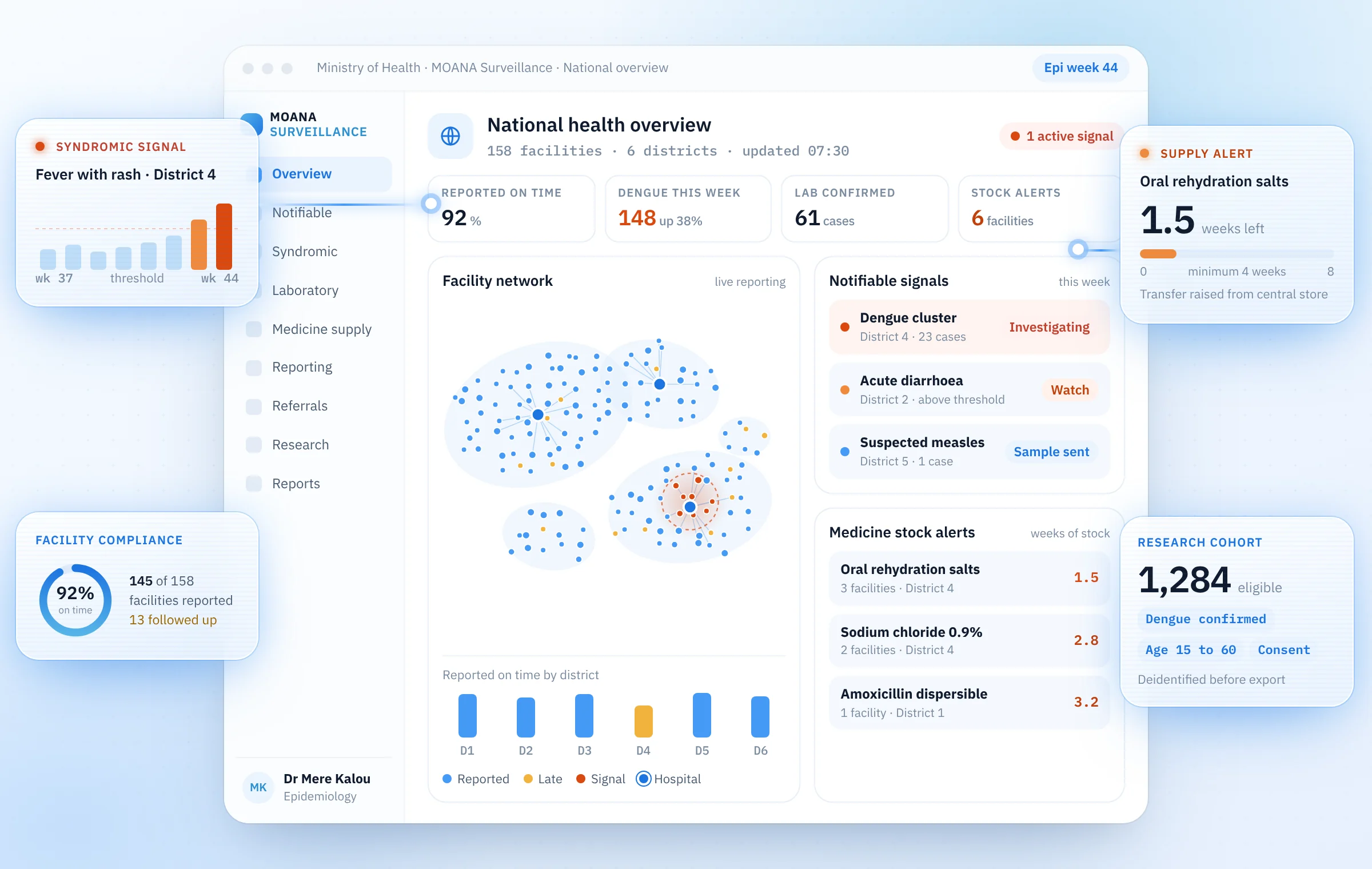
- National systems on routine care. MOANA Surveillance, the Moana Medical Supply System and MOANA Clinical Research read from the record instead of separate data entry, and aggregates report into DHIS2.
- Named standards. FHIR R4, HL7 v2, DICOM, ICD 10, ICD 11, SNOMED CT and LOINC, so the ministry is not tied to a proprietary format.
- Data sovereignty. The organisation that collects the data owns it, and hosting is agreed with each ministry.
Key questions for procurement
How widely are electronic health records used in Pacific Island countries?
A 2025 scan found that 12 of 14 Pacific Island countries and territories in the WHO Western Pacific Region use an EHR in at least part of the public system, with 46% coverage of tertiary hospitals but only 1.5% of primary care facilities [1].
What are the main barriers to digital health in the Pacific?
Pacific health leaders cite weak strategies and legal frameworks, unreliable power and connectivity, workforce shortages, funding that ignores recurrent costs, fragmented systems and the absence of unique health identifiers [2].
Can one system serve both a referral hospital and an outer island clinic?
Yes, if features are matched to each facility's level and the system tolerates intermittent connections. The alternative, separate systems by level, recreates the fragmentation the region is trying to remove.
How should a ministry protect ownership of national health data?
By contracting for data ownership, agreed hosting and export in open standards from the start. The issues are covered in health data sovereignty.
Which regional frameworks should a digital health investment align with?
The WHO Global strategy on digital health [6], the WHO Regional action framework on digital health in the Western Pacific [5], the Healthy Islands vision 2050 [9] and, for investment planning, the ADB Digital Health Implementation Guide for the Pacific [7].
Sources
- National Electronic Health Record Coverage in Pacific Island Countries and Territories: Environmental Scan, Journal of Medical Internet Research (Porrello, Peden, Nunan, Joshi), 2025
- Update on eHealth and Health Information Systems in the Pacific, Seventh Pacific Heads of Health Meeting, Pacific Community, 2019
- Digital health and Universal Health Coverage: opportunities and policy considerations for Pacific Island countries and territories, Pacific Health (Craig and colleagues), 2023
- Western Pacific Region achieves milestone: 19 countries complete comprehensive health information system assessments, WHO Regional Office for the Western Pacific, 2026
- WHO publishes Regional action framework on digital health in the Western Pacific, WHO Regional Office for the Western Pacific, 2025
- Global strategy on digital health 2020 to 2025: summary, World Health Organization, 2021
- ADB launches Digital Health Implementation Guide for the Pacific, Asian Development Bank, 2021
- Data report tracks connectivity successes and challenges in small island developing states, International Telecommunication Union, 2024
- After 30 years, Pacific health leaders reimagine the Healthy Islands vision, World Health Organization, 2025
- Addressing noncommunicable diseases in the Pacific islands, WHO Regional Office for the Western Pacific, accessed 2026
- AeHIN participates in the 2025 PHIN meeting and technical workshop in Fiji, Asia eHealth Information Network, 2025
- Pacific Syndromic Surveillance System, Pacific Public Health Surveillance Network, accessed 2026