Total cost of ownership of an EHR in low resource settings
The total cost of ownership (TCO) of an EHR is every cost of acquiring, deploying, operating and eventually replacing the system over its life, not only the software. In low resource settings the largest and most often underestimated share is operations: support, connectivity, power, hardware replacement, refresher training and the staff time to keep data accurate. Published estimates put ongoing operations at roughly half of total cost.
Ministries and hospital boards are rarely short of quotations for software. What they lack is a credible view of what the system will cost to run in year three, when the implementation grant has ended, devices are starting to fail and newly recruited nurses need training. This guide sets out a cost structure that holds up in budget negotiations, the evidence on where costs fall, and how to reduce the costs that do not add clinical value.
Why purchase price misleads
The Inter American Development Bank, in its 2023 publication on the true cost of digital health tools, argues that the purchase price understates real expense and that TCO must cover acquisition, use, maintenance and eventual retirement, with both direct and indirect costs across the lifecycle [1]. Its guidance notes that many digital health projects fail because their costs were not realistically estimated when budgets were set, and that a project is not sustainable unless its whole lifecycle is budgeted [2].
Digital Square reached the same conclusion from country data. Analysing costed digital health roadmaps from 13 African countries, it found that operations costs were largely not accounted for, and estimated that ongoing operations make up roughly 50 per cent of total costs [3]. Country stakeholders at a 2022 regional meeting told Digital Square there were "no standards for costing", which made budget requests hard to justify [4].
The practical consequence is familiar: systems that launch well and decline once nobody is funded to replace a broken tablet or train a new ward clerk.
A cost structure that holds up
Two frameworks are widely used and compatible. The Inter American Development Bank divides costs into four stages: preliminary studies; acquisition, development or adaptation; use and maintenance; and evaluation and closure. Each stage is costed across five categories: internal human resources, external professional resources, infrastructure, licences and other operating costs [2]. Digital Square's Total Cost of Ownership Tool and its Sustainability Calculator use three phases: development, deployment and operations [3][5].
The table below combines both into a structure suited to an EHR.
| Phase | Typical cost lines | Often missed |
|---|---|---|
| Planning and design | Needs assessment, workflow mapping, requirements, procurement | Clinician time spent in mapping sessions |
| Acquisition and configuration | Software, configuration per department, data migration, integrations | Interfaces to laboratory analysers and national systems |
| Deployment | Devices, networking, power backup, initial training, go live support | Site preparation, secure storage for devices |
| Operations | Hosting, connectivity, support, maintenance, upgrades | Refresher training for staff turnover |
| Hardware lifecycle | Replacement of devices, batteries, network equipment | Devices lost, damaged or repurposed |
| Data quality | Registry clean up, duplicate resolution, audit | Staff time to correct records |
| Evaluation and transition | Monitoring, evaluation, eventual migration | Export of data at contract end |
Infrastructure: power, connectivity and devices
Power
Electricity is the first infrastructure cost and the one most frequently assumed away. The WHO, World Bank and partners' 2023 report on electricity in health facilities found that about 12 per cent of health facilities in South Asia and 15 per cent in sub Saharan Africa have no electricity access, and that only about 40 per cent of facilities in low and lower middle income countries in sub Saharan Africa have reliable power [6]. Primary health centres generally fare worse than hospitals, and rural facilities worse than urban ones [6]. The report estimates that about US$4.9 billion is urgently needed to reach a minimal standard of electrification [7].
For an EHR budget this means battery backup for devices and network equipment, and in some facilities solar or generator capacity. It also argues for devices with good battery life and for software that does not lose work when power fails.
Connectivity
The International Telecommunication Union reported in 2025 that 2.2 billion people remain offline, that only 58 per cent of rural residents use the internet compared with 85 per cent of urban residents, and that mobile broadband remains unaffordable in about 60 per cent of low and middle income countries [8]. Connectivity is therefore both a capital cost, for network equipment, and a recurring cost, for data plans or fixed links, which rises with the volume of data a system transfers.
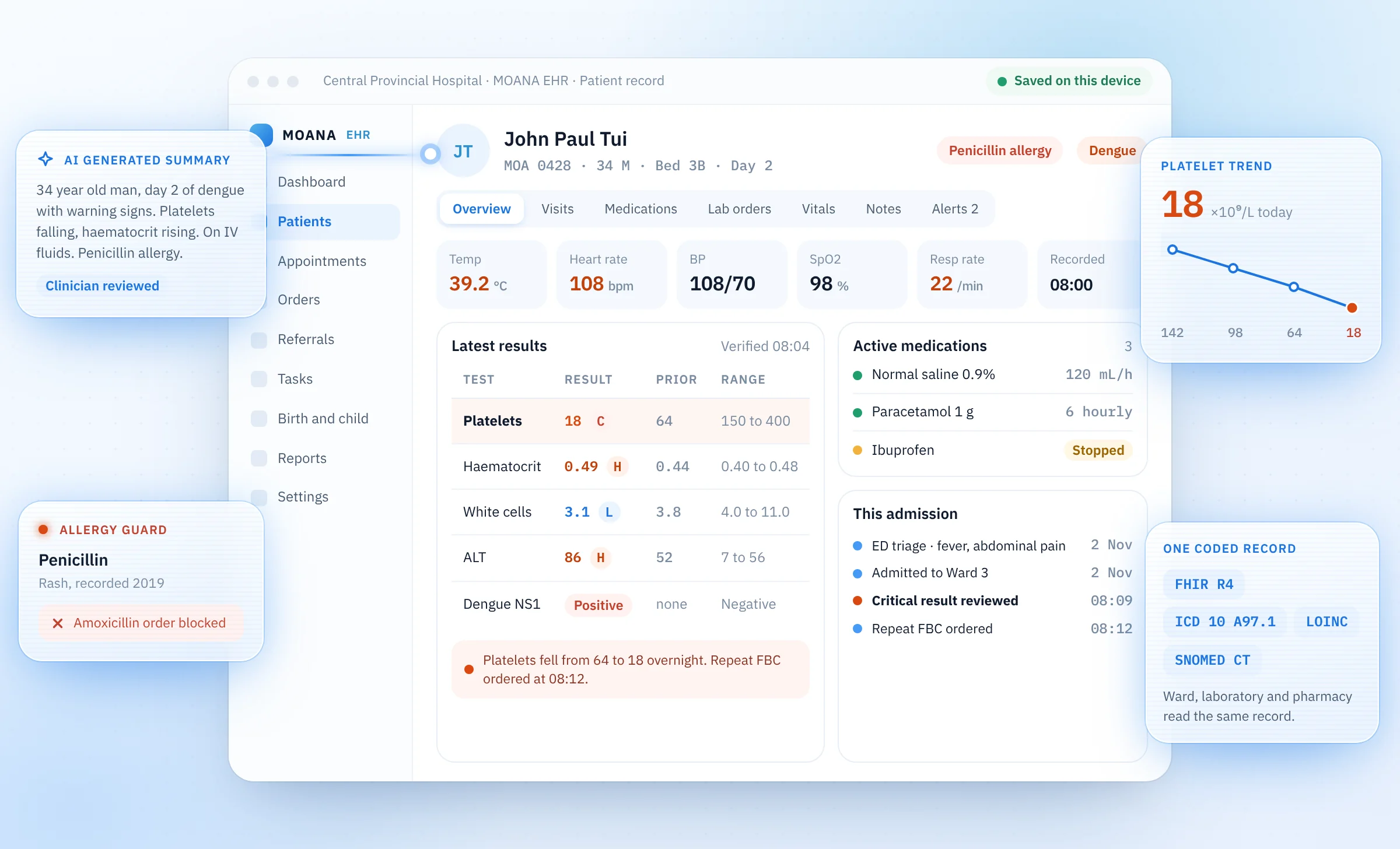
A system designed for unreliable connectivity changes this calculation. When work is saved on the device and synchronised when the connection returns, a facility can operate on a lower cost link without stopping care when the link drops. The design principles are covered in designing health systems for unreliable connectivity.
Devices
Device costs include the initial purchase and a replacement cycle. Budgets should allow for devices that are damaged, lost or moved to other uses, and for secure storage and charging points in each department. Cross platform software, which runs on the computers a facility already has, reduces the initial outlay.
Hosting and data sovereignty
Hosting choices carry both cost and governance consequences. Cloud hosting moves capital cost into recurring cost and reduces the need for in country server administration. National or on premise hosting may be required by data protection policy, and brings costs for servers, backup, physical security and skilled staff. Whichever model is chosen, the contract should state who owns the data, where it is held, and how a complete export is provided if the relationship ends. An exit cost that is unknown at signing is a cost that will be paid later at a disadvantage.
People: training, support and turnover
Training is a recurring cost, not a one time event. The 2023 systematic review of EHR adoption in low income countries found lack of training to be the most frequently reported barrier [9]. Yet a review of 47 studies on EMR success criteria in low resource settings found training and skilled personnel mentioned in only about 10 per cent of papers [10], suggesting that programmes and their evaluations routinely underweight it.
Staff turnover drives the recurring element. A United States government report on patient matching noted that registration staff at one large health system stayed in post for about four months on average [11]. Turnover in public hospitals in low and middle income countries varies, but the principle holds: every new clerk, nurse or doctor needs training, and the budget must carry it.
Support has three tiers that should each be costed: first line support in the facility, usually by trained super users; second line support from the implementing team; and third line support from the software provider for defects and upgrades.
Data quality has a cost
Poor data quality is a hidden operating cost. The same United States report found duplicate record rates averaging 8 per cent across 112 master patient indexes, and cited an estimate of about US$60 in operational cost to resolve a single duplicate record [11]. Each duplicate also represents a clinical risk, because results and history are split across two charts. Budgeting for registration training, duplicate review and periodic audit is cheaper than correcting the consequences. Patient identification is covered in master patient index and unique health identifiers.
Weighing cost against return
TCO is half of the equation. A modelling study of an EMR at a central hospital in Lilongwe, Malawi, estimated annual savings of US$284,395 from reduced length of stay, transcription time and laboratory use, with a net financial gain by the third year and a five year net benefit of US$613,681 [12]. The study is one hospital and one model, but it shows that the right comparison is not software price against zero; it is the full cost of the system against the full cost of paper, duplicate tests and lost information.
WHO's Digital Implementation Investment Guide includes developing a budget as a defined step in planning digital health investment, alongside monitoring the implementation and setting out its value proposition [13].
A five year TCO checklist
- Workflow mapping and configuration for every department in scope
- Integration with laboratory analysers, existing hospital systems and the national HMIS
- Devices per department, with a replacement allowance
- Power backup and network equipment per facility
- Connectivity costs per facility per year
- Hosting, backup and disaster recovery
- Initial training, refresher training and training for new staff each year
- First, second and third line support
- Software maintenance and upgrades
- Data quality: duplicate review, audit and registry maintenance
- Monitoring and evaluation
- Data export and transition at contract end
How Moana reduces the costs that do not add clinical value
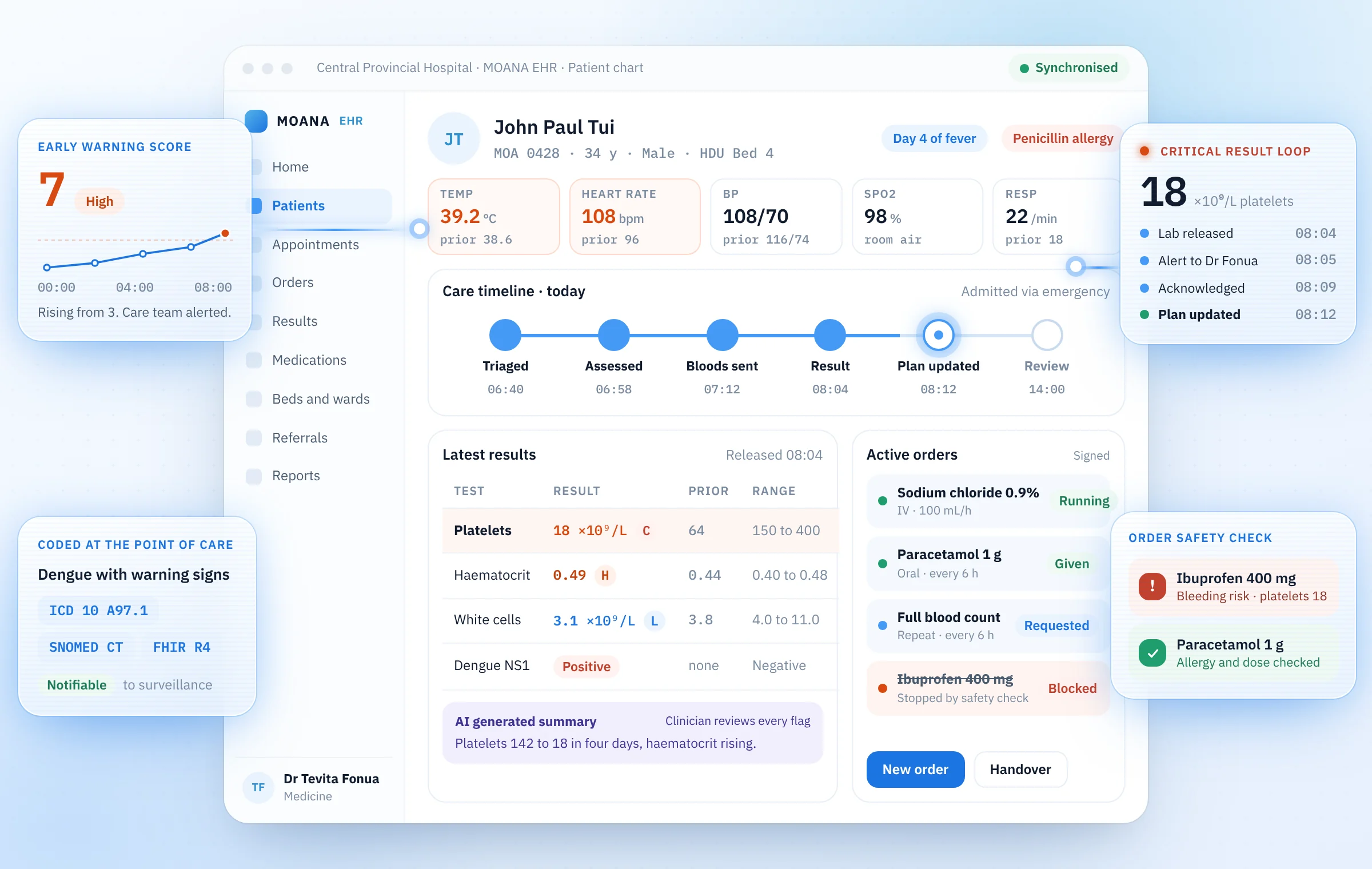
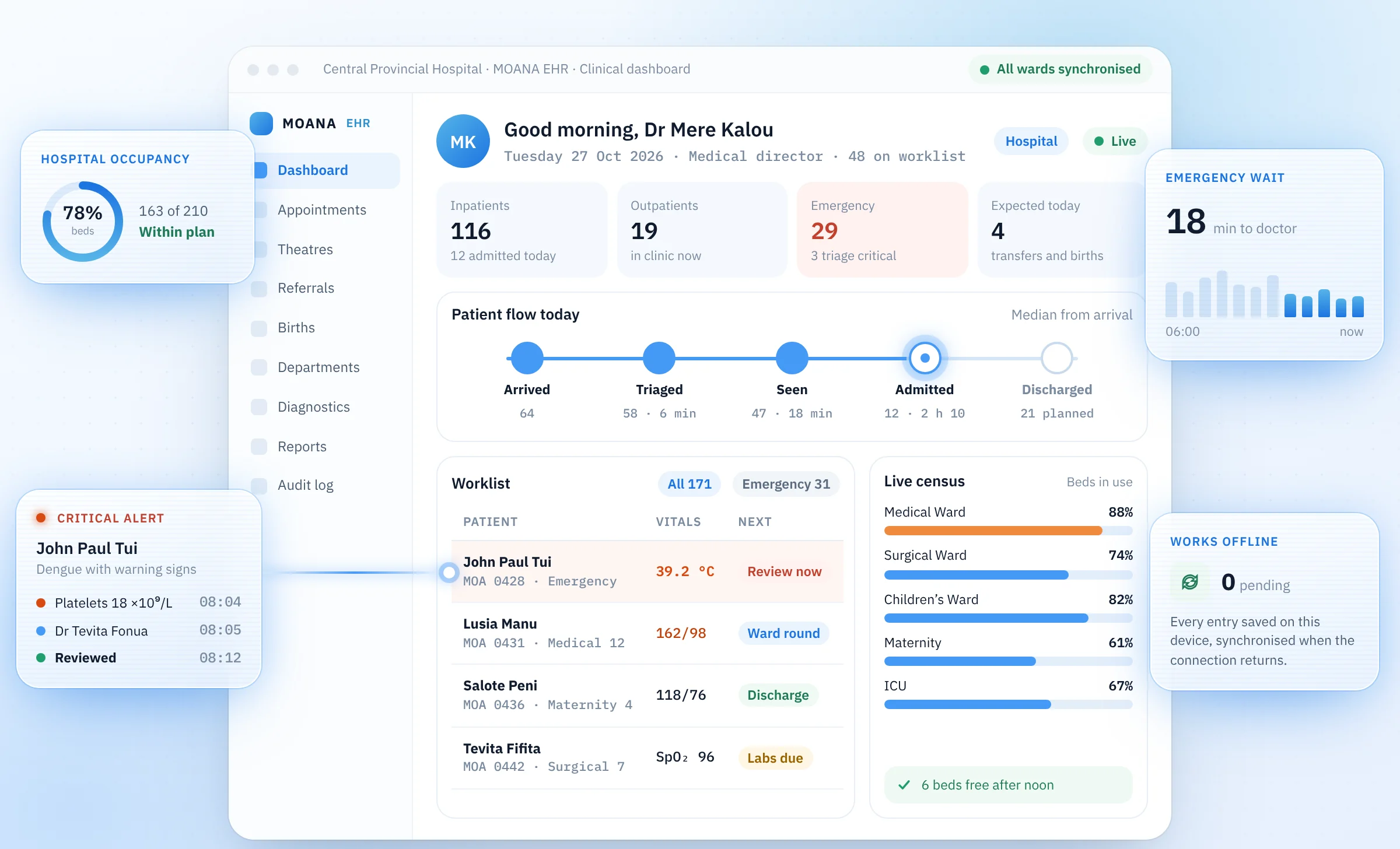
Moana is designed to keep operating cost proportionate to the care being delivered. Because the Moana EHR, MOANA LIS, the Moana Pharmacy Management System, MOANA PACS and hospital operations share one patient record, a hospital does not pay to build and maintain interfaces between separate departmental products, and staff do not re register the same patient in each department. MOANA LIS integrates with analysers and instruments, which removes manual transcription of results.
Moana is designed for unreliable connectivity. Work is saved on the device and synchronised when the connection returns, so care continues when the link drops, and the same platform performs equally on stable networks. MOANA Desktop runs on Windows, macOS and Linux computers, so facilities can use suitable equipment they already own. Facility service levels match features to each facility's level, so a health centre is not configured, trained and supported for modules it does not use.
On implementation, Moana maps and configures each department with the people who do the work before moving to the next, which concentrates training on the workflows staff will use. At ANGAU Memorial Provincial Hospital in Lae, Papua New Guinea, every department has been mapped and configured with its Officer in Charge, the Consultation Clinic is already live in the Moana system, and hospital go live is expected in the coming weeks. The method is described in how Moana works.
On data governance, the organisation that collects the data owns it, and Moana's FHIR R4 and FHIR bulk export capabilities give the health system a standards based route to its own data, which reduces dependency at contract end. Moana is live across clinics in Pakistan, clinics in the South Pacific and India.
Key questions for procurement
What share of EHR cost is operations?
Digital Square's analysis of national digital health roadmaps estimated that ongoing operations make up roughly half of total cost, and found that most roadmaps had not budgeted for them [3].
What costs are most often left out of EHR budgets?
Refresher training for staff turnover, device replacement, power backup, connectivity, data quality work and the cost of exporting data at contract end.
Over what period should TCO be calculated?
At least five years, which covers implementation, a device replacement cycle and the period after initial funding ends. Digital Square's tools frame costing around the full lifecycle of the intervention [5].
Does a system designed for unreliable connectivity reduce cost?
It can reduce the cost of interruptions, because care and data entry continue when the link drops. It does not remove the need for connectivity, since results, referrals and reporting depend on synchronisation.
How should we compare quotations from different vendors?
Use the same cost structure for every option, include all phases and categories, and compare full TCO rather than acquisition cost alone, as the Inter American Development Bank recommends [2].
Sources
- Beyond the price tag: understanding the true cost of digital health tools, Inter American Development Bank, 2023
- How much does it cost? The importance of understanding the total cost of digital health projects, Inter American Development Bank, 2023
- Calculating the cost of digital health transformation, Digital Square at PATH, 2023
- How much do digital health interventions cost? A new tool helps countries estimate, Digital Square at PATH, 2022
- Total Cost of Ownership Tool, Digital Square at PATH, 2022
- Energizing health: accelerating electricity access in health care facilities, World Health Organization, World Bank, Sustainable Energy for All and International Renewable Energy Agency, 2023
- Close to one billion people globally are served by health care facilities with no electricity access or with unreliable electricity, World Health Organization, 2023
- Facts and Figures 2025, International Telecommunication Union, 2025
- Adoption of electronic health record systems to enhance the quality of healthcare in low income countries: a systematic review, BMJ Health and Care Informatics, 2023
- Success criteria for electronic medical record implementations in low resource settings: a systematic review, Journal of the American Medical Informatics Association, 2015
- Patient identification and matching final report, Office of the National Coordinator for Health Information Technology, 2014
- Modeling return on investment for an electronic medical record system in Lilongwe, Malawi, Journal of the American Medical Informatics Association, 2013
- Digital implementation investment guide: integrating digital interventions into health programmes, World Health Organization, 2020