Building a national health information system on routine care
A national health information system built on routine care records each patient contact once, in the clinical record at the point of care, and derives registries, programme reports and national aggregates from that record. WHO's Health Metrics Network framework recognised that most data on clinical services are generated routinely while services are delivered [1]; the architectural task for a ministry is to make that routine record the source of national figures rather than one of several parallel registers.
This guide sets out the components of a national health information system, the cost of the parallel recording model most countries still run, a reference architecture from point of care to national reporting, and the standards and sequencing that make the approach work.
What a national health information system is made of
The Health Metrics Network framework, published by WHO in 2008, remains a standard reference for describing a country health information system [1][2]. It describes six components.
| Component | What it covers [1] |
|---|---|
| Resources | Legislation, planning frameworks, personnel, financing, logistics, ICT and coordination |
| Indicators | A core set across determinants of health, the health system and health status |
| Data sources | Population based sources (census, civil registration, surveys) and institution based sources (individual, service and resource records) |
| Data management | Collection, storage, quality assurance, processing and analysis |
| Information products | Data turned into information that supports action |
| Dissemination and use | Information made accessible to decision makers, with incentives to use it |
The framework's founding argument was that countries need to strengthen whole health information and statistical systems rather than systems for single diseases [2]. Nearly two decades later, many ministries still run a separate register, form and database for each programme. The architecture described here is a way of honouring that original argument with current technology.
The cost of parallel recording
In most low and middle income health systems the same consultation is written several times: in the patient's book, in a programme register, on a tally sheet and finally in a monthly form. A 2021 study of primary care facilities in Cambodia, Ghana, Mozambique, Nigeria and Tanzania measured what this costs [3]:
- Facilities held an average of 34 registers per country, with an average of 25 mandatory cells to complete per patient.
- Countries used an average of 35 monthly reporting forms; one main outpatient form contained 4,632 cells.
- Recording took about one third of consultation time across outpatient, family planning, antenatal and immunisation services.
- Monthly reporting took about nine hours per health worker on average.
Pacific health leaders have described the same pattern: data use centred on aggregate reports rather than patient level data, paper collection adding to the burden on nurses, vertical programmes running separate systems, and most countries lacking unique health identifiers [11].
Every transcription is also an opportunity for error, and the aggregate cannot be traced back to the patients behind it. That is the subject of the companion guide on traceable national health reporting.
A reference architecture from point of care to ministry
The OpenHIE community publishes an architecture specification that is intended to represent a pattern for the key components of a health information exchange, reflecting the consensus of its Architecture Review Board [4]. Within that pattern, the shared health record supports three exchanges: querying a patient's previous encounters, providing data to the record, and requesting a document on demand [4].
In practice a national system built on routine care has five layers.
| Layer | Function | Typical standards |
|---|---|---|
| Point of service | EHR, laboratory, pharmacy and radiology systems where care is recorded | FHIR R4, HL7 v2, DICOM |
| Shared registries | Patients (master patient index), facilities, health workers, terminology | FHIR R4, ICD 10, ICD 11, LOINC, SNOMED CT |
| Shared health record | A longitudinal record available across facilities | FHIR R4 |
| Aggregate reporting | Indicators by place and period for the HMIS | FHIR MeasureReport, IHE ADX, DHIS2 |
| National systems | Surveillance, supply chain and research reading from the record | FHIR R4, DHIS2 |
Three principles hold the layers together:
- Capture once. A diagnosis, result or dispensing event is recorded once, by the person who performed the service.
- Share identities and codes. Every layer uses the same patient identity, facility list and terminology, so a count in one system means the same thing in the next.
- Derive, do not re enter. Programme reports and national aggregates are computed from the record, never typed again.
The platform choice at the reporting layer is often already made. More than 70 countries use DHIS2 as their national health management information system, representing key health data about more than 40% of the world's population [5]. The question for most ministries is therefore not what replaces the HMIS, but how facility systems feed it.
From patient level records to national aggregates
A national indicator is a count of patients or events that meet a definition, in a place, during a period. When the definition is expressed against coded data in the record, the count can be computed rather than tallied.
Standards for computed reporting
- FHIR MeasureReport. The HL7 FHIR MeasureReport resource holds the results of evaluating a measure and can represent three levels of report: an individual patient, a list of patients who meet the criteria, and a summary population count for each criterion, with stratifiers such as sex or age group [8]. The patient list level is what makes a national figure traceable.
- IHE Aggregate Data Exchange (ADX). ADX supports interoperable reporting of routine weekly, monthly or quarterly aggregate data from facilities to districts and onward, where each data point is a data element, a period and a location. Its documented example is a facility EMR generating monthly reports that a national HMIS receives [7].
- DHIS2 Tracker. Where patient level data is held in DHIS2 itself, Tracker records can be aggregated automatically for routine reports without entering the same data twice, and DHIS2 notes that capturing data closer to the individual reduces aggregation errors and allows finer disaggregation [6].
Encoding the guideline, not only the report
WHO SMART guidelines take the same idea further upstream. SMART stands for standards based, machine readable, adaptive, requirements based and testable, and the guidelines are organised in five layers that support consistent data collection, decision support and the calculation of indicators across geographies [9]. When a country adopts a digital adaptation kit, the indicator definitions travel with the clinical workflow that produces the data.
Shared registries: identity, facilities and terminology
Aggregates built from records are only as reliable as the identities and codes underneath them.
- Patients. Without a master patient index, a patient seen at three facilities is counted three times. Matching and duplicate review are covered in master patient index and unique health identifiers.
- Facilities. A single authoritative facility list, with the level and catchment of each facility, lets every report aggregate to the same district and province.
- Terminology. ICD 10 or ICD 11 for diagnoses, LOINC for laboratory tests and, where licensed, SNOMED CT for clinical detail. ICD 11 has been in effect since 1 January 2022 [13]. The roles and licensing of each are covered in clinical terminologies: ICD, SNOMED CT and LOINC.
Data quality designed in rather than inspected later
WHO's Data Quality Review toolkit assesses routine data on completeness and timeliness, internal consistency, external comparison with other sources, and the consistency of population denominators [10]. Its site verification method recounts events from registers and divides by the reported value; a verification factor outside 0.90 to 1.10 indicates over or under reporting of more than 10% [10].
When national figures are computed from the record, that recount and the report come from the same data, so transcription error disappears from the equation. The quality questions that remain are more useful ones:
- Is every service being recorded in the system, or are some still on paper?
- Are diagnoses coded consistently, and by whom?
- Are facilities synchronising on time, and which are behind?
These can be monitored continuously from the system itself, rather than through periodic field audits.
Governance and sequencing
The architecture does not implement itself. The Principles for Digital Development, refreshed in 2024, begin with understanding the existing ecosystem and include building for sustainability and establishing people first data practices [12]. The WHO Global strategy on digital health asks every country to own, adapt and strengthen its own digital health strategy [14].
A practical sequence for ministries:
- Agree the national indicator set and data dictionary, mapped to ICD and LOINC codes.
- Establish the facility list and the approach to patient identity.
- Implement the full record at referral hospitals, where volume justifies the investment.
- Generate programme reports from the record and run them in parallel with paper returns for a defined period.
- Retire each tally sheet once verification shows the computed figure is reliable.
- Extend to health centres, with features matched to each facility's level.
How Moana builds national systems on the record
Moana is designed on the principle that the clinical and operational record is the foundation and national systems read from it.
At the point of care, MOANA EHR, MOANA LIS, the Moana Pharmacy Management System, MOANA PACS and hospital operations share one patient record. Diagnoses are coded in ICD 10 or ICD 11, laboratory tests in LOINC, and SNOMED CT is supported.
On top of that record sit three standalone national systems, described on the national systems page:
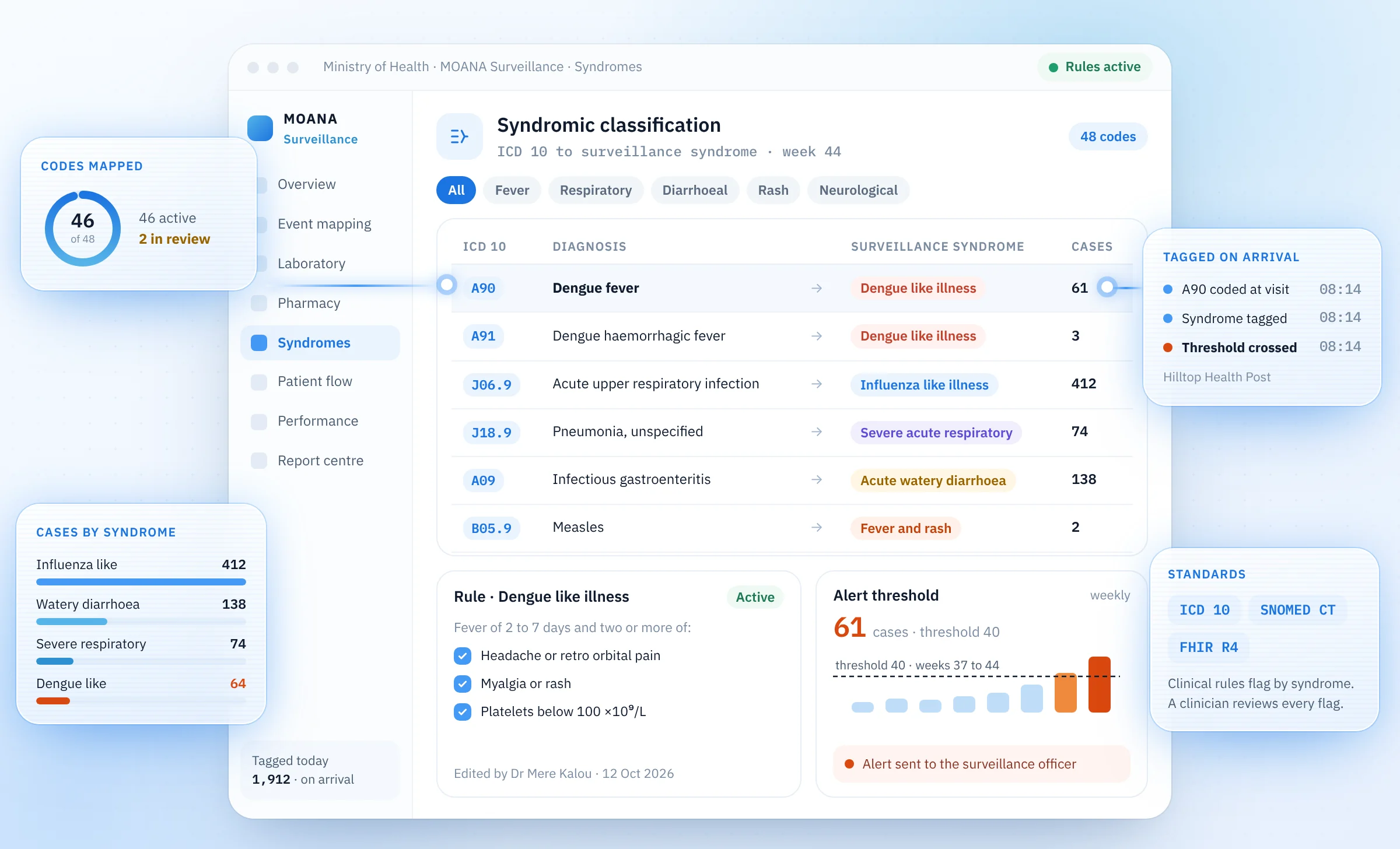
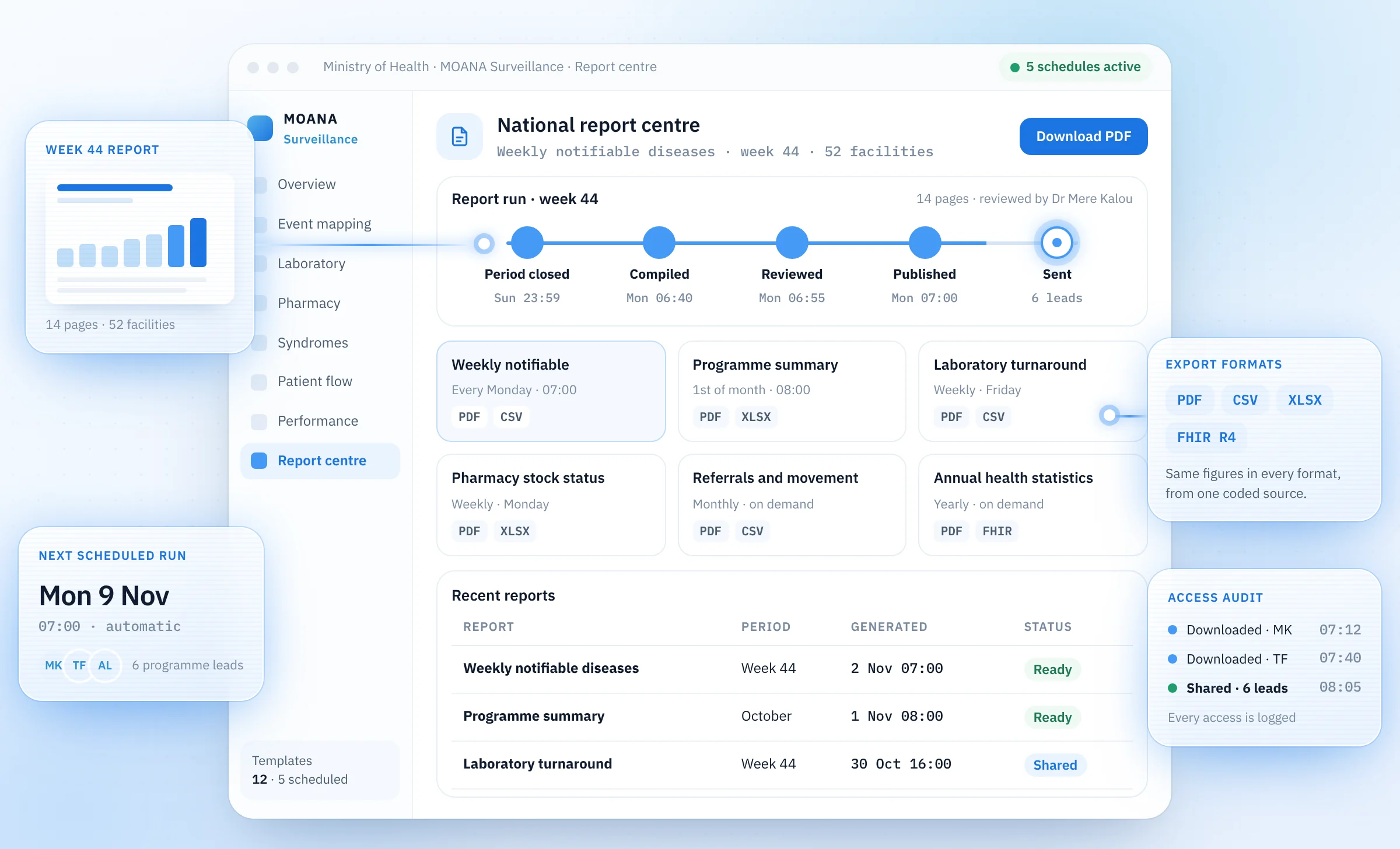
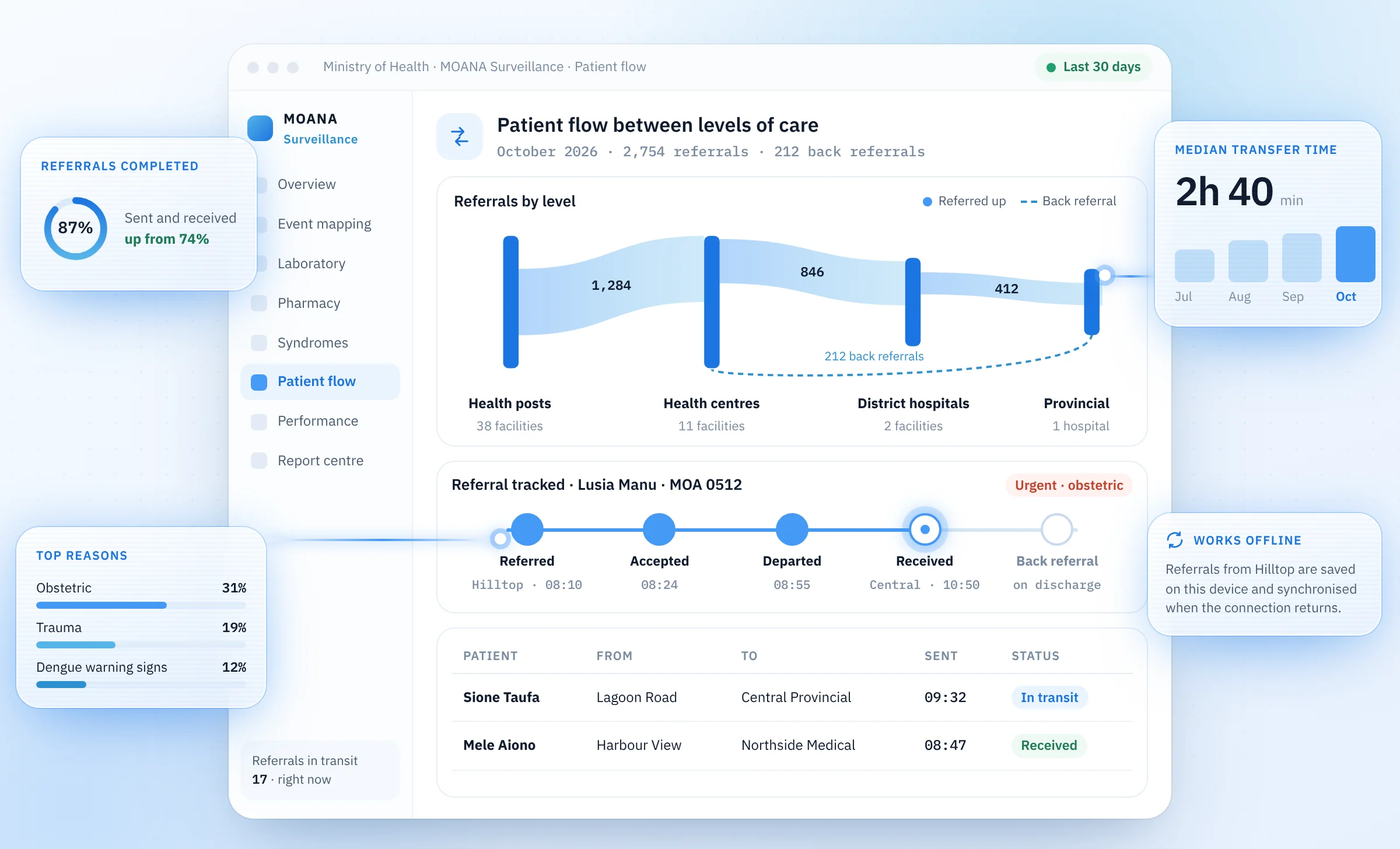
- MOANA Surveillance classifies coded diagnoses into syndromes as they are recorded, checks events against the master patient index for duplicates, monitors reporting compliance by facility and exports aggregates as FHIR MeasureReport bundles and to DHIS2.
- The Moana Medical Supply System tracks stock, requisitions and deliveries from warehouse to facility, draws on what was dispensed and reconciles with finance systems.
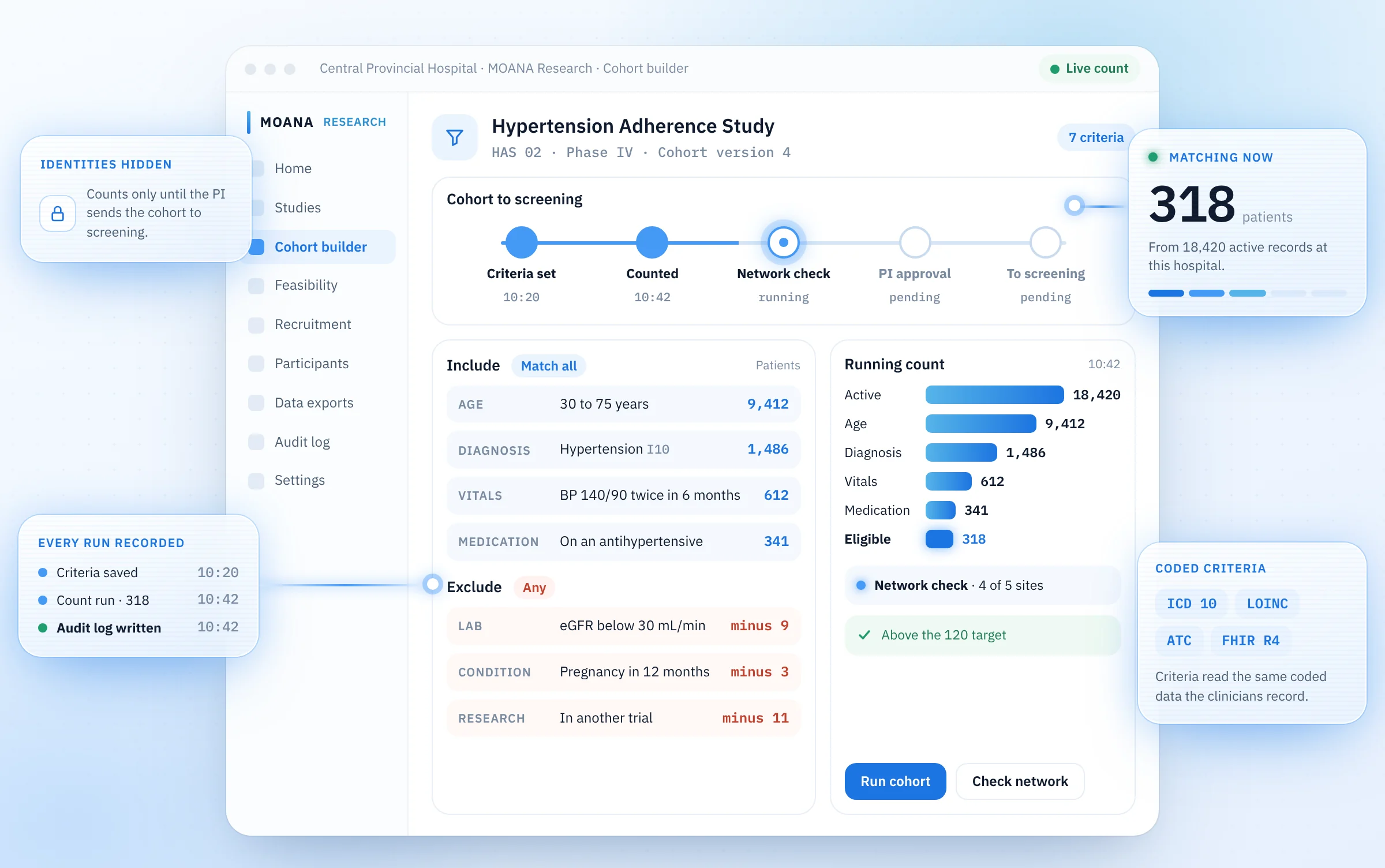
- MOANA Clinical Research counts eligible patients from the same record for feasibility, with small counts suppressed and identities protected until a study is approved.
Interoperability is through named standards: FHIR R4, SMART on FHIR app launch, FHIR bulk export, HL7 v2 and DICOM, detailed on the interoperability page. Facility service levels match features to each facility, so the referral hospital and the health centre run one platform. Moana is designed for unreliable connectivity: work is saved on the device and synchronised when the connection returns. The organisation that collects the data owns it.
Moana is live across clinics in Pakistan and clinics in the South Pacific. At ANGAU Memorial Provincial Hospital in Papua New Guinea, every department has been mapped and configured with its Officer in Charge, the Consultation Clinic is already live in the Moana system, and hospital wide go live is expected in the coming weeks.
Frequently asked questions
Does a routine care architecture replace DHIS2?
No. DHIS2 remains the national aggregate platform in more than 70 countries [5]. The architecture changes how data reaches it: computed from the clinical record instead of typed from tally sheets.
What is the difference between a shared health record and an HMIS?
A shared health record holds patient level clinical information available across facilities [4]. An HMIS holds aggregate indicators by place and period. A routine care architecture derives the second from the first.
Which standards should a ministry specify for aggregate reporting?
FHIR MeasureReport [8] and IHE ADX [7] are the established options for sending computed aggregates, with DHIS2 as the common destination. FHIR R4 is the baseline for patient level exchange, as explained in FHIR R4 explained for ministries of health.
How long should paper and digital reporting run in parallel?
Long enough to verify computed figures against registers using the WHO verification approach [10]. The period varies by indicator and facility; the decision to retire a paper form should rest on evidence, not a calendar.
Can the approach work where only hospitals are digitised?
Yes. Hospitals can report from the record while health centres continue on paper, and the share of computed reporting grows as facilities join.
Sources
- Framework and Standards for Country Health Information Systems, second edition, World Health Organization and Health Metrics Network, 2008
- Framework and standards for country health information systems, publication record, World Health Organization, 2008
- The burden of recording and reporting health data in primary health care facilities in five low and lower middle income countries, BMC Health Services Research (Siyam and colleagues), 2021
- OpenHIE Architecture Specification: shared health record, OpenHIE, accessed 2026
- DHIS2: the world's largest HMIS, DHIS2, University of Oslo, accessed 2026
- DHIS2 Tracker, DHIS2, University of Oslo, accessed 2026
- Aggregate Data Exchange profile, IHE International, accessed 2026
- MeasureReport resource, HL7 International, accessed 2026
- SMART Guidelines, World Health Organization, accessed 2026
- Data Quality Review toolkit, Module 3: site assessment of data quality, World Health Organization, 2020
- Update on eHealth and Health Information Systems in the Pacific, Pacific Community, 2019
- Principles for Digital Development, Principles for Digital Development, 2024
- WHO releases new International Classification of Diseases (ICD 11), World Health Organization, 2018
- Global strategy on digital health 2020 to 2025: summary, World Health Organization, 2021