Scalable health information systems for small island developing states
A health information system scales in a small island developing state when one platform serves every facility, from the national referral hospital to the outer island clinic, with features matched to each facility's level, services shared wherever a country is too small to sustain them alone, and a design that tolerates long and frequent connectivity outages. Scale in this context means reach and sustainability across dispersed islands and thin teams, not transaction volume.
Small island developing states face the same obligations as larger countries, to deliver care, report to national programmes and meet the International Health Regulations, with a fraction of the population, budget and workforce, spread across ocean distances that make every service more expensive. This guide sets out the constraints, the evidence on health information systems in the Pacific, and the design and governance choices that allow one system to serve a whole country sustainably.
What makes small island states different
The United Nations lists 39 small island developing states, together with 18 associate members of United Nations regional commissions, across the Caribbean, the Pacific, and the Atlantic, Indian Ocean and South China Sea regions [1]. They differ greatly in size and income, but share structural features that shape any national system.
The World Bank's Independent Evaluation Group describes the Pacific case clearly. Remoteness and dispersion across ocean archipelagos raise the cost and complexity of public services, all six countries reviewed share thin administrative capacity, and capacity limits are most acute on the smallest islands [2]. Kiribati, for example, has 33 islands spread over 3.5 million square kilometres of ocean, and the Marshall Islands comprises 29 atolls and 5 isolated islands [2].
For a health information system, this means:
- A small national team that must support every facility in the country
- Facilities ranging from a national referral hospital to clinics staffed by a single nurse
- High fixed costs that cannot be spread across a large population
- Long supply lines for hardware, spare parts and specialist support
- Exposure to cyclones, earthquakes and volcanic events that can isolate facilities for weeks
Connectivity and resilience
Connectivity in small island developing states has improved quickly, but remains uneven and expensive. ITU reports that 67 percent of the population of small island developing states was online by 2023, in line with the world average, with internet use growing faster than the global rate [3]. The averages hide large internal gaps.
| Indicator for small island developing states | Figure | Source |
|---|---|---|
| Population online, 2023 | 67 percent | ITU [3] |
| Internet use, urban versus rural | 84 percent versus 44 percent | ITU [3] |
| Mobile broadband coverage | 85 percent, against 95 percent globally | ITU [3] |
| Rural population with a 4G signal | 43 percent | ITU [3] |
| Fixed broadband subscriptions | 10 per 100 people, against 19 globally | ITU [3] |
| Price of data only mobile broadband | Almost twice the world median | ITU [3] |
Single points of failure are common. After the January 2022 eruption, Tonga's undersea cable to Fiji, 827 kilometres long, was damaged, and full internet access took 38 days to restore [4]. A national system that requires a constant connection to a central server would have stopped across the country for that period. The guide to designing health systems for unreliable connectivity sets out the architecture that prevents this.
The health burden makes the patient level record essential
Small island states carry some of the highest burdens of noncommunicable disease in the world. At the 2023 ministerial conference that adopted the Bridgetown Declaration, WHO reported that over 45 percent of adults in the Pacific live with obesity, that the 10 countries with the highest obesity rates globally are all Pacific small island states, and that 8 of the 15 countries with a more than 30 percent risk of premature death from the four major noncommunicable diseases are small island developing states [5].
Chronic disease is managed over years, across visits, medicines and laboratory results. Aggregate tallies cannot support that care; a longitudinal patient record can. The same record supports overseas medical referral, which the WHO Asia Pacific Observatory describes as a growing and costly necessity for Pacific Island countries, often operating outside the national health system with weak coordination and integration [6]. A referral summary drawn from the record, and a structured return of the specialist's findings, are among the most direct ways a national system can improve quality and control cost.
The international agenda reflects this. The Antigua and Barbuda Agenda for SIDS, adopted in 2024 to set priorities to 2034, calls for international support to strengthen health systems and commits to strengthening data collection, storage and analysis, including through a SIDS Data Hub [7].
The state of health information systems in the Pacific
A paper prepared for the 2019 Pacific Heads of Health meeting gives the clearest regional picture. Of 22 Pacific Island countries and territories, all but 4 had some form of electronic health information system, ranging from spreadsheets to hospital systems, and reporting frequency and quality had improved [8]. The constraints it identified remain the design brief for any national system:
- Limited power, mobile signal and internet access, concentrated in urban areas
- A shortage of trained ICT and health informatics staff
- Opportunistic, donor dependent investment that often excludes operating, maintenance and replacement costs
- A focus on aggregate reporting rather than patient level data that supports direct care
- Fragmented, standalone systems alongside common paper records
- Multiple health identifiers that are often not unique or linked across facilities
- Birth and death registration completeness ranging from about 15 percent to 90 percent [8]
The paper recommended that governments build foundations including unique health identifiers, ICT infrastructure and information sharing mechanisms, strengthen links between civil registration and health ministries, and support regional networks such as the Pacific Health Information Network [8]. WHO's Western Pacific regional overview of health information systems, prepared with the Pacific Community and the Pacific Health Information Network, documents the Healthy Islands Monitoring Framework that countries report against [9]. The guide to digital health infrastructure in Pacific Island countries covers this context in more depth.
Design principles for scale in small states
One platform, every level of care
Separate systems for the hospital, the laboratory, the pharmacy and the outer island clinic multiply the cost of hosting, support and training, and each adds an interface to maintain. A small country is better served by one platform with one patient record, configured differently for each facility.
Match features to the facility's level
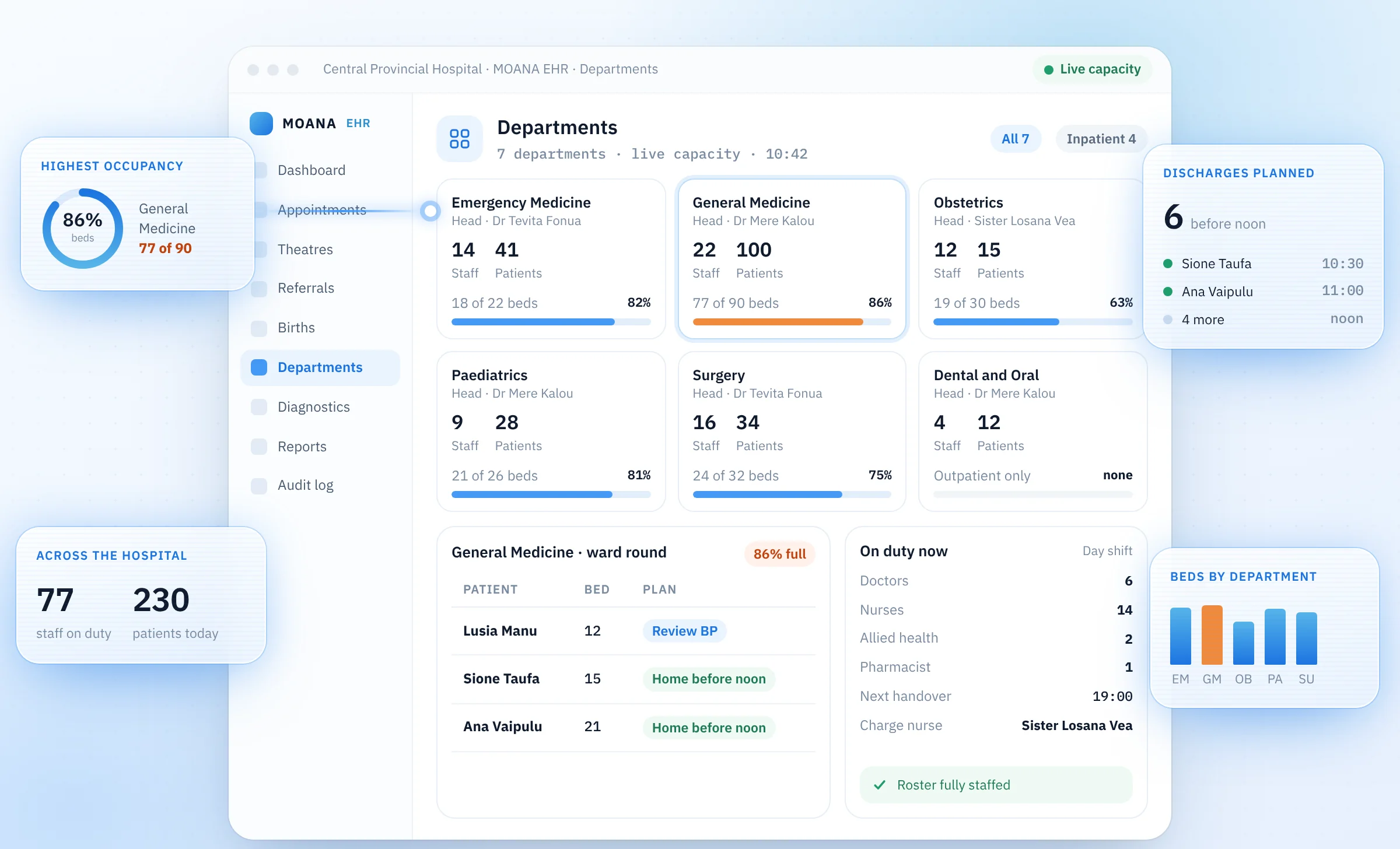
A national referral hospital needs theatres, inpatient wards, a full laboratory and imaging. A nurse led clinic needs registration, consultations, immunisation, maternal and child health, dispensing and referral. Giving every facility every feature confuses staff and complicates support; giving small facilities a separate system breaks the record. The answer is a single platform in which features are matched to each facility's service level.
| Facility level | Typical features | Typical reporting |
|---|---|---|
| National referral hospital | Full record, inpatient wards, theatres, laboratory, imaging, pharmacy, blood bank | National returns, surveillance, programme indicators |
| Provincial or island hospital | Record, inpatient beds, core laboratory, pharmacy, referral | National returns, surveillance |
| Health centre | Record, outpatient care, maternal and child health, immunisation, dispensing, referral | Programme returns, notifiable events |
| Nurse led clinic or aid post | Registration, consultation, immunisation, dispensing, referral | Notifiable events, immunisation and stock returns |
Configure centrally, support remotely
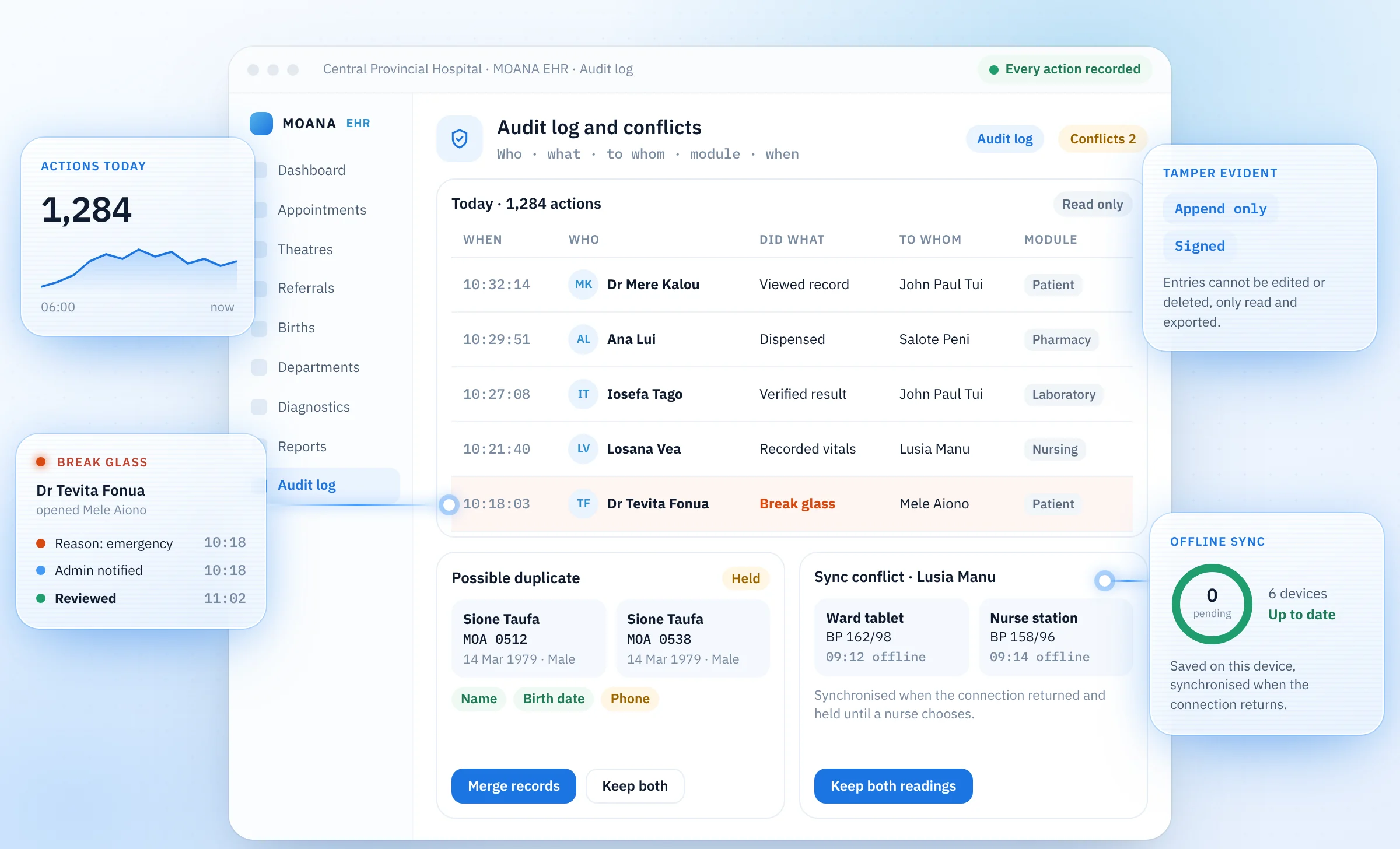
With few ICT staff in the country, configuration, updates and most support must be delivered centrally and remotely. Facilities should receive changes automatically, and a facility's level should be changed by an accountable authority rather than by local workarounds.
Use standards so the country is never locked in
Data should be exchanged through named standards, such as HL7 FHIR R4 and established terminologies, and aggregate returns should flow to the national reporting platform. This keeps future choices open and allows regional exchange where countries agree to it. The guide to building a national health information system on routine care explains the architecture.
Shared services and pooled approaches
Where a country is too small to sustain a function alone, pooling can work. The Eastern Caribbean provides a well documented precedent in medicines: the OECS Pharmaceutical Procurement Service purchased about 25 million dollars of medical products in 2016 to 2017 and generated aggregate savings of about 5 million dollars for member states [10].
The same logic applies to digital health. Functions that can be shared include hosting and disaster recovery, terminology maintenance, training curricula, specialist support and security monitoring. Peer learning between ministries is another form of sharing: a recent account of an exchange between two Pacific ministries of health found that observing a neighbour's national health information system in operation strengthened planning for a national digital health strategy and electronic record implementation [11].
WHO's Regional Action Framework on Digital Health in the Western Pacific, endorsed by Member States in 2024, sets three strategic objectives, enhanced digital health governance, people centric innovative technology, and empowered and included actors, across five domains: governance, socio technical infrastructure, financing and economics, digital health solutions, and data [12]. The refreshed Principles for Digital Development add "share, reuse, and improve" and "build for sustainability" [13].
Shared services must not dilute national ownership. Each country should own the data its facilities collect, decide where it is hosted, and approve any cross border exchange. The guide to health data sovereignty sets out the questions to resolve.
Financing for the whole life of the system
The 2019 Pacific paper's observation that investment often excludes operating, maintenance and replacement costs [8] is the most common reason national systems decline after their first funding cycle. WHO's Global strategy on digital health asks each country to take ownership of its digital health strategy and tailor it to its own context, priorities and resources [14]. In practice that means budgeting from the start for support, hosting, connectivity, device replacement and refresher training, and choosing a system whose running cost a small country can carry once project funding ends.
How Moana approaches this
Moana is one platform with one patient record across the EHR, MOANA Desktop, MOANA Mobile and the Patient Portal, MOANA LIS, MOANA PACS, the Pharmacy Management System, the Moana Medical Supply System and MOANA Surveillance. A small country runs the same platform in its referral hospital and its outer island clinics, so a patient referred between islands, or overseas, carries one record.
Facility service levels are built into the platform. A ministry assigns each facility a level, and the features the facility sees are matched to that level: a referral hospital has inpatient wards, theatres, laboratory and imaging, while a nurse led clinic has the registration, consultation, immunisation, dispensing and referral functions it needs. Features can be included, optional or read only for a level, a facility can request a feature above its level, and level changes are decided by an accountable authority with a preview of what each facility will gain or lose.
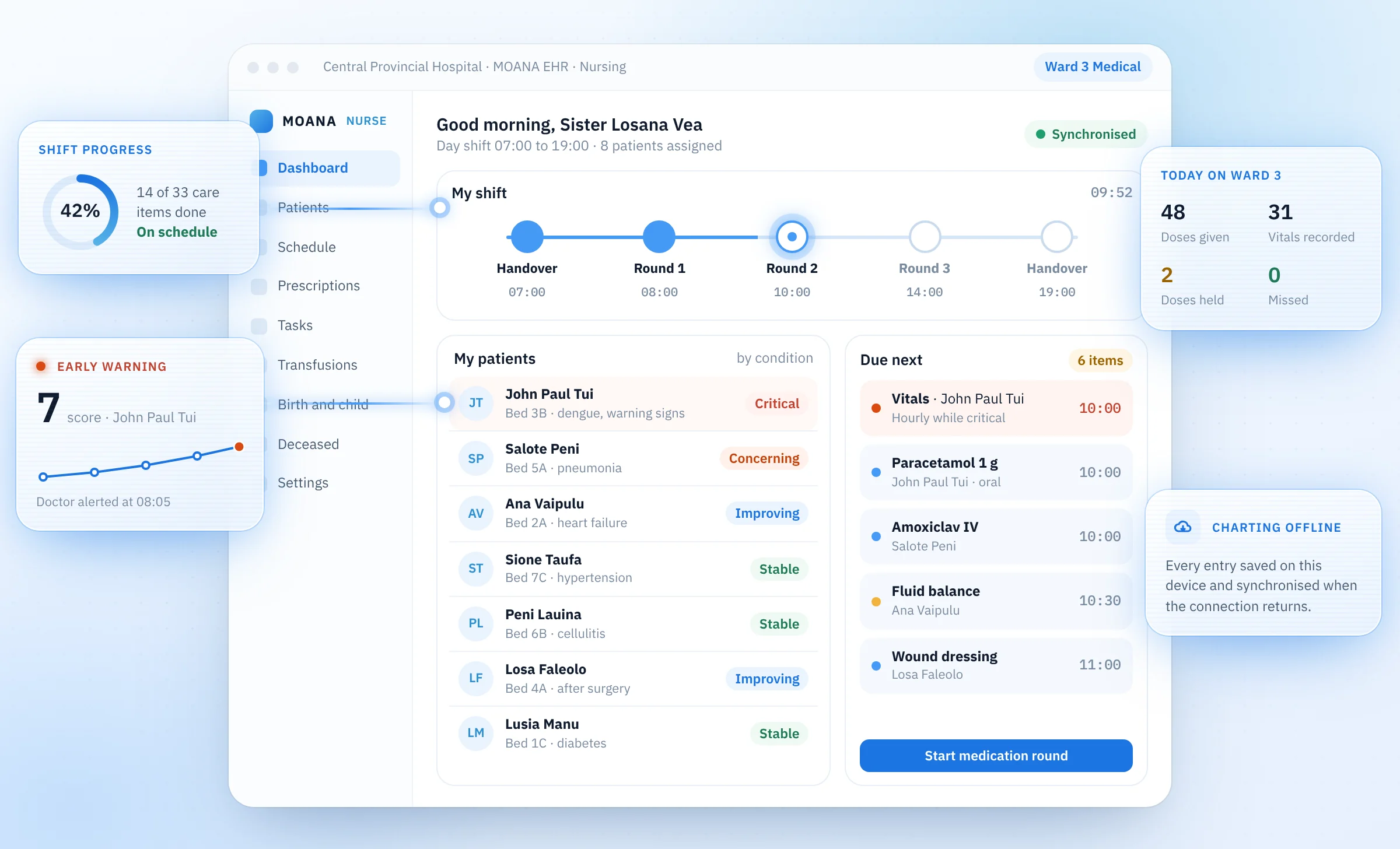
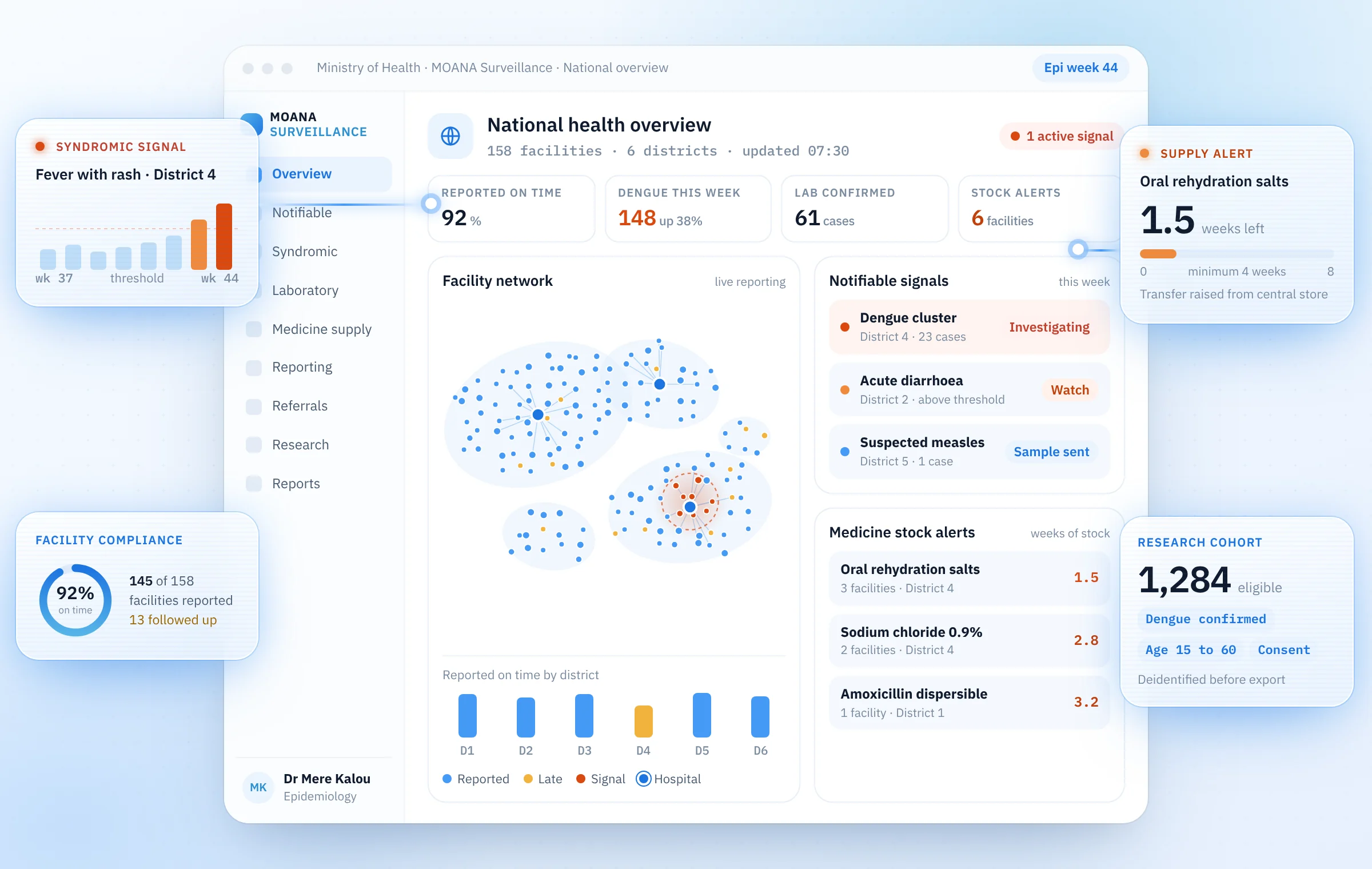
Moana is designed for unreliable connectivity. Work is saved on the device and synchronised when the connection returns, so a cable outage or cyclone does not stop care, and the platform performs in the same way on stable networks. National reporting is built from the record: notifiable events are coded at source, MOANA Surveillance applies syndromic classification and thresholds to national dashboards, aggregate returns flow to DHIS2, and data is exchanged through HL7 FHIR R4, SMART on FHIR, ICD 10, ICD 11 and LOINC.
The organisation that collects the data owns it. Role based access, two factor authentication, audited break glass access, encryption and consent for sharing apply at every facility. Moana is live across clinics in the South Pacific and in Pakistan. More is on national systems and Moana for governments.
Key questions for procurement
Can one system serve both the referral hospital and the smallest clinic?
It should. Ask whether features can be matched to each facility's service level within one platform and one patient record, rather than through separate products for different levels.
What happens when the international cable or a local link fails?
Clinical work should continue with every entry saved on the device and synchronised when the connection returns. Ask the supplier to demonstrate a disconnection of several hours and the subsequent synchronisation.
Which services could be shared with neighbouring countries?
Hosting and disaster recovery, terminology maintenance, training materials and specialist support are candidates. Data ownership and hosting decisions should remain with each country.
How does the system support overseas medical referral?
Look for a structured referral summary generated from the record, tracking of the referral's status, and a way to return the specialist's findings into the patient's record on return.
What will the system cost to run after project funding ends?
Ask for a whole of life estimate covering support, hosting, connectivity, device replacement and refresher training, and compare it with the ministry's recurrent budget, not the project budget.
Sources
- Small Island Developing States, United Nations Office of the High Representative for the Least Developed Countries, Landlocked Developing Countries and Small Island Developing States
- Overview and summary: Completion and Learning Reviews for the Pacific Island Countries, World Bank Independent Evaluation Group, covering FY11 to FY17
- Data report tracks SIDS connectivity successes and challenges, International Telecommunication Union, 2024
- Internet is back in Tonga after 38 days of outage, Cloudflare, 2022
- Small islands agree bold plan of action on noncommunicable diseases and mental health, World Health Organization, 2023
- Overseas medical referral: the health system challenges for Pacific Island Countries, WHO Asia Pacific Observatory on Health Systems and Policies, 2020
- Fourth International Conference on Small Island Developing States, closing press release, United Nations, 2024
- eHealth and health information systems in Pacific Island countries, paper for the 7th Pacific Heads of Health meeting, Pacific Community, 2019
- Health information systems in the Pacific at a glance 2016, World Health Organization Western Pacific Region, 2017
- OECS Member States working together to save 5 million dollars in annual pharmaceutical procurement, Organisation of Eastern Caribbean States, 2017
- Peer learning for digital health transformation in Pacific Island countries, Medical Research Archives, 2026
- WHO publishes Regional action framework on digital health in the Western Pacific, World Health Organization Western Pacific Region, 2025
- The Principles for Digital Development have been refreshed for the next decade, Principles for Digital Development, 2024
- Global strategy on digital health 2020 to 2025, summary, World Health Organization, 2021