Pharmacy Management Systems and Medication Safety in Hospitals
A pharmacy management system improves medication safety when it connects every step of medication use: the prescription in the patient record, automated interaction and allergy checks, pharmacist verification, dispensing by batch and expiry, and the record of each dose given on the ward. Most preventable medication harm arises at prescribing and monitoring, so a system that only manages stock leaves the largest risks untouched.
Medication is among the largest sources of preventable harm in health care. A meta analysis in The BMJ of 70 studies covering 337,025 patients found that about 1 in 20 patients experienced preventable harm, and that drug and other treatment incidents accounted for almost half (49%) of it [1]. WHO's Medication Without Harm challenge set the goal of halving severe, avoidable medication harm [2]. This guide sets out where the harm occurs, what the evidence says about digital interventions, and what a hospital or ministry should require of a pharmacy system.
WHO Medication Without Harm
WHO launched Medication Without Harm in March 2017 as its third global patient safety challenge, with the goal of reducing severe, avoidable medication associated harm in all countries by 50 percent over five years [2]. WHO estimated the global cost of medication errors at USD 42 billion annually, almost 1 percent of total global health expenditure, and noted that in low and middle income countries the impact is about twice as large in terms of years of healthy life lost [2].
The challenge organises action in four areas [2]:
- patients and the public;
- health care professionals;
- medicines as products;
- systems and practices of medication.
A pharmacy management system belongs to the fourth area. WHO also observed that many countries lack good data on medication harm [2], which makes the structured recording of prescriptions, interventions and safety events a contribution to national knowledge as well as to the care of each patient.
How much medication harm is preventable
The largest meta analysis of preventable medication harm, published in BMC Medicine in 2020, pooled 81 studies involving 285,687 patients [3]. Its findings give a ministry or hospital a reasonable baseline:
- The pooled prevalence of preventable medication harm was 3%, and of all medication harm 9% [3]. PSNet summarised this as about 1 in 30 patients exposed to preventable medication harm [4].
- About 26% of preventable medication harm was clinically severe or life threatening [3].
- The highest rates were in elderly care (11%), intensive care (7%), highly specialised or surgical care (6%) and emergency medicine (5%) [3].
Evidence from low and middle income countries is thinner, but not reassuring. The same review cites a study of 26 hospitals in eight low and middle income countries that found an adverse event rate of around 8%, of which 83% were judged preventable and about 30% were associated with the patient's death [3]. The authors note that most medication safety research comes from high income countries, so the scale of preventable medication harm elsewhere remains relatively unknown [3].
Where in the process harm occurs
Medication use is a chain. The PSNet primer describes four stages: ordering, transcribing, dispensing and administration [5]; the BMC Medicine review used five, adding monitoring [3]. The review found the highest share of preventable harm at prescribing (58%) and monitoring (47%) [3].
| Stage | Typical failure | System control |
|---|---|---|
| Prescribing | Wrong drug, dose or frequency; missed allergy or interaction | Structured electronic prescribing with interaction and allergy checks graded by severity |
| Transcribing | Misread handwriting, copying errors to ward charts | Prescription flows directly from the record to pharmacy and the ward |
| Verification and dispensing | Wrong product or strength, expired stock | Pharmacist verification, dispensing by batch with expiry checks |
| Administration | Dose omitted, given twice, or given to the wrong patient | Electronic administration record with given, held and missed status |
| Monitoring | Effect, levels or adverse reactions not followed up | Results and safety events visible in the same patient record |
The PSNet primer notes that widespread use of electronic health records has helped avert errors at ordering and transcribing, but that these errors still occur [5]. The BMC Medicine authors reach the same conclusion: electronic records and electronic prescribing have helped at the prescribing and transcribing stages, but preventable harm persists across all pathways of medication use, most likely because of underlying system flaws [3].
What the evidence says about electronic prescribing
The evidence supports electronic prescribing, but it does not support treating software as the whole answer. A systematic review and meta analysis in the Journal of the American Medical Informatics Association examined electronic medication systems among hospital inpatients. According to the PSNet summary, included studies reported reductions in medication error rates, but the evidence was variable and implementation did not reduce patient harm [6].
An earlier meta analysis in the same journal quantified the effect on errors. It found that processing a prescription through computerised provider order entry decreased the likelihood of error on that order by 48 percent (95% confidence interval 41 to 55 percent) [7]. Its authors were careful to add that it is unclear whether this translates into reduced harm for patients [7].
Three practical lessons follow for buyers:
- Checks must reach the moment of decision. Interaction and allergy checking is only useful if it happens while the prescriber is choosing the drug, with the patient's allergies, current medicines and relevant results in view.
- Severity matters. A check that flags every minor interaction with the same weight as a contraindication teaches clinicians to ignore it. Grading by severity lets the most dangerous combinations stand out.
- The pharmacist remains essential. The PSNet primer recommends that clinical pharmacists oversee dispensing, checking for interactions and allergies before medication is released [5]. Software should support that review, not replace it.
Explicit prescribing tools can add value in high risk groups. A systematic review in the Journal of Clinical Pharmacy and Therapeutics found that randomised trials of explicit tools such as STOPP/START and FORTA showed significant clinical and economic impact in geriatric and internal medicine settings, while noting the limited number of trials [8]. Transitions are another point of risk: a review in BMJ Quality and Safety of interventions at transfer out of adult intensive care found that multicomponent interventions based on staff education and guidelines achieved almost four times more deprescribing of inappropriate medicines by discharge [9].
Functions a hospital pharmacy system needs
The checklist below reflects the stages above and the controls a pharmacy and therapeutics committee will expect.
Clinical safety
- Electronic prescribing from the patient record, with dose, route, frequency and duration structured rather than free text
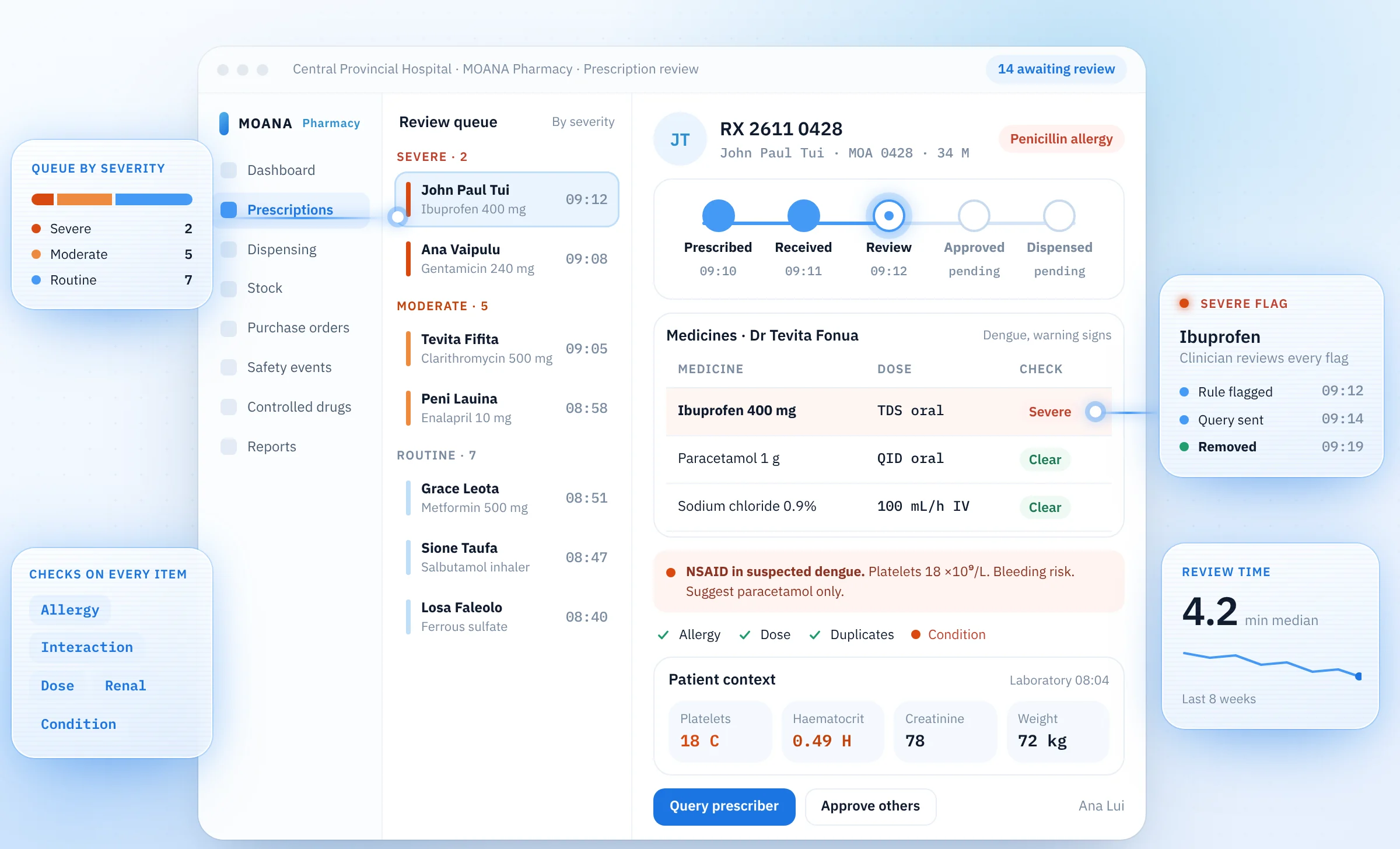
- Drug interaction and allergy checks graded by severity, shown to the prescriber and the pharmacist
- A pharmacist verification step before dispensing, with the decision and any intervention recorded
- Recording and review of medication safety events, so patterns can be found and acted on
Dispensing and stock
- Dispensing by batch, with expiry dates checked and near expiry stock visible
- A controlled drug register with running balances and audit
- Ward supply and requisitions, so ward stock is visible to pharmacy
- Product recall by batch, identifying where the affected stock went
Administration and monitoring
- An electronic medication administration record on the ward, recording each dose as given, held or missed with a reason
- The same record visible to prescriber, pharmacist and nurse, alongside laboratory results
Governance
- Role based access, so prescribing, verification and controlled drug actions are limited to authorised staff
- A complete audit trail of every prescription, verification, dispensing and administration event
Many of these functions depend on the wider record. Interaction checks need an accurate medication list; dose checks may need renal function from the laboratory; administration depends on knowing which ward the patient is on. That is why the guide on what an electronic health record is treats pharmacy as part of the record rather than a separate system. Where clinical rules flag deteriorating patients, the same principles of severity and clinician review apply, as described in the guide on clinical decision support and early warning scores.
Measuring medication safety
A hospital cannot manage what it does not measure. Indicators a pharmacy system should be able to produce include:
| Indicator | What it shows |
|---|---|
| Pharmacist interventions per 100 prescriptions, by type | Where prescribing needs support |
| Severe interaction and allergy alerts, and how they were resolved | Whether checks are acted on |
| Doses held or missed, by reason and ward | Supply and administration gaps |
| Medication safety events by stage and severity | Where harm originates |
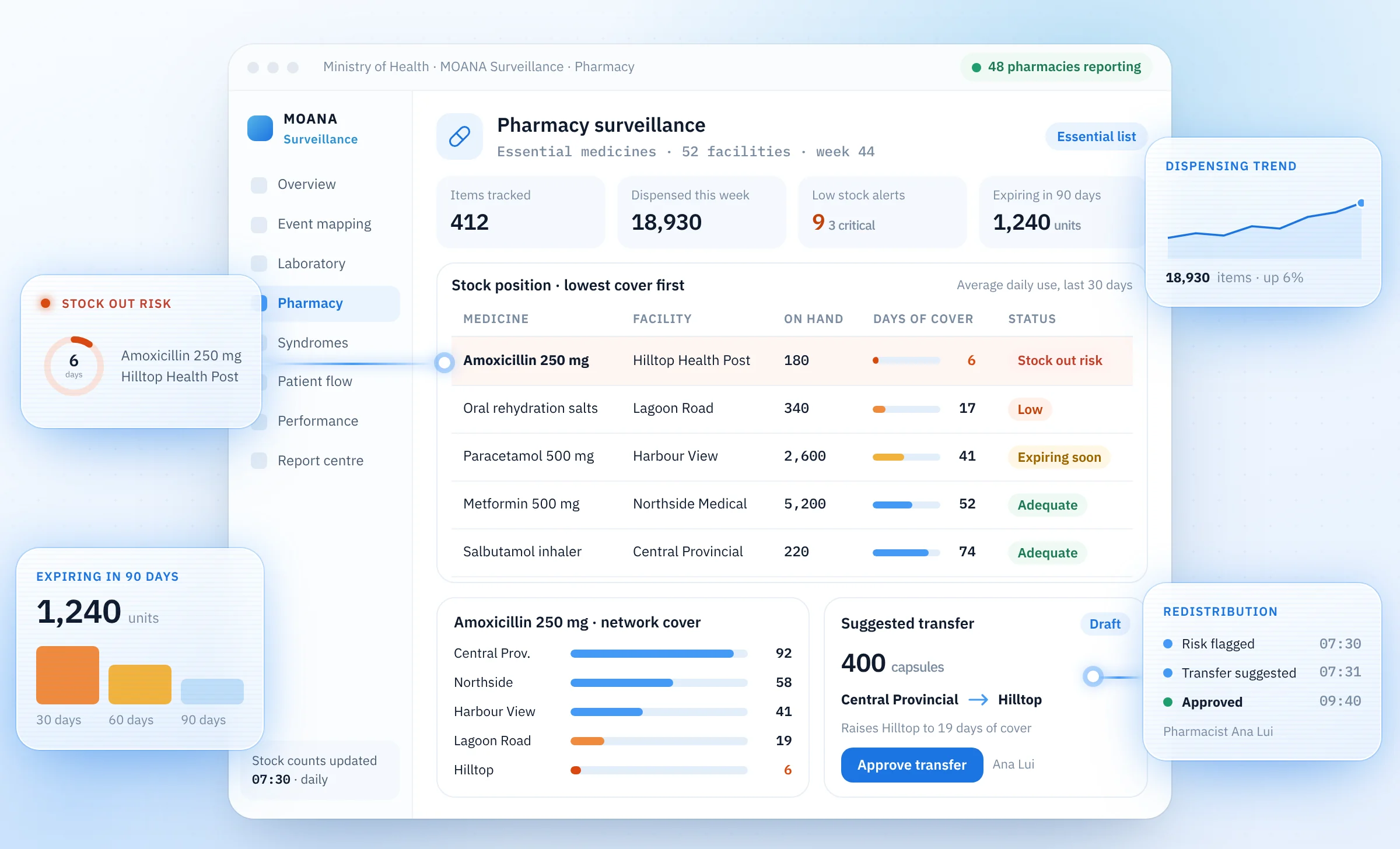
| Stock expiring within a set period, by store | Waste and stockout risk |
| Controlled drug balance discrepancies | Diversion and recording risk |
The BMC Medicine authors recommend that harm assessment record severity, the stage at which harm occurred and its classification against the five rights of patient, drug, dose, route and time [3]. A system that captures events in that structure makes the analysis possible.
How the Moana Pharmacy Management System approaches this
The Moana Pharmacy Management System is production ready and available standalone, or as part of the Moana platform, where pharmacy, prescribers and nurses share one patient record.
On the platform, a doctor prescribes from the patient record on MOANA Desktop, choosing the medicine, dose, frequency and duration, and stock availability can be checked at the point of prescribing. Interaction and allergy checks run with severity grading, so the most serious findings stand out.
The prescription arrives in the pharmacy review queue for pharmacist verification. The pharmacist reviews the checks, the patient's other medicines and relevant results before verifying the prescription. Dispensing records the batch and expiry, so recalled or expiring stock can be traced. Controlled drugs are recorded in a controlled drug register, ward supply is managed from the same system, and medication safety events are recorded and reviewed.
On the ward, nurses see the prescribed medicines and record each administration as given, held or missed, with notes on any adverse event. The prescriber, pharmacist and nurse therefore work from the same record, which removes transcription between systems.
Role based access and an audit log cover every step. The system is designed for unreliable connectivity: work is saved on the device and synchronised when the connection returns, and it performs equally on stable networks. The Moana Medical Supply System extends stock visibility from the warehouse to the facility. The pharmacies solution describes how Moana configures medicines, stores and wards with each pharmacy team.
Frequently asked questions
Does electronic prescribing eliminate medication errors?
No. It reduces errors at prescribing and transcribing, but harm persists across all stages of medication use [3], and a meta analysis of hospital electronic medication systems found that implementation did not reduce patient harm [6]. Electronic prescribing works best combined with pharmacist review and good administration practice.
Why grade interaction alerts by severity?
Because not every interaction carries the same risk. Grading lets prescribers and pharmacists concentrate on contraindicated and serious combinations, which keeps the checks meaningful.
Should a pharmacist verify every inpatient prescription?
That is a policy decision for each hospital, but the PSNet primer recommends that clinical pharmacists oversee dispensing and check for interactions and allergies before medication is released [5]. A system should make verification part of the workflow and record it.
Can a pharmacy system be deployed before the hospital adopts a full electronic record?
Yes, if it is available standalone. The pharmacy can manage stock, dispensing and controlled drugs immediately, and connect to electronic prescribing when the record is introduced.
Which patients carry the highest risk?
Preventable medication harm is highest in elderly care, intensive care, specialised and surgical care, and emergency medicine [3]. These areas are sensible priorities for pharmacist review and for implementation.
Sources
- Around one in 20 patients are affected by preventable harm, The BMJ, 2019
- WHO launches global effort to halve medication related errors in 5 years, World Health Organization, 2017
- Preventable medication harm across health care settings: a systematic review and meta analysis, BMC Medicine, 2020
- Preventable medication harm across health care settings: PSNet review, Agency for Healthcare Research and Quality, 2020
- Medication errors and adverse drug events: PSNet primer, Agency for Healthcare Research and Quality, accessed 2026
- How effective are electronic medication systems in reducing medication error rates and associated harm among hospital inpatients?, Agency for Healthcare Research and Quality, summarising the Journal of the American Medical Informatics Association, 2021
- Reduction in medication errors in hospitals due to adoption of computerized provider order entry systems, Journal of the American Medical Informatics Association, 2013
- Clinical and economic impacts of explicit tools detecting prescribing errors: a systematic review, Agency for Healthcare Research and Quality, summarising the Journal of Clinical Pharmacy and Therapeutics, 2021
- Medication related interventions to improve medication safety and patient outcomes on transition from adult intensive care settings, Agency for Healthcare Research and Quality, summarising BMJ Quality and Safety, 2022