PACS and Teleradiology for Hospitals Without a Radiologist
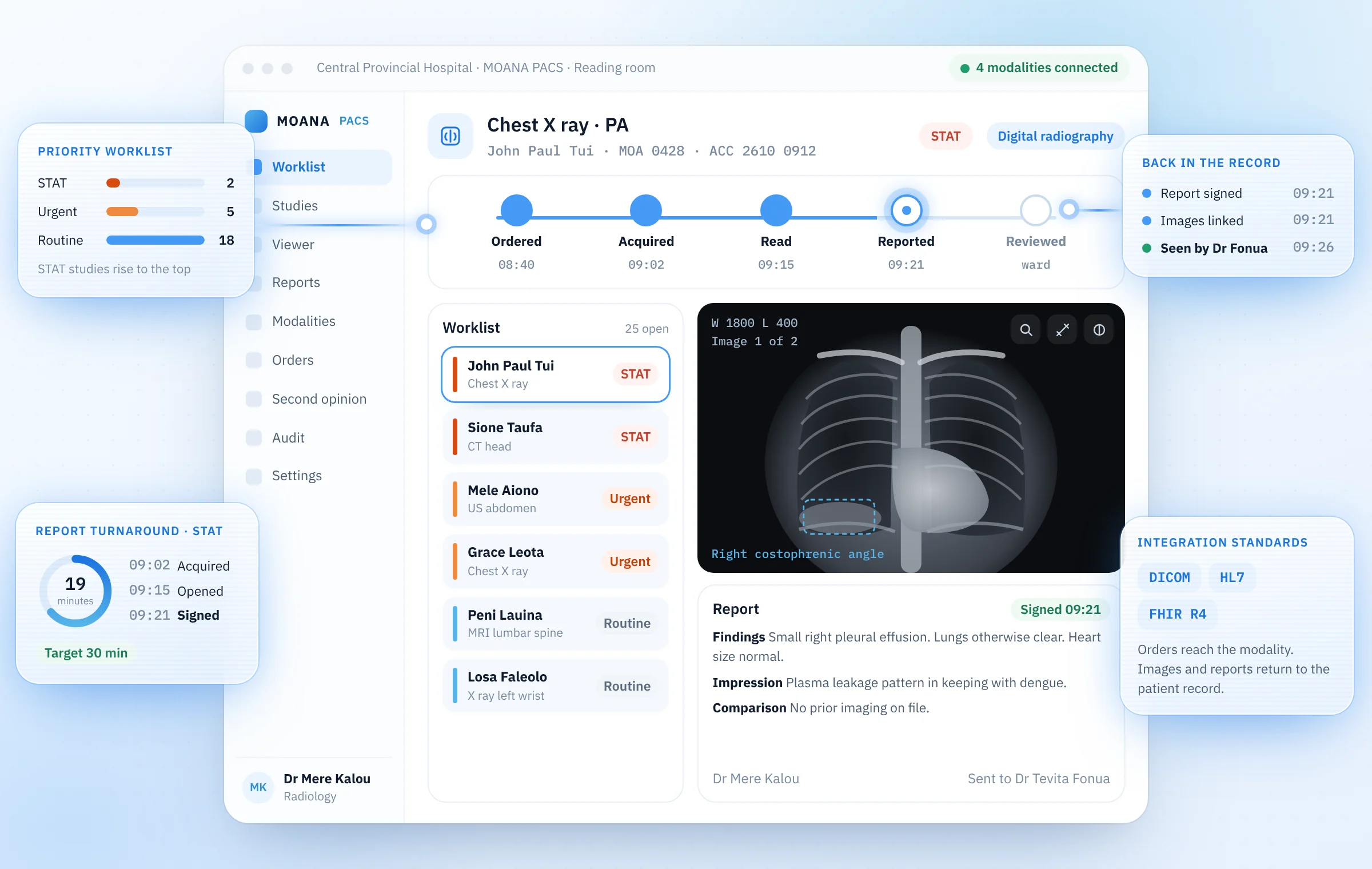
A picture archiving and communication system (PACS) stores medical images in the DICOM standard, presents them on a worklist and in a viewer, and delivers the radiologist's report back to the clinician who asked for the study. For a hospital without a radiologist on site, the PACS is what makes reporting possible at all: it lets studies acquired locally be read at another hospital or a national centre, prioritised by urgency, and returned into the patient's record with the turnaround measured.
Imaging is one of the least developed services in many health systems. WHO estimates, as cited by RAD AID International, that two thirds of the world's population has little or no access to radiology services [2]. National health facility surveys in ten low and middle income countries, published in The Lancet Global Health in 2021, found ultrasound to be the least available diagnostic in primary care, at 1.2% of facilities, and CT the least available in hospitals, at 6.1% [1]. The WHO Regional Office for Africa describes diagnostic imaging services as "inaccessible", receiving little attention and investment, and among the least developed areas of health systems in the region [6].
Equipment is only half of the gap. A study of radiologist density in Ghana counted three radiologists per million people in 2022, with eight of sixteen regions below one per million, against international guidelines of 100 to 120 per million, a level met in Germany and the United States [7]. Where the X ray machine works but no radiologist is nearby, images are interpreted by the requesting clinician, sent on paper or film with the patient, or not reported at all.
This guide explains what a PACS does, which standards matter, how teleradiology works in practice, what turnaround to measure and what a hospital or ministry should ask before buying.
Why imaging capacity is now a policy priority
In May 2025 the Seventy eighth World Health Assembly adopted resolution WHA78.13 on strengthening medical imaging capacity, noting that access to imaging equipment is highly inequitable globally and limited in many developing countries [3]. The draft recommended by the Executive Board urges Member States to improve access through digital health to reach rural and remote areas, and to consider integrating telehealth, teleradiology and clinical decision support into radiology information systems for patient records, in line with international standards on ethics, security and confidentiality [4]. It also asks countries to collect data on the availability and functionality of imaging equipment, to budget for maintenance, and to involve biomedical engineers and medical physicists across the equipment lifecycle [4].
The economic case is substantial. The Lancet Oncology Commission on medical imaging and nuclear medicine, convened by the International Atomic Energy Agency with 27 professional organisations [9], estimated that scaling up imaging alone could avert 2.47 million cancer deaths worldwide between 2020 and 2030, and that combined scale up of imaging, treatment and quality of care would return US$12.43 for every dollar invested [8]. Its recommended actions include adding imaging to universal health coverage packages and expanding human resources and equipment [9].
What a PACS does
A PACS is often described as an image archive, but its clinical value comes from the workflow around the archive. The table sets out the components a hospital should expect.
| Component | Function | Why it matters without a radiologist on site |
|---|---|---|
| Electronic request | The clinician orders the study from the patient record with the clinical question | The reader at another site sees why the study was requested |
| Modality worklist | Scheduled studies appear at the X ray, CT or ultrasound unit with patient details | Removes retyping at the modality and mismatched names |
| DICOM storage | Images are received and archived in the standard format with their metadata | Any compliant viewer or remote reader can open them |
| Reporting worklist | Studies awaiting a report, by modality and priority | Urgent studies are read first, wherever the reader is |
| Viewer | Images displayed with tools for windowing, measurement and comparison | A browser viewer avoids installing workstations at every site |
| Report | Structured or narrative report signed by the reader | The finding becomes part of the record, not a note on a film |
| Result delivery | Report returned to the requesting clinician and the patient record | Closes the loop between request and treatment |
| Audit and indicators | Who viewed and reported each study, and when | Turnaround and workload can be measured and managed |
A radiology information system (RIS) traditionally handles requests, scheduling and reports while the PACS handles images. In an integrated hospital record, the request and the report live in the patient record and the PACS holds the images, so the distinction matters less than whether the loop from order to report is closed.
The standards that make it work
DICOM (Digital Imaging and Communications in Medicine) is the international standard for medical images and related information, recognised by the International Organization for Standardization as ISO 12052, with NEMA acting as its secretariat [10]. First published in 1993, it is implemented in nearly all radiology, cardiology imaging and radiotherapy devices [10]. Any PACS a ministry buys must store and exchange images in DICOM, and any modality it buys must send them.
The DICOM Basic Worklist Management service defines how a device obtains a worklist, a structure presenting information about a set of tasks, such as scheduled imaging procedures presented to the operator of an imaging modality [11]. In tender language, this is the modality worklist requirement: the patient and procedure details should flow to the X ray unit from the order rather than be typed at the console.
Orders and reports also need to move between the imaging system and the wider record, which is where HL7 v2 and FHIR R4 apply. The roles of these standards are compared in the guide on interoperability standards.
Getting studies read without a radiologist on site
Hospitals without a radiologist generally combine three approaches:
- Clinician interpretation at the point of care, with the image and interpretation recorded, for decisions that cannot wait.
- Reporting by a radiologist at a referral hospital in the same health system, using the PACS to send studies up the referral chain.
- Teleradiology from a national centre or contracted service, where a pool of radiologists reports for many facilities.
The evidence on teleradiology in Africa is encouraging but thin. A 2022 narrative review in Annals of Global Health covering 1995 to 2021 found that teleradiology had shown benefit for patient outcomes, but that implementation remained limited to feasibility projects, with no single PACS in use across the continent [5]. In Malawi, teleradiology review changed management in 23.5% of cases; in the Democratic Republic of the Congo, it changed the diagnosis in 62% of cases and the treatment plan in 61% [5]. In Mali, nearly all radiologists were located in the capital [5].
The same review identified the barriers a buyer must plan for: infrastructure, low and variable volumes with some sites sending fewer than ten cases a month, weak training for clinicians and technologists, and poor communication between the sending site and the reader [5]. Low volume is often a symptom of workflow friction. If sending a study requires a separate login, a separate upload and a phone call, it will be used only in emergencies.
Turnaround: what to measure
Report turnaround is the indicator that tells a hospital whether its imaging service is working. Two reference points show what is achievable remotely. A teleradiology programme operated by Médecins Sans Frontières reported a mean teleradiologist response time of 6.1 hours across 564 cases, 470 of them from Africa [5]. A service reading 58,223 studies for 39,513 patients in Africa from India between 2017 and 2022 reported a mean turnaround of just under 2.5 hours, including 2.43 hours for plain radiographs and 2.21 hours for CT [12]. The authors also cautioned that remote reads may not suit studies that need an expedited result, such as suspected stroke [12].
Turnaround should be broken into intervals so that delays can be located:
| Interval | From | To | Typical cause of delay |
|---|---|---|---|
| Scheduling | Request created | Study acquired | Equipment downtime, patient transport, backlog |
| Transfer | Study acquired | Study available to the reader | Bandwidth, manual upload, film based workflow |
| Reporting | Study available | Report signed | Reader capacity, priority not visible |
| Delivery | Report signed | Clinician has seen the report | Report sent outside the record, no acknowledgement |
The PACS should calculate each interval from timestamps it already holds, by modality and by priority. A worklist that shows priority makes the reporting interval manageable; a report that lands in the patient record removes the delivery interval almost entirely.
Infrastructure, connectivity and maintenance
Bandwidth is the constraint most often cited. The Annals of Global Health review reported fixed broadband subscriptions in Africa at about one per 100 inhabitants, compared with 35 per 100 in Europe [5]. Imaging studies are large, so the system must queue transfers, resume them after interruption and keep the local department working while studies wait to send. Local storage at the acquiring hospital matters for the same reason: the image should be viewable on site immediately, whatever the state of the link.
Maintenance is the other recurring failure. WHO notes that many low and lower middle income countries cannot afford imaging equipment and often lack health workers trained to use it [13], and the WHO African regional strategy lists missing infrastructure, basic equipment, skilled workforce and equipment maintenance among the main challenges [6]. A PACS cannot fix a broken X ray tube, but it can record which modalities are producing studies and which have gone silent, giving managers the equipment functionality data that WHA78.13 asks countries to collect [4]. Related design principles are set out in the guide on designing health systems for unreliable connectivity.
How MOANA PACS approaches this
MOANA PACS is built around the path from request to report rather than the archive alone. It is part of the Moana platform, where radiology, the laboratory and the treating clinician share one patient record, and it can also integrate with a hospital's existing PACS where one is already installed.
The request starts in the record. A clinician orders the study from the patient chart on MOANA Desktop, with the clinical question attached, and the request appears on the radiology worklist by modality and priority. Images are received and stored in DICOM, and studies are viewed in a browser viewer, so reporting does not depend on a dedicated workstation installed at each site.
Reporting is done against the worklist, and the signed report is returned to the requesting clinician in the patient record, where it sits alongside laboratory results and clinical notes. The clinician does not need to collect a paper report or search a separate system, and the hospital can see from the record when each study was requested and when it was reported.
Role based access, two factor authentication and an audit log record who viewed and reported each study, and the organisation that collects the data owns it. Orders and results are exchanged with other systems through the platform's interoperability layer using DICOM, HL7 v2 and FHIR R4. The platform is designed for unreliable connectivity: work is saved on the device and synchronised when the connection returns, and it performs equally on stable networks.
At ANGAU Memorial Provincial Hospital in Lae, Papua New Guinea, the regional referral hospital for the Momase region, the Radiology department has been mapped and configured in Moana with integration to the hospital's existing PACS, and go live is expected in the coming weeks. The hospitals solution describes how Moana configures radiology with the rest of the hospital, and the guide on the hospital information system for public hospitals places imaging within the wider hospital record.
Key questions for procurement
Does the system store and exchange images in DICOM, and support modality worklist?
It should. DICOM is the international standard for medical images, ISO 12052 [10], and the Basic Worklist Management service lets modalities receive scheduled procedures rather than have details typed at the console [11].
Can it work with the PACS or modalities we already have?
Many hospitals already own modalities and sometimes an archive. Require integration with the existing PACS and a named list of modality types already connected, rather than replacement as a condition of purchase.
Where does the report go?
The report should return to the requesting clinician inside the patient record. A report delivered only by print, email or a separate portal adds a delivery delay and risks being missed.
How is turnaround measured?
Require turnaround by interval, modality and priority, calculated from system timestamps. Use published teleradiology results, such as a mean of 6.1 hours in an MSF programme [5] and about 2.5 hours in a large remote reading service [12], as reference points when setting targets.
What happens when the link to the reader is down?
Images must remain viewable at the acquiring hospital, transfers must queue and resume, and urgent cases need a defined fallback, since remote reads may not suit studies that need an expedited result [12].
Who can view and report studies from another site?
Access should be role based and audited, with reporting rights granted to named readers at the referral or national centre, consistent with the ethics, security and confidentiality standards WHA78.13 references [4].
Sources
- Availability of essential diagnostics in ten low income and middle income countries: results from national health facility surveys, The Lancet Global Health, 2021
- RAD AID Hexarad Global Radiology Program, RAD AID International, accessed 2026
- Strengthening medical imaging capacity, resolution WHA78.13, World Health Assembly, 2025
- Strengthening medical imaging capacity, draft resolution EB156(17), World Health Organization Executive Board, 2025
- Evaluation of current and former teleradiology systems in Africa: a review, Annals of Global Health, 2022
- Regional strategy on diagnostic and laboratory services and systems 2023 to 2032 for the WHO African Region, WHO Regional Office for Africa, 2023
- Density and regional distribution of radiologists in a low income country: the Ghana situation, Chinese Journal of Academic Radiology, 2023
- Lancet Oncology Commission on Medical Imaging and Nuclear Medicine launched at ECR 2021, Applied Radiology, 2021
- Lancet Oncology Commission on medical imaging and nuclear medicine, International Atomic Energy Agency, 2021
- About DICOM: overview, DICOM Standards Committee, NEMA, accessed 2026
- DICOM PS3.4 Service Class Specifications: Basic Worklist Management Service, NEMA, 2026
- Cloud based platforms could expand teleradiology access to tens of thousands of patients in need, Health Imaging, accessed 2026
- Strengthening medical imaging, World Health Organization, accessed 2026