Clinical decision support and early warning scores in hospitals
Clinical decision support is software that brings the right information to a clinician at the moment of a decision: an allergy warning at prescribing, a critical laboratory value, or an early warning score that flags a patient who is deteriorating. In resource limited hospitals its main value is consistency, calculating scores correctly and surfacing risk on every shift, while the clinician reviews every flag and makes every decision.
Clinicians work under pressure, with incomplete information and too few colleagues, and some errors are predictable: a score added up wrongly, an interaction missed, an abnormal result not seen until the next day. This guide covers what decision support includes, what WHO evidence shows, how early warning scores such as NEWS2 work, what studies in low resource hospitals show, how rules should be governed, and what safeguards apply when an AI generated summary is added.
What clinical decision support includes
Decision support is a family of functions that differ in how they interrupt the clinician.
| Type | Example | When it acts |
|---|---|---|
| Safety checks | Drug interaction and allergy warnings with severity | At prescribing and dispensing |
| Result alerts | Critical laboratory values sent to the responsible clinician | When a result is validated |
| Calculated scores | Early warning and triage scores from recorded vital signs | When observations are entered |
| Reminders | Overdue observations, immunisations due, follow up | On opening a record or worklist |
| Protocols and order sets | Guideline based care pathways | When a condition is recorded |
| Summaries | A concise view of the record before review | Before a ward round or consultation |
The common principle is that the software presents and the clinician decides. A system that blurs that line, by acting automatically on a score or hiding the reasoning behind a recommendation, is harder to trust and harder to govern.
What WHO evidence shows
WHO's 2019 guideline on digital interventions for health system strengthening recommends decision support via digital devices for community and facility based health workers, for tasks already within their scope of practice [1].
The evidence behind these recommendations is modest and specific. The review found moderate certainty that mobile decision support probably increases the number of people taking antihypertensive medication, but probably makes little or no difference to systolic blood pressure among people at high cardiovascular risk [2]. Evidence on provider performance was of very low certainty [2]. The review drew three practical conclusions [2]:
- decision support algorithms should be developed from clinical guidelines and validated before they are embedded in software;
- some health workers find algorithms too prescriptive and worry about losing clinical skills;
- training, user testing and ongoing software maintenance are needed.
A wider review of electronic records in low resource settings adds a caution: positive effects dominated the published literature, and unintended harms were possibly underreported [3].
How early warning scores work
An early warning score is a track and trigger tool. Each recorded vital sign, such as respiratory rate, heart rate, blood pressure and temperature, is compared with a range and assigned points. The points are summed, and the total maps to a level of concern with a defined response: continue routine observations, increase their frequency, inform the nurse in charge, or call for urgent medical review.
The same idea appears in emergency triage. The South African Triage Scale combines a triage early warning score with clinical discriminators to assign one of four urgency levels [4]. The Interagency Integrated Triage Tool, developed by WHO with the International Committee of the Red Cross and Médecins Sans Frontières, deliberately omits an early warning score to keep triage fast in resource limited settings [4]. The choice depends on staffing, training and the population served. Either way, the score is a clinical standard; the software should implement the one the hospital or national body has adopted rather than introduce its own.
NEWS2: the reference adult score
NEWS2 is the Royal College of Physicians' National Early Warning Score 2, published in December 2017 as an update to the original score of 2012 [5]. It has formal endorsement from NHS England and NHS Improvement as the early warning system for identifying acutely ill patients, including those with sepsis, in hospitals in England [5].
NEWS2 scores six parameters: respiration rate, oxygen saturation, systolic blood pressure, pulse rate, level of consciousness or new confusion, and temperature [5]. Each parameter scores from 0 to 3, and a patient who needs supplemental oxygen to maintain the recommended saturation receives an additional 2 points [5][6]. New confusion scores 3 [5]. Two oxygen saturation scales are used: Scale 1, with a target of 94 to 98 percent, for most patients, and Scale 2, with a target of 88 to 92 percent, only for patients with confirmed chronic hypercapnic respiratory failure, a decision that a competent doctor or advanced nurse practitioner must make and record on admission [6].
The Royal College of Physicians sets the escalation thresholds as follows [7]:
| NEWS2 trigger | Clinical risk | Response |
|---|---|---|
| Aggregate score 0 to 4 | Low | Ward based response |
| Score of 3 in any single parameter | Low to medium | Urgent ward based response |
| Aggregate score 5 or 6 | Medium | Key threshold for urgent response |
| Aggregate score 7 or more | High | Urgent or emergency response, including staff with critical care skills and airway management |
Urgent responses should come from a clinician or team competent in assessing and treating acutely ill patients and in recognising when escalation to critical care is appropriate [7]. NHS implementation guidance requires NEWS2 to be recorded at least every 12 hours, with frequency set by the aggregate score and increased at any sign of deterioration [6].
For a system designer, NEWS2 shows how much depends on structured data. The oxygen flag, the saturation scale chosen for the patient and the level of consciousness must each be recorded as a defined value, or the score cannot be calculated.
Why calculating the score matters
The strongest argument for digital early warning scores is arithmetic. When prehospital providers in Cape Town applied the South African Triage Scale to 5,100 clinical vignettes, the triage early warning score was correct in only 42.6 percent of responses and under calculated in 45.0 percent [8]. The final triage category was under triaged in 29.5 percent [8].
Under calculation is the dangerous error, because it reassures. A patient whose score is added up as three when it should be six may wait for routine observations instead of receiving urgent review. A system that calculates the score from the observations as they are entered removes that error and shows which parameter drove it. It also makes the score visible beyond the bedside: the nurse in charge can see every patient whose score has crossed a threshold, a subject developed in bed management and ward visibility.
Accuracy, over triage and alert burden
No score is perfectly accurate, and the trade off between missing sick patients and flagging well ones is unavoidable.
At Kenyatta National Hospital in Nairobi, the South African Triage Scale showed sensitivity of 92.2 percent but specificity of 37.7 percent for admission, death or discharge from the emergency unit [9]. Introducing the scale reduced over triage from 70.9 to 62.3 percent, while under triage did not change significantly [9]. In the broader literature, mostly from high resource settings, triage tools showed sensitivities of 36 to 92 percent across urgent conditions, including 36 to 74 percent for severe sepsis [4].
Two design consequences follow:
- High sensitivity produces many flags. A system that interrupts clinicians for every flag will be ignored. Flags should be graded by severity and presented in a worklist that clinicians review, with interruption reserved for the most serious.
- Thresholds need local review. A hospital should monitor how often flags lead to action and adjust escalation rules through its clinical governance process, not leave them as delivered.
Evidence from low resource hospitals
Scores derived in high income health systems do not transfer automatically. In a prospective cohort of 302 adults admitted to medical wards in Blantyre, Malawi, the Modified Early Warning Score at a cut point of 5 or more had sensitivity of 58.8 percent and specificity of 56.2 percent for death within three days [10]. A locally derived score performed better, but not well enough to warrant clinical use, and the authors concluded that local validation and impact assessment should precede adoption of these scores in resource limited settings [10].
A larger study pooled 5,573 hospitalised adults from six sub Saharan African countries [11]. The Modified Early Warning Score predicted in hospital mortality with an area under the curve of 0.70 and qSOFA with 0.69, while the Universal Vital Assessment score, derived for the region and including HIV serostatus, reached 0.77 [11]. NEWS could not be tested because supplemental oxygen use had not been recorded in the pooled data, and the new score had been validated only internally, so its authors called for prospective external validation [11].
The lessons for a ministry are practical:
- choose a score with evidence in a comparable population, or plan to validate one locally;
- record every parameter the score needs, including oxygen use, so that the score can be calculated and later evaluated;
- treat thresholds as governed settings, reviewed against the hospital's own outcomes.
Building rules from guidelines
Decision support is only as good as the rules behind it. WHO's SMART guidelines translate WHO recommendations into components that are standards based, machine readable, adaptive, requirements based and testable [12]. Each digital adaptation kit sets out workflows, core data elements mapped to standard terminology codes, decision support content, indicators and functional requirements [13].
For a hospital, this means four things:
- Use published logic where it exists. Antenatal, postnatal and immunisation decision support should follow the relevant WHO kit, adapted to national guidance [12].
- Code the data. Rules can only fire on structured data, not free text.
- Test before release. Every rule should be tested against sample cases, as the WHO evidence review recommends [2].
- Keep a change record. When a threshold or rule changes, the system should record who changed it, when and why.
AI generated summaries and the safeguards they need
Hospitals are now offered AI generated summaries of the patient record. Used well, a summary saves the clinician time before a review; used carelessly, it can omit a critical fact or state something the record does not support.
- The summary supports; it does not decide. It should never diagnose, prescribe or change a care plan.
- The source is always visible. The clinician should be able to move from any statement in the summary to the record entry behind it.
- Rules flag, clinicians review. Severity flags should come from defined clinical rules, so that the reason for each flag is explainable, and the clinician should review every flag.
- Use is auditable. The record should show what was presented and what the clinician did.
WHO's 2021 guidance on the ethics and governance of artificial intelligence for health, developed over two years by an international expert panel, sets six principles; the first, protecting human autonomy, holds that humans should remain in control of health care systems and medical decisions [14]. WHO's 2024 guidance on large multimodal models identifies documented risks of false, inaccurate, biased or incomplete statements and of automation bias among health professionals and patients, and sets out more than 40 recommendations, including post release auditing and impact assessments by independent third parties when such models are deployed at scale [15].
Governance of decision support
| Question | Recommended practice |
|---|---|
| Who owns each rule? | A named clinical lead or committee |
| How are rules approved? | Through the hospital's clinical governance process, against a guideline |
| How are overrides recorded? | With the user, time and reason |
| How is performance monitored? | Flag rates, response times and outcomes reviewed regularly |
| How are changes released? | Tested, documented and communicated to staff |
How Moana approaches this
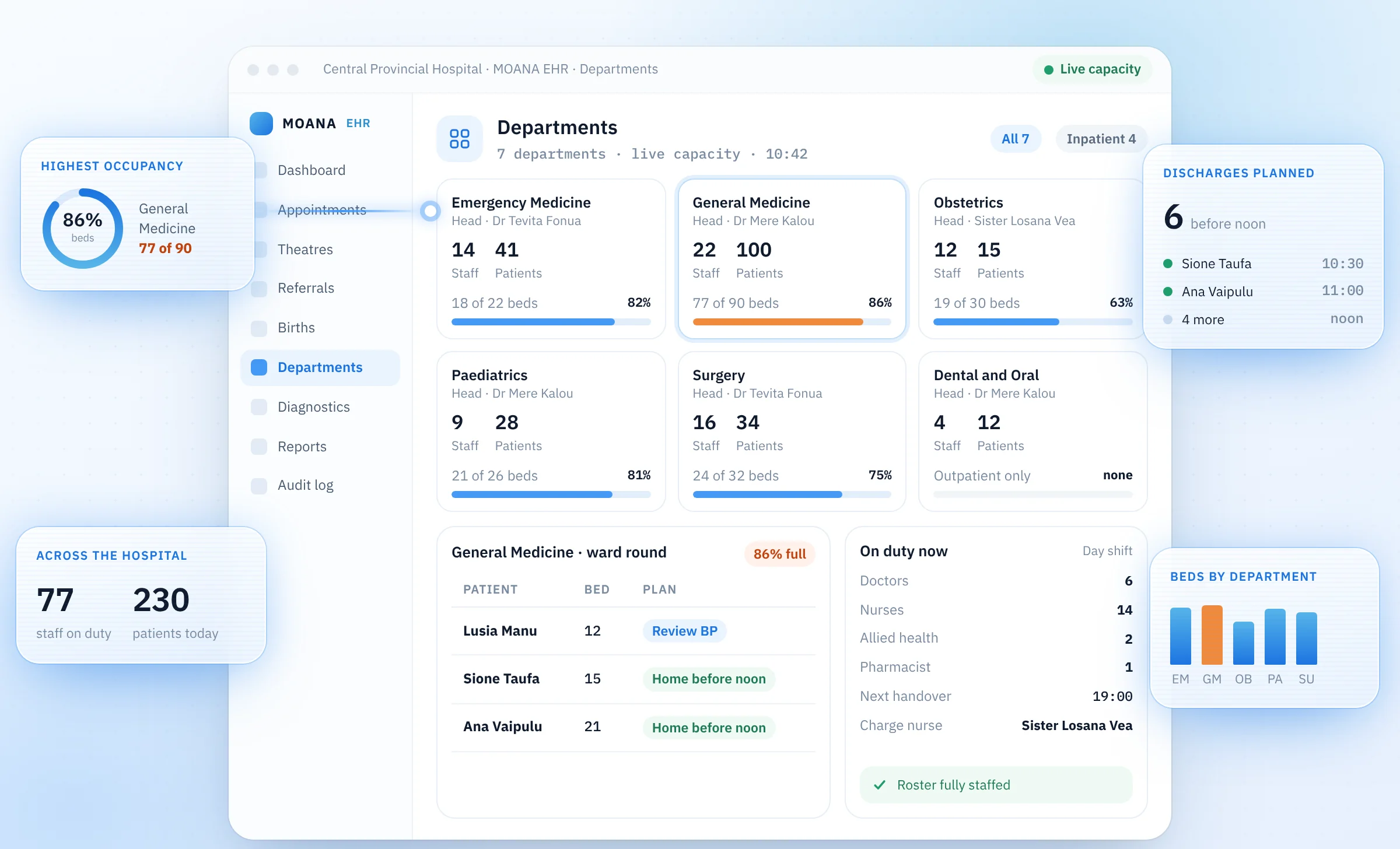
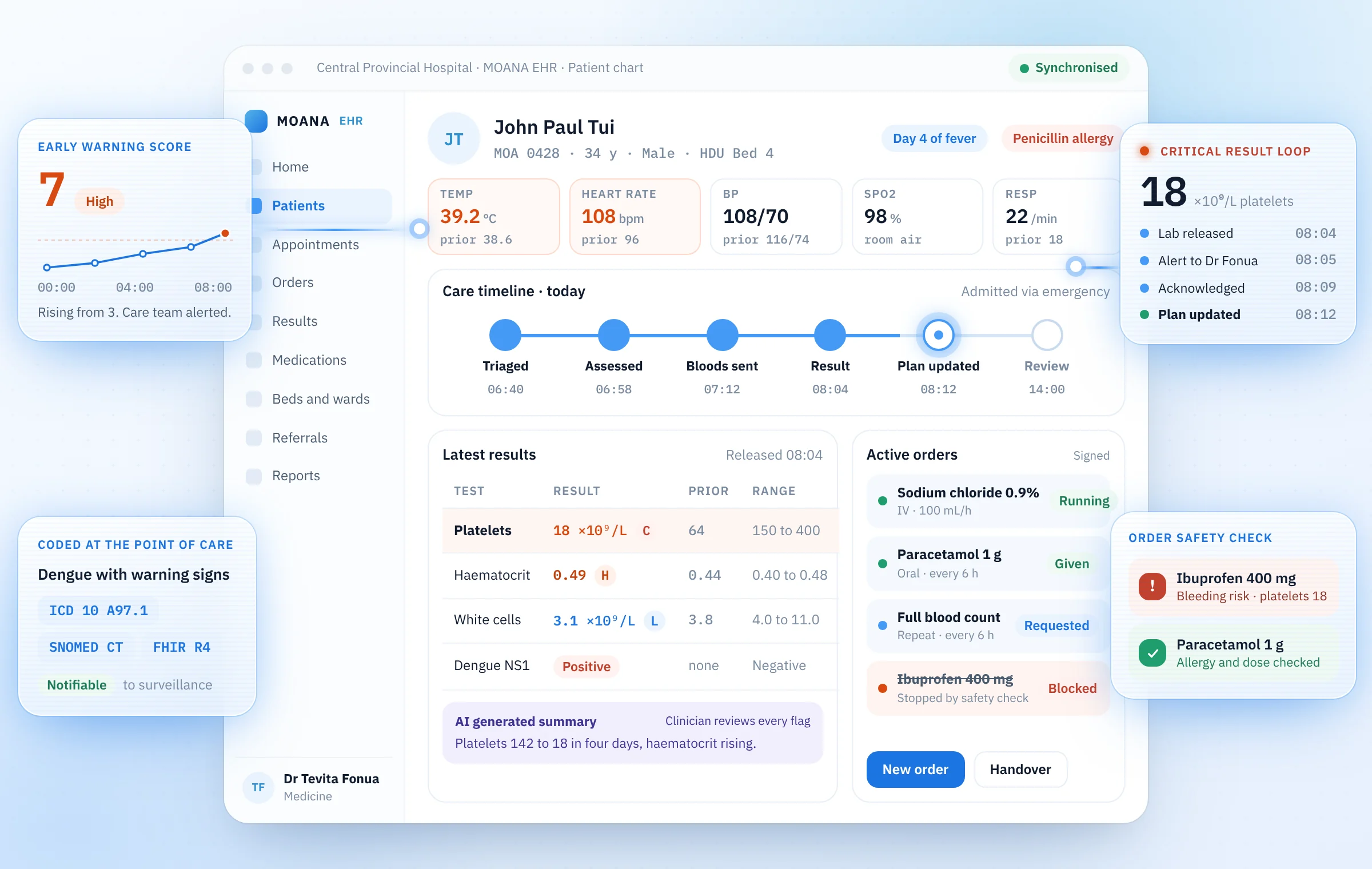
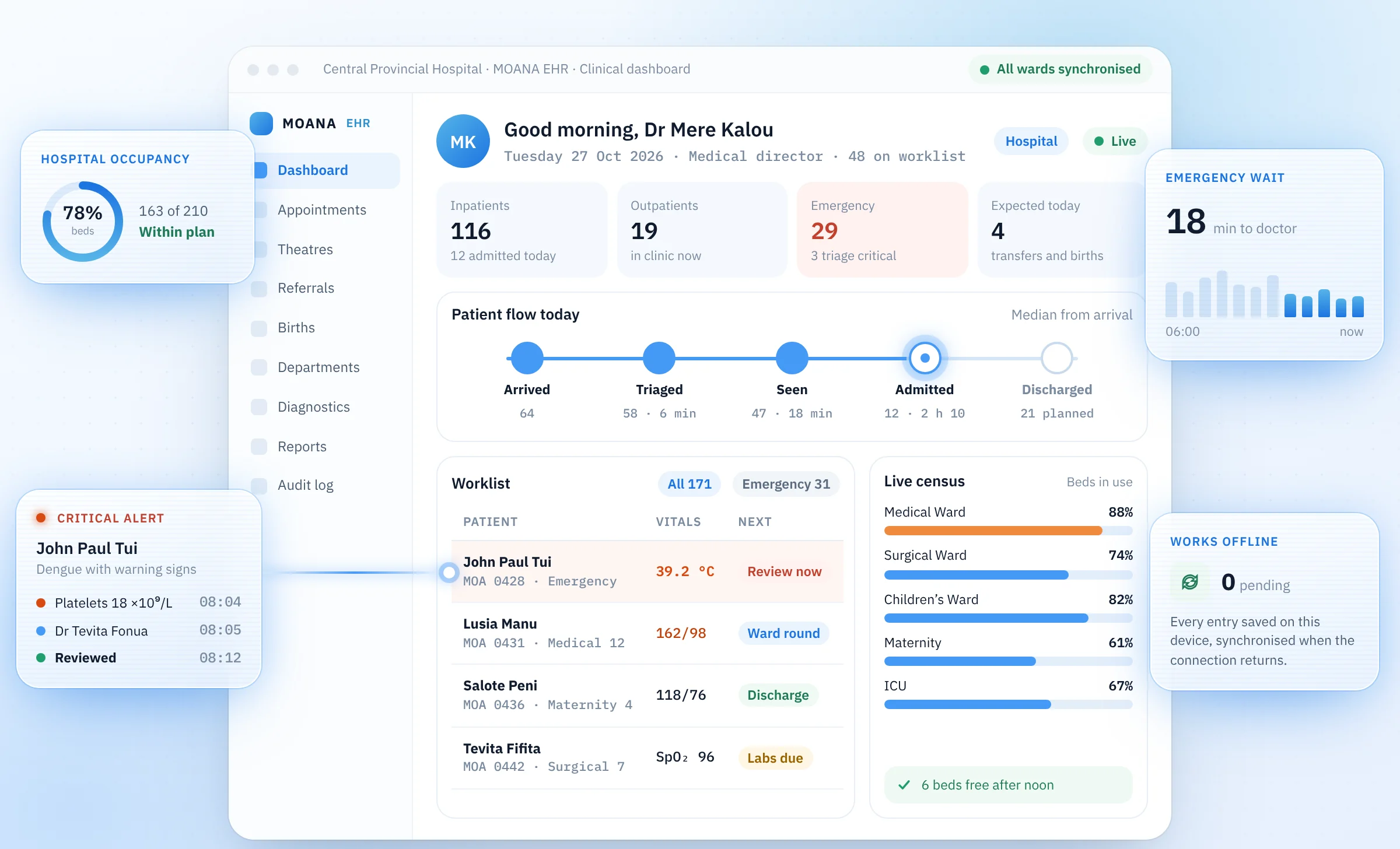
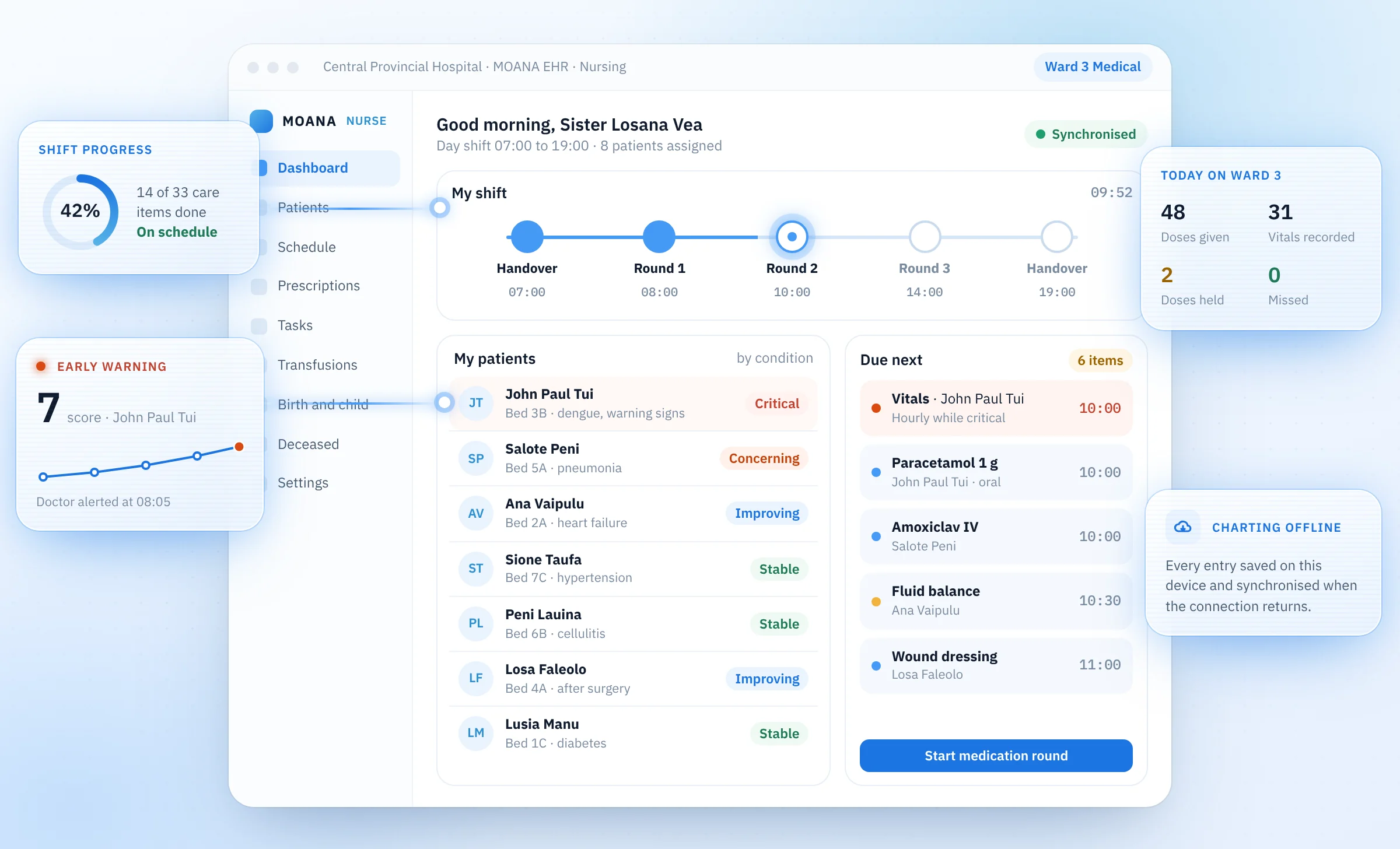
In Moana, decision support is built into the same patient record that clinicians, pharmacists and laboratory staff use. Clinical rules flag patients by severity so that deterioration is visible on the ward and in each clinician's workspace in MOANA Desktop; an AI generated summary supports the clinician before review; and the clinician reviews every flag. Moana does not diagnose or make clinical decisions.
Observations recorded by nurses are available to the rules as soon as they are entered, and patients whose observations cross configured thresholds are flagged on the nurse workspace and for the treating team.
Medication safety is handled in the Pharmacy Management System, which is production ready: interaction and allergy checks with severity at prescribing, pharmacist verification before dispensing, and a stock check so the prescriber knows whether a medicine is available. In MOANA LIS, critical values generate alerts to the responsible clinician with read back, so that the loop is closed. In maternal and newborn care, newborns are flagged using recorded APGAR scores and observations.
Rules and thresholds are configured to the score and escalation policy the hospital has adopted and to national guidance, rather than fixed by the software, and every view and change is recorded in the audit log. Moana is designed for unreliable connectivity: observations are saved on the device and synchronised when the connection returns, and the same platform performs equally on stable networks. The wider platform is described on the electronic health record page, and the hospital context in hospital information systems for public hospitals.
Key questions for procurement
Does the system calculate early warning scores automatically?
It should calculate the score from observations as they are entered, display the parameters that drove it, and implement the score your hospital has adopted. For NEWS2, that includes the supplemental oxygen points and the choice of saturation scale [5][6].
Can thresholds and escalation rules be configured by the hospital?
Rules should be configurable through clinical governance and every change recorded. Evidence from Malawi shows why local validation should precede adoption [10].
How are flags presented to avoid alert fatigue?
Ask to see flags graded by severity, a worklist view for review, and interruption reserved for the most serious findings.
What does the AI generated summary do, and what does it not do?
It should support review, link every statement to the record and never diagnose or prescribe, consistent with WHO's principle that humans remain in control of medical decisions [14].
Are rules based on published guidelines, and how is their use audited?
Ask how rules are sourced and validated, whether the system can carry WHO digital adaptation kit content [2][12], and whether it records what was shown, to whom and what action followed, including overrides with reasons.
Sources
- WHO guideline: recommendations on digital interventions for health system strengthening, World Health Organization, 2019
- Recommendations on digital interventions for health system strengthening: evidence and recommendations, World Health Organization, 2019
- Benefits and challenges of EMR implementations in low resource settings: a state of the art review, BMC Medical Informatics and Decision Making, 2016
- Triage systems in low resource emergency care settings, Bulletin of the World Health Organization, 2025
- National Early Warning Score (NEWS) 2, Royal College of Physicians, 2017
- National Early Warning Score 2 guideline, NHS Greater Glasgow and Clyde, accessed 2026
- NEWS2 chart 2: NEWS thresholds and triggers, Royal College of Physicians, 2017
- Validity and reliability of the South African Triage Scale in prehospital providers, BMC Emergency Medicine, 2021
- Implementation and performance of the South African Triage Scale at Kenyatta National Hospital in Nairobi, Kenya, International Journal of Emergency Medicine, 2019
- Early warning scores generated in developed healthcare settings are not sufficient at predicting early mortality in Blantyre, Malawi, PLOS ONE, 2013
- Derivation and validation of a universal vital assessment (UVA) score for predicting mortality in adult hospitalised patients in sub Saharan Africa, BMJ Global Health, 2017
- SMART guidelines, World Health Organization, accessed 2026
- WHO SMART guidelines: optimising country level use of guideline recommendations in the digital age, The Lancet Digital Health, 2021
- WHO issues first global report on artificial intelligence in health and six guiding principles for its design and use, World Health Organization, 2021
- WHO releases AI ethics and governance guidance for large multimodal models, World Health Organization, 2024