What a Laboratory Information System Should Do: A Buyer's Guide
A laboratory information system (LIS) manages the whole testing process: the electronic request, sample identification and tracking, instrument results, quality control, verification and the delivery of a validated report to the clinician who asked for it. A good LIS also produces the records an accrediting body expects under ISO 15189, so the laboratory can show how every result was produced, checked and released.
Laboratory results sit at the centre of diagnosis, yet access to them remains uneven. The Lancet Commission on diagnostics estimated that 47% of the world's population has little to no access to diagnostics, and that in low income and lower middle income countries only about 19% of people have access to the simplest tests at primary care level, rising to 60 to 70% in hospitals [1]. The same Commission identified missing information technology, including laboratory information systems, as one of the gaps holding diagnostic services back, and warned that systems "unnecessarily complex for LMIC needs" are themselves a barrier [1].
This guide sets out what an LIS must do, how its functions map to the laboratory quality standards ministries already use, and what a buyer should test before signing.
What a laboratory information system is
WHO describes information management as one of the twelve quality system essentials of a medical laboratory, alongside organisation, personnel, equipment, purchasing and inventory, process control, documents and records, occurrence management, assessment, process improvement, customer service, and facilities and safety [2]. WHO's handbook states plainly that "test results are the final product of the laboratory", and that the information system must deliver accessibility, accuracy, timeliness, security, confidentiality and privacy of patient information [2].
The handbook lists the elements any information system, paper or electronic, has to provide [2]:
- unique identifiers for patients and samples
- standardised test request forms
- logs and worksheets
- checking processes to assure accuracy of data recording and transmission
- protection against loss of data
- protection of patient confidentiality and privacy
- effective reporting systems
- effective and timely communication
An LIS is the electronic form of that system. The terms LIS and LIMS are often used interchangeably; the Association of Public Health Laboratories distinguishes them in its guidebook for international implementations, which treats a national LIS programme as a project in its own right with its own governance, monitoring and sustainability planning [10].
Why the LIS must cover the whole testing process
Most laboratory errors do not happen on the analyser. A widely cited review in Clinical Chemistry and Laboratory Medicine found that preanalytical factors account for 46% to 68.2% of laboratory errors and postanalytical steps for 18.5% to 47% [5]. A team implementing an LIS at Kamuzu Central Hospital, a 750 bed government referral hospital in Lilongwe, Malawi, cited estimates that 32% to 75% of errors occur in the preanalytical phase, 13% to 32% in the analytical phase and 9% to 31% in the postanalytical phase [6]. They also noted that most descriptions of LIS implementations in low resource settings focus on the analytical phase, which is where the fewest errors occur [6].
The practical conclusion for a buyer is that an LIS which only captures instrument output solves the smallest part of the problem. The system has to reach back to the ward where the sample is drawn and forward to the clinician who acts on the result.
Core functions, phase by phase
The table below sets out the functions a hospital or national reference laboratory should expect, grouped by the phase of testing.
| Phase | Function | Why it matters |
|---|---|---|
| Preanalytical | Electronic test request from the patient record | Removes illegible and incomplete paper requests |
| Preanalytical | Unique patient and sample identifiers, with barcode labels printed at collection | Prevents mislabelling and sample mix up |
| Preanalytical | Sample receipt, rejection with reason, and chain of custody | Records who handled each sample and when |
| Analytical | Worklists by bench and department | Organises work and shows what is outstanding |
| Analytical | Bidirectional analyser integration | Sends orders to instruments and returns results without transcription |
| Analytical | Internal quality control with Levey Jennings charts and Westgard rules | Stops a run before unreliable results are released |
| Postanalytical | Technical and clinical verification with an audit trail | Records who validated each result |
| Postanalytical | Critical value alerts with documented notification | Ensures life threatening results reach a clinician quickly |
| Postanalytical | Result dispatch to the requesting clinician and the patient record | Closes the loop between order and action |
| Management | Turnaround time, workload, rejection and quality indicators | Supports accreditation and planning |
| Management | Reagent, consumable and blood bank inventory | Prevents stockouts and tracks expiry |
Preanalytical functions
Identification is the foundation. WHO advises that the sample's unique number be used "on all aliquots of the sample, on the request form, the laboratory register or log, and the result sheet" [2]. The handbook also recommends designing electronic fields so that data entry cannot be completed when required information is missing [2]. In the Malawi implementation, requirements were gathered as user stories from laboratory technicians and checked against the Association of Pathology Informatics functionality assessment toolkit, which contains 850 statements describing what an LIS should do; the team then trimmed it to what mattered in a low resource setting [6].
Analytical functions
Analyser interfacing removes the transcription step WHO identifies as a common point of error [2]. CLSI LIS02 defines the message content for two way exchange of test requests, results and demographic data between laboratory instruments and information systems [8]. In practice the buyer should ask which instruments in the current fleet are already interfaced, and how new instruments are added.
Quality control belongs inside the LIS rather than in a separate spreadsheet. WHO's handbook instructs that patient results must not be reported until a QC problem is resolved and the controls show proper performance [2]. The method is covered in the guide on laboratory quality control and Westgard rules.
Postanalytical functions
Verification, critical value notification and dispatch are where results either reach the clinician or are lost. WHO requires that a telephoned result be recorded with the date, time and, wherever possible, the recipient's name, and followed by a written report [2]. A nationwide survey of 134 Nigerian laboratories found that only 51.5% practised critical value notification and only a third of those had a written policy [11]. A CDC Laboratory Medicine Best Practices review found that automated notification systems improved the timeliness of critical value reporting, while warning that they need two way acknowledgement, escalation routes and a manual backup [4]. The LIS should make the notification step part of the workflow, as described in the guide on critical value reporting.
How the LIS supports ISO 15189 and SLIPTA
ISO 15189 is the international standard for quality and competence in medical laboratories. The 2022 edition was announced by ILAC in December 2022, with a three year transition after which accreditation to the 2012 edition is no longer recognised under the ILAC Arrangement [3]. The 2022 edition also brings the requirements for point of care testing, previously in ISO 22870, into the standard itself [3].
Many laboratories approach accreditation through WHO's Stepwise Laboratory Quality Improvement Process Towards Accreditation (SLIPTA). Version 3 of the checklist is based mainly on ISO 15189:2022, is organised in twelve sections that match the twelve quality system essentials, and awards a rating from zero to five stars [7].
An LIS does not make a laboratory accredited. It does make the evidence available. Auditors ask to trace a single result back to the sample, the analyser, the QC run that preceded it, the reagent lot, the person who verified it and the person who received it. If those links live in the LIS, the trace takes minutes. If they live in separate registers, it may take days or be impossible.
Standards and interoperability
A laboratory does not operate alone. Results must reach the electronic health record, referral laboratories, public health surveillance and national reporting. Three standards matter most:
- LOINC codes laboratory tests and other observations. It is maintained by the Regenstrief Institute, is free of charge under its licence terms, and is updated twice a year [9]. Mapping the local test catalogue to LOINC is what allows results from different laboratories to be compared.
- HL7 v2 and FHIR R4 carry orders and results between the LIS and other systems.
- CLSI LIS01 and LIS02 govern communication between instruments and the LIS [8].
The roles of these standards are compared in the guides on interoperability standards and clinical terminologies.
Design for the setting
The Lancet Commission notes that facilities need reliable connectivity to make full use of information systems and to integrate between facilities [1]. Where connectivity is intermittent, the LIS must keep working at the bench and synchronise when the connection returns, so that sample receipt and result entry are never blocked by the network. WHO also warns that computerised systems need scheduled backup, and lists incompatibility between information systems and equipment as a common cause of data transmission problems [2].
The Malawi team concluded that implementation may require new hardware adapted to local conditions and strongly encouraged thorough testing before go live [6]. APHL's guidebook places equal weight on project management, procurement, staffing and sustainability [10]. A buyer should therefore evaluate the implementation plan with the same rigour as the software.
A buyer's checklist
| Question | What a strong answer looks like |
|---|---|
| Is the request electronic from the clinical record? | Orders arrive with patient identity and clinical details already attached |
| How are samples identified? | Barcode labels printed at collection, scanned at receipt and at the bench |
| Which analysers are interfaced? | A named list, with the process for adding instruments |
| Is QC enforced? | Westgard rules applied automatically, with runs held until QC is accepted |
| How are critical values handled? | Automatic flag, documented notification, read back and escalation |
| What is audited? | Every verification, amendment and release, with user and time |
| Which codes are used? | Local catalogue mapped to LOINC, results exchanged by HL7 v2 or FHIR R4 |
| What happens when the network fails? | Work continues locally and synchronises without loss or duplication |
| Can it run standalone? | Yes, and it can integrate with an existing hospital record later |
How MOANA LIS meets these requirements
MOANA LIS is built around the full testing process rather than the analyser alone. It is available standalone for independent and reference laboratories, and as part of the Moana platform, where the laboratory and the clinician share one patient record.
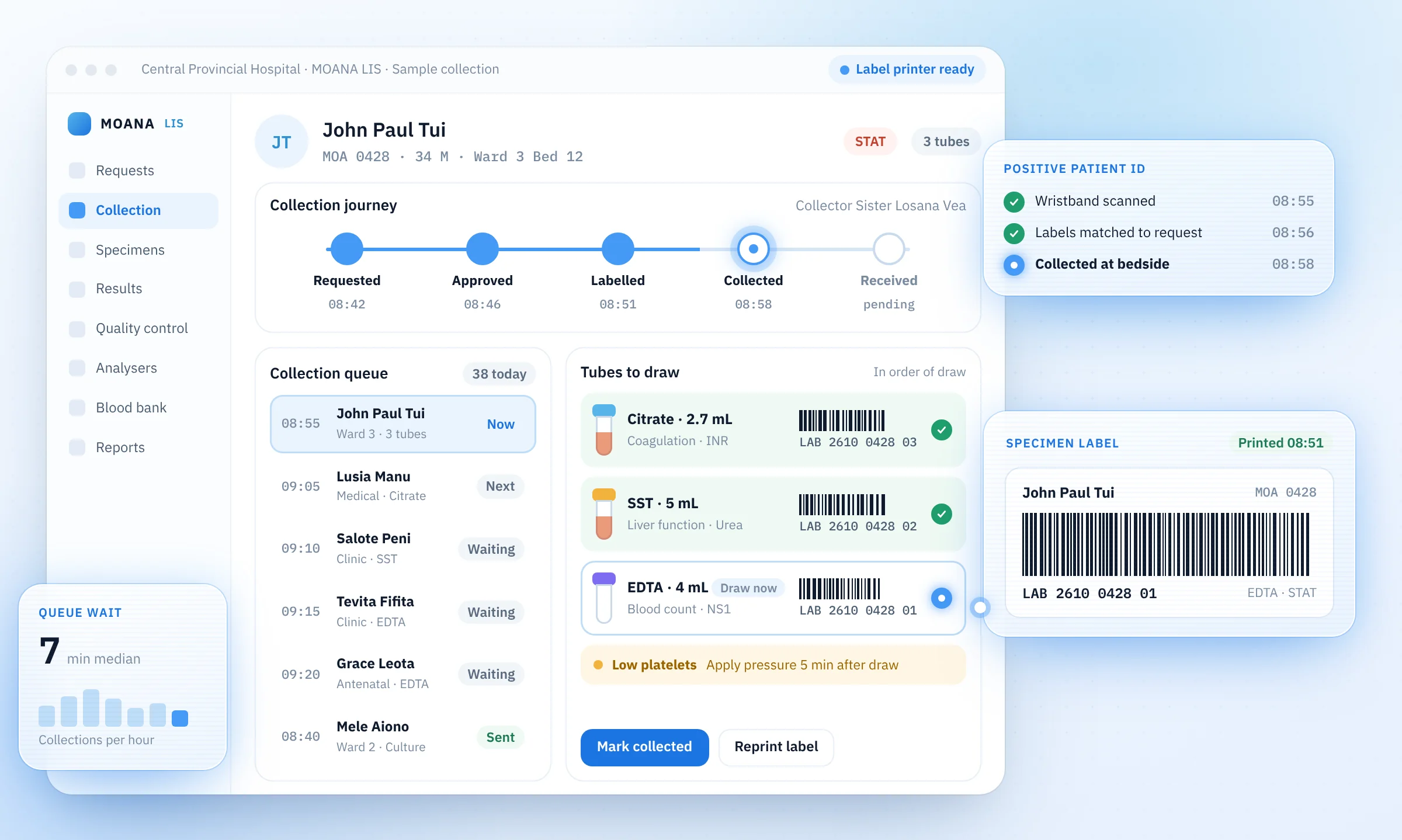
The request starts in the record. A clinician orders from the patient chart on MOANA Desktop, and the order arrives at the laboratory with patient identity and clinical context attached. At collection, barcode labels are printed and the sample is tracked from the ward through receipt, rejection with a recorded reason, and the bench.
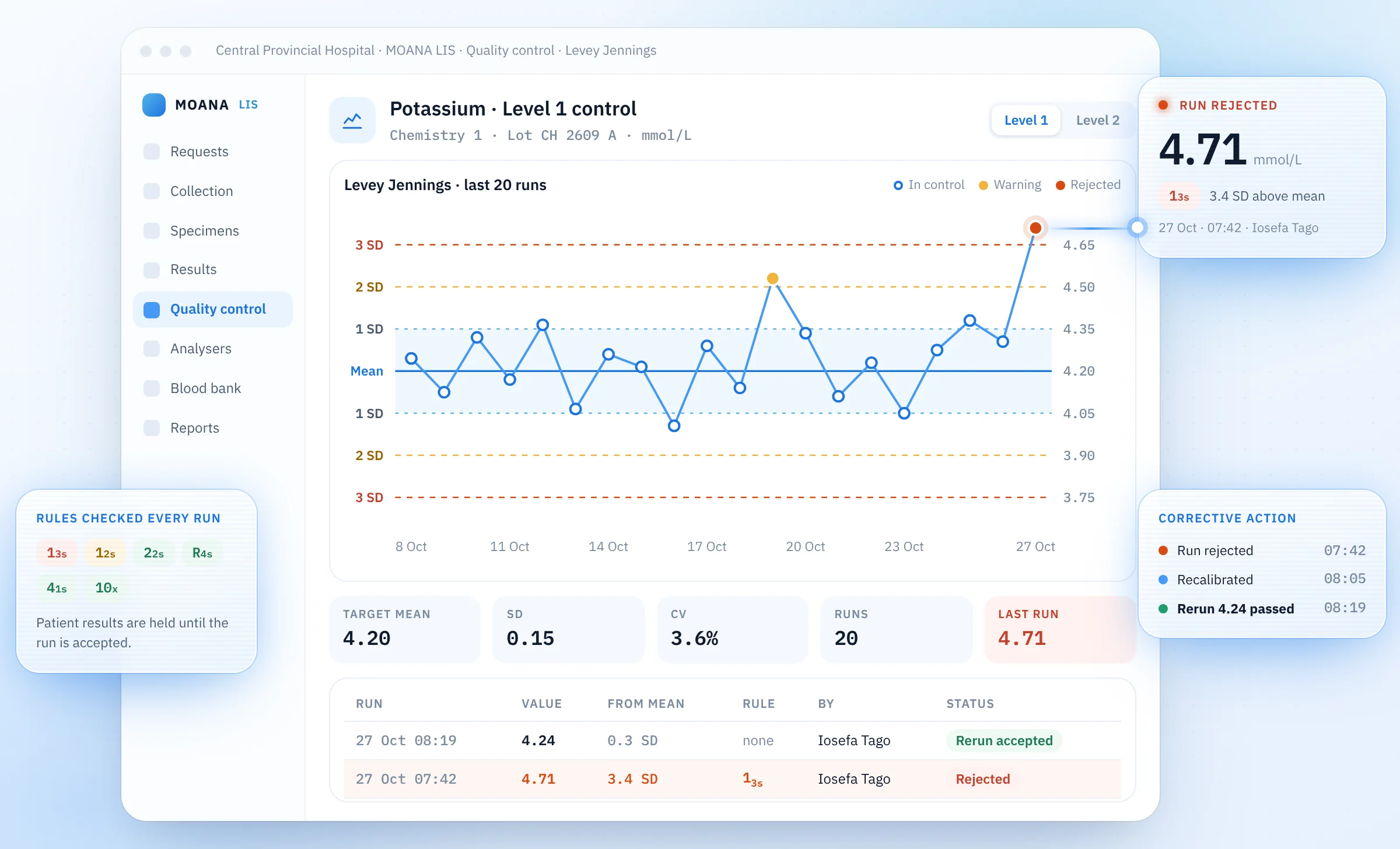
At the bench, MOANA LIS integrates with analysers and instruments, so orders flow to the instrument and results return without retyping. Internal quality control is applied inside the system: Westgard rules evaluate each run, Levey Jennings charts show shifts and trends, and a run that violates a rule is flagged before results are verified.
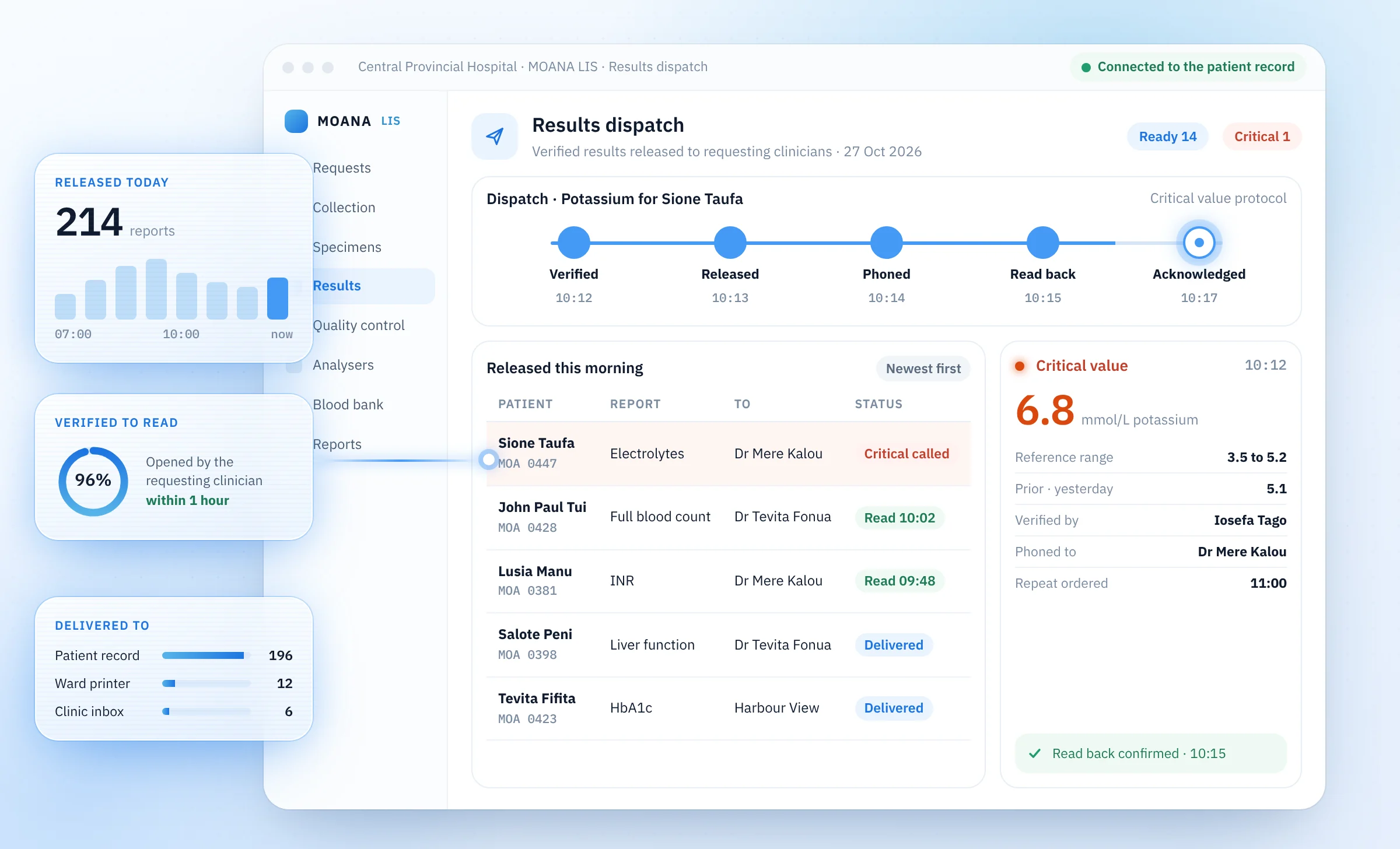
After analysis, results pass through verification with a full audit trail. Critical values are flagged automatically, and notification and read back are recorded against the result. Verified results are dispatched to the requesting clinician and into the patient record. Blood bank inventory is managed in the same system.
For integration, the test catalogue can be mapped to LOINC, and results are exchanged using HL7 v2 and FHIR R4 through the platform's interoperability layer. MOANA LIS is designed for unreliable connectivity: work is saved on the device and synchronised when the connection returns, and it performs equally on stable networks. Role based access and an audit log protect patient data, and the organisation that collects the data owns it.
At ANGAU Memorial Provincial Hospital in Lae, Papua New Guinea, the Pathology department has been mapped from specimen receipt to result dispatch and configured on MOANA LIS ahead of go live, which is expected in the coming weeks. The laboratories solution describes how Moana works with laboratory teams through configuration and training.
Frequently asked questions
What is the difference between an LIS and a LIMS?
The terms overlap and are often used interchangeably. WHO's handbook refers to a computerised laboratory system as "LIMS or LIS" [2]. In common usage an LIS supports clinical diagnostic work centred on patients, while a LIMS is often associated with public health, research or sample centric workflows. APHL's guidebook discusses the distinction for international implementations [10].
Does an LIS make a laboratory ISO 15189 compliant?
No. Accreditation depends on the laboratory's quality management system, competence and practice. An LIS provides the traceability, QC records, audit trails and indicators that make compliance demonstrable, and supports SLIPTA audits that are organised around the same twelve quality system essentials [7].
Can a laboratory start with an LIS before the hospital has an electronic record?
Yes, if the LIS is available standalone. Requests can be registered at the laboratory and results printed or sent electronically. When the hospital adopts an electronic record later, the LIS should integrate with it so that ordering moves to the ward.
Which analysers can be connected?
That depends on the instruments and their interfaces. CLSI LIS01 and LIS02 define how instruments and information systems exchange data [8], and some instruments use HL7 messages instead. A buyer should require a list of instruments already interfaced and a documented process for adding new ones.
How should a ministry choose an LIS for a national network?
Start with the national test catalogue, the referral pathways between laboratories and the reporting obligations to surveillance. Require LOINC mapping, standard interfaces and a credible implementation and support plan, and treat the programme as APHL recommends: as a national project with governance, monitoring and sustainability planning [10].
Sources
- The Lancet Commission on diagnostics: transforming access to diagnostics, The Lancet, 2021
- Laboratory quality management system: handbook, World Health Organization, 2011
- ISO 15189:2022 for medical labs published, International Laboratory Accreditation Cooperation, 2022
- Effective practices for the timely and accurate reporting of laboratory critical values, Centers for Disease Control and Prevention, 2012
- Errors in clinical laboratories or errors in laboratory medicine?, Clinical Chemistry and Laboratory Medicine, 2006
- Design and implementation of a clinical laboratory information system in a low resource setting, African Journal of Laboratory Medicine, 2019
- WHO Stepwise Laboratory Quality Improvement Process Towards Accreditation (SLIPTA) Checklist, African Society for Laboratory Medicine, 2023
- Specification for Transferring Information Between Clinical Laboratory Instruments and Information Systems (LIS02), Clinical and Laboratory Standards Institute, 2004
- LOINC Implementation Guide: LOINC features, SNOMED International, accessed 2026
- Laboratory Information Systems Project Management: A Guidebook for International Implementations, Association of Public Health Laboratories, 2019
- Critical values notification: a nationwide survey of practices among clinical laboratories across Nigeria, African Journal of Laboratory Medicine, 2023