What is an electronic health record (EHR)? A guide for health systems
An electronic health record (EHR) is a digital, longitudinal record of a person's health and care, created by the clinicians who treat them and designed to be shared across the services and facilities involved in that care. A complete EHR combines clinical documentation, orders, results, medications, decision support and reporting in one record per patient, so that information follows the patient rather than staying in one clinic's filing cabinet.
For a ministry of health or a hospital executive, the definition matters because it sets expectations for procurement. A system that only digitises one department's paper chart is useful, but it is not an EHR in the sense that national digital health strategies intend. This guide sets out the accepted definitions, the core functions, the evidence on benefits, and the conditions that determine whether an EHR delivers them in low and middle income settings.
Defining the electronic health record
The international reference point is ISO/TR 20514, the technical report from the International Organization for Standardization that sets out the definition, scope and context of the electronic health record and distinguishes its main categories [1]. The common thread across these definitions is that an EHR is person centred and longitudinal: it accumulates a patient's information over time, across encounters and across providers.
The United States Office of the National Coordinator for Health Information Technology draws a practical distinction that many ministries now use. An electronic medical record (EMR) holds the medical and treatment history of patients in one practice. An EHR is designed to reach beyond the organisation that originally collects and compiles the information, so that laboratories, specialists, hospitals and the patient can share it [2]. The difference is not cosmetic. It determines whether a referral arrives with the patient's history, whether a laboratory result reaches the clinician who ordered it, and whether a ministry can build national reporting on routine care. The distinctions between record types and broader hospital and national systems are covered in detail in EHR vs EMR vs hospital information system.
The World Health Organization classifies these functions under "person centred health records", which include longitudinal tracking of health status and services, structured clinical records and unstructured records such as notes, images and documents [13].
The core functions of an EHR
In 2003 the United States Institute of Medicine set out eight core functions that an EHR system should perform [3]. Two decades later they remain the clearest functional checklist, and they translate directly to the needs of public hospitals and primary care networks.
| Core function | What it means in practice |
|---|---|
| Health information and data | Diagnoses, allergies, medications, results and history available at the point of care |
| Results management | New and past laboratory and imaging results visible to every clinician involved |
| Order entry and management | Electronic prescriptions, laboratory orders and service requests |
| Decision support | Alerts and reminders for best practice, drug interactions and allergies |
| Electronic communication | Secure exchange between providers, and between providers and patients |
| Patient support | Patients can view their records and manage their own care |
| Administrative processes | Scheduling, admissions, billing and other operational tools |
| Reporting and population health | Reporting built on uniform data standards for safety and disease surveillance |
A system that covers only the first function is a digital chart. A system that covers all eight, on one record per patient, is what health systems mean when they procure an EHR.
Components a modern EHR adds
Since 2003, three further expectations have become standard:
- Interoperability through open standards. HL7 FHIR, published by HL7 International, defines modular "resources" for patients, practitioners, organisations, medications, diagnostics and care plans, exchanged through modern web standards [11]. National architectures such as OpenHIE assume that point of care systems exchange data with shared registries, a shared health record and the national health management information system [12].
- Coded clinical content. Diagnoses, laboratory tests and clinical findings are captured with standard terminologies so that data can be aggregated and compared.
- Security and audit. Role based access, audit logging and controlled emergency access are expected of any system that holds identifiable health data.
What the evidence says about benefits
The evidence base is strongest for specific functions rather than for EHRs as a whole, and procurement teams should read it that way.
Medication safety. A meta analysis published in the Journal of the American Medical Informatics Association found that processing a prescription through computerised provider order entry reduced the likelihood of a medication error on that order by 48 per cent. Applied to adoption levels in United States hospitals in 2008, the authors estimated that about 17.4 million medication errors were averted in a single year [4]. The authors were careful to note that fewer errors do not automatically mean less harm, but the direction of the effect is consistent.
Efficiency and financial return in low income settings. A modelling study of an EMR at a central hospital in Lilongwe, Malawi, estimated annual savings of US$284,395 from shorter length of stay, reduced transcription time and lower laboratory use. The hospital reached a net financial gain by the third year of operation, with an estimated five year net benefit of US$613,681 [7].
Quality of care in low income countries. A 2023 systematic review in BMJ Health and Care Informatics found that nine of twelve included studies reported benefits from EHR adoption, mapped to WHO quality dimensions including safety, effectiveness, timeliness and efficiency. In one Ethiopian survey, 75 per cent of health professionals agreed that EMRs can improve timely patient care [6].
The same review is a reminder of the gap between promise and practice: most low income countries in the review remained at the pre implementation or pilot stage [6].
Where EHR programmes succeed and where they stall
A systematic review of 47 articles on EMR implementation in low resource settings extracted 381 success criteria and grouped them into seven categories: ethical, financial, functionality, organisational, political, technical and training [5]. Functionality was cited most often, followed by organisational issues and technical infrastructure. Training and skilled personnel appeared in only about 10 per cent of papers [5], which is notable given how often training is cited elsewhere as the reason implementations fail.
The 2023 review of low income countries found the most frequently reported barriers were lack of training, poor infrastructure, lack of standards and lack of management commitment, with absence of interoperability also reported [6]. These barriers are predictable, and a sound programme designs around them from the start:
- Infrastructure. Power and connectivity are uneven, so the record must protect work when the connection drops.
- Standards. Without coded data and open exchange standards, every facility becomes a separate silo.
- People. Clinicians adopt systems that reflect how their departments actually work, configured with them rather than for them.
- Leadership. Management commitment and clear ownership of the record determine whether paper registers are retired.
The costs behind each of these factors are discussed in the total cost of ownership of an EHR.
The EHR as national infrastructure
The WHO Global strategy on digital health 2020 to 2025 asks countries to own, adapt and strengthen digital health strategies that fit their health priorities and resources, and to put people at the centre of digitally enabled health systems [9]. In May 2025 the World Health Assembly extended the strategy to 2027 and asked WHO to develop a new strategy for 2028 to 2033. WHO reported at the time that 129 countries had national digital health strategies [10].
National EHR systems remain far from universal. In the WHO third global survey on eHealth, 47 per cent of responding countries reported having a national EHR system, and 54 per cent reported legislation protecting the privacy of electronically held patient data [8].
For ministries, the EHR is the source that makes the rest of the national architecture work. When care is documented once, in coded form, at the point of care, the same data can feed disease surveillance, supply planning and aggregate reporting without separate data entry. A record that is not interoperable cannot play that role, however well it serves the facility that runs it.
What to expect from an EHR in a low resource setting
The definition and the evidence point to a short list of expectations that apply regardless of vendor:
| Expectation | Why it matters |
|---|---|
| One record per patient across departments | Prevents duplicate charts and missing history |
| Role based workspaces for each profession | Doctors, nurses, pharmacy and laboratory see what their work requires |
| Order entry with safety checks | Captures the medication error reduction the evidence describes |
| Closed loop results | Results return to the ordering clinician and are acknowledged |
| Designed for unreliable connectivity | Work is saved on the device and synchronised when the connection returns |
| Open standards | FHIR, HL7 v2, ICD and LOINC allow exchange and national reporting |
| Audit and access control | Protects patients and supports accountability |
| Configurable to facility level | A health centre and a referral hospital need different scope |
A structured way to score systems against these criteria is set out in how to choose an EHR for low and middle income countries.
How Moana approaches the electronic health record
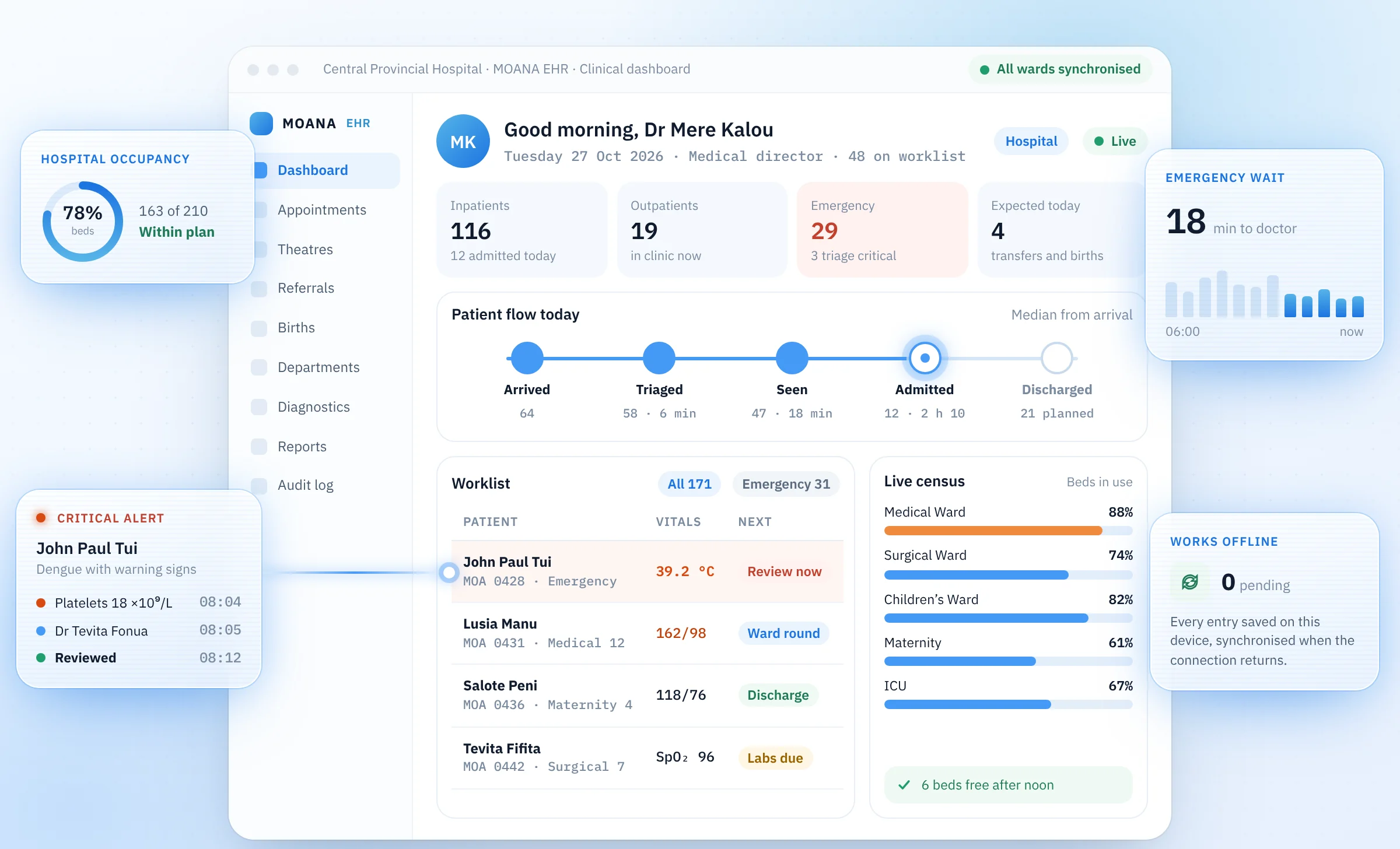
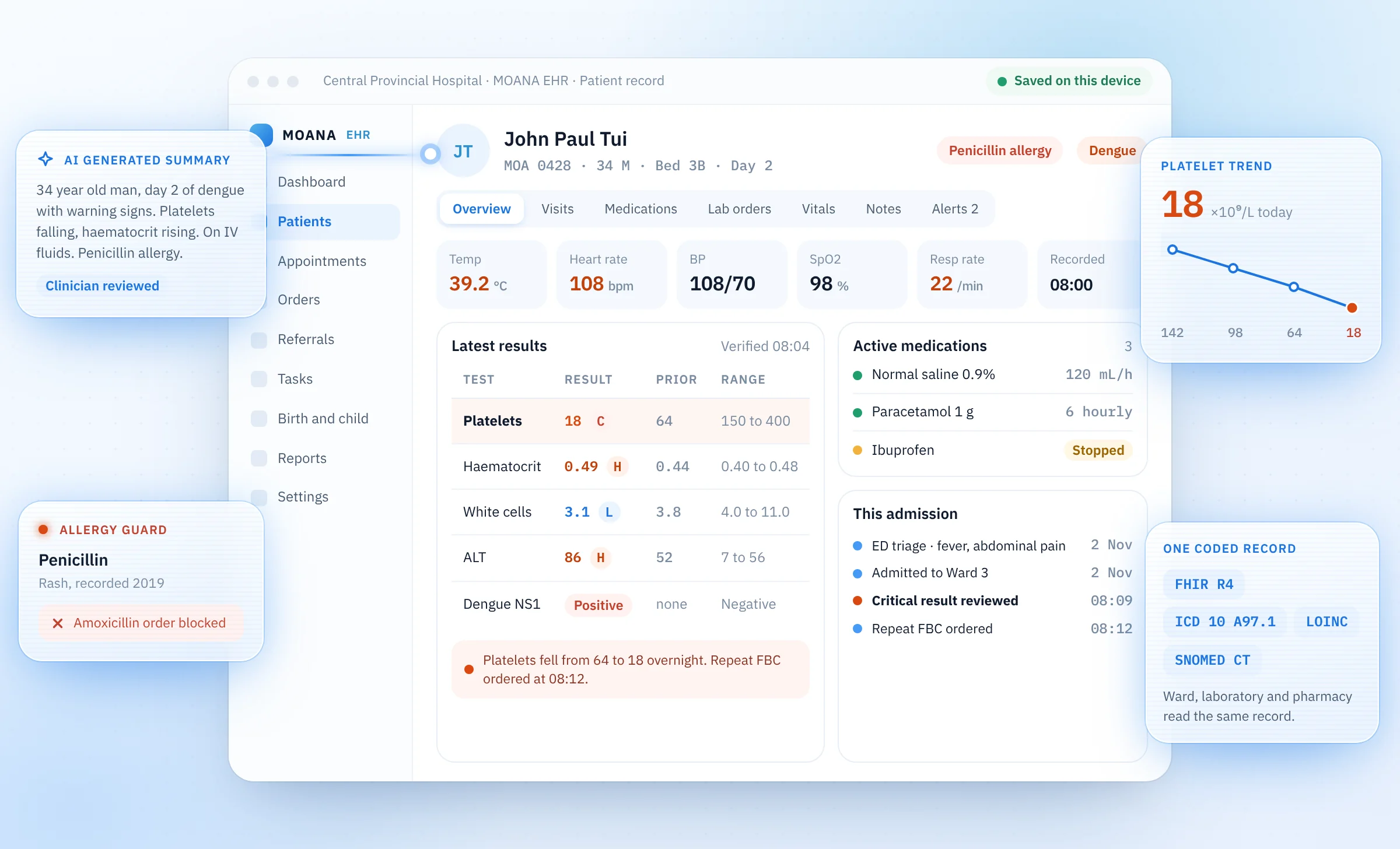
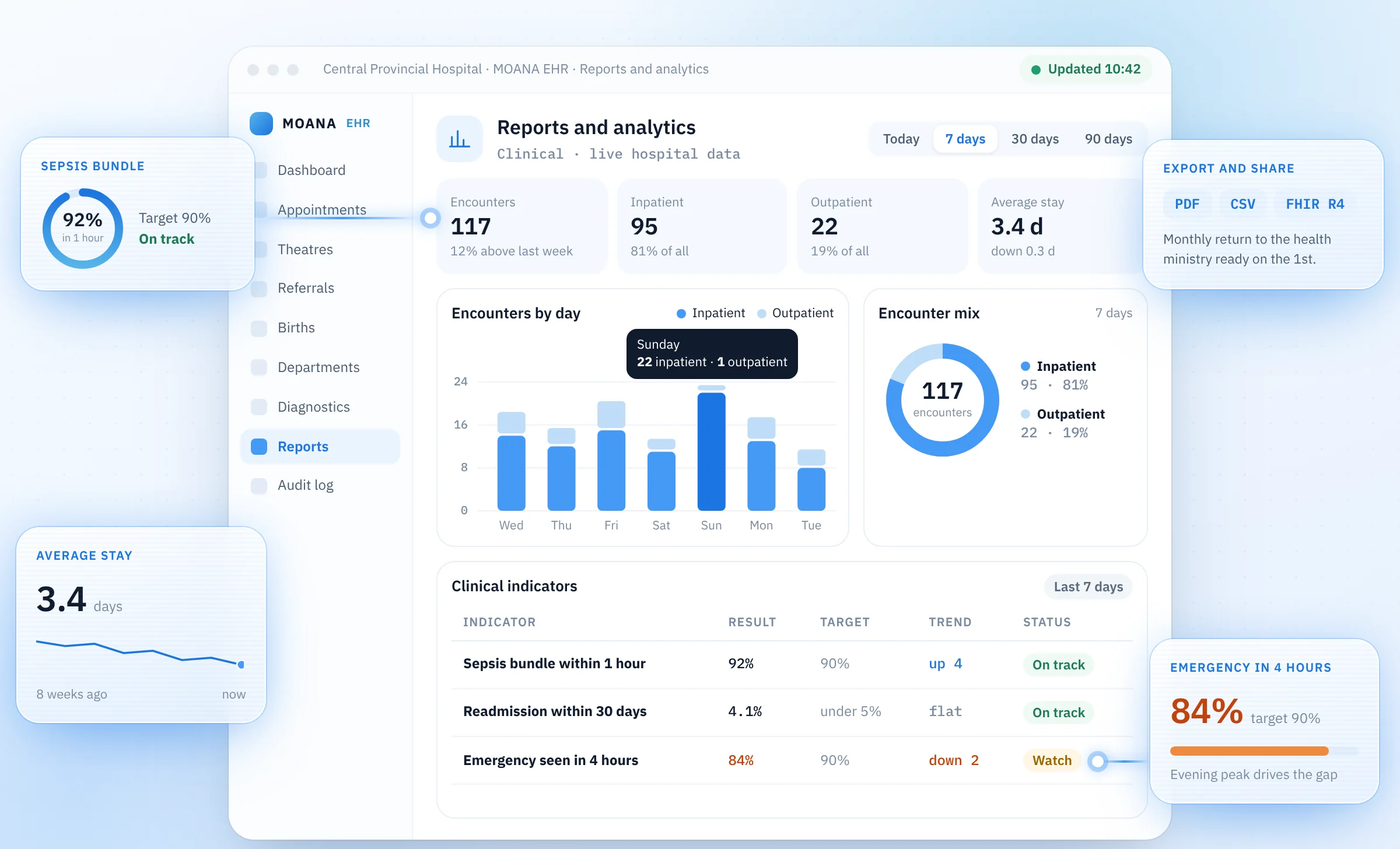
Moana is built on the principle that each patient has one record, used by every department that cares for them. The Moana EHR holds history, problems, allergies, medications, orders, results, vitals and notes in a single longitudinal record. MOANA Desktop provides role based workspaces for doctors, nurses, pharmacy, laboratory, radiology and administration, so each profession works from the same record with the tools its work requires. MOANA Mobile and the Patient Portal extend the record to clinicians on the move and to patients.
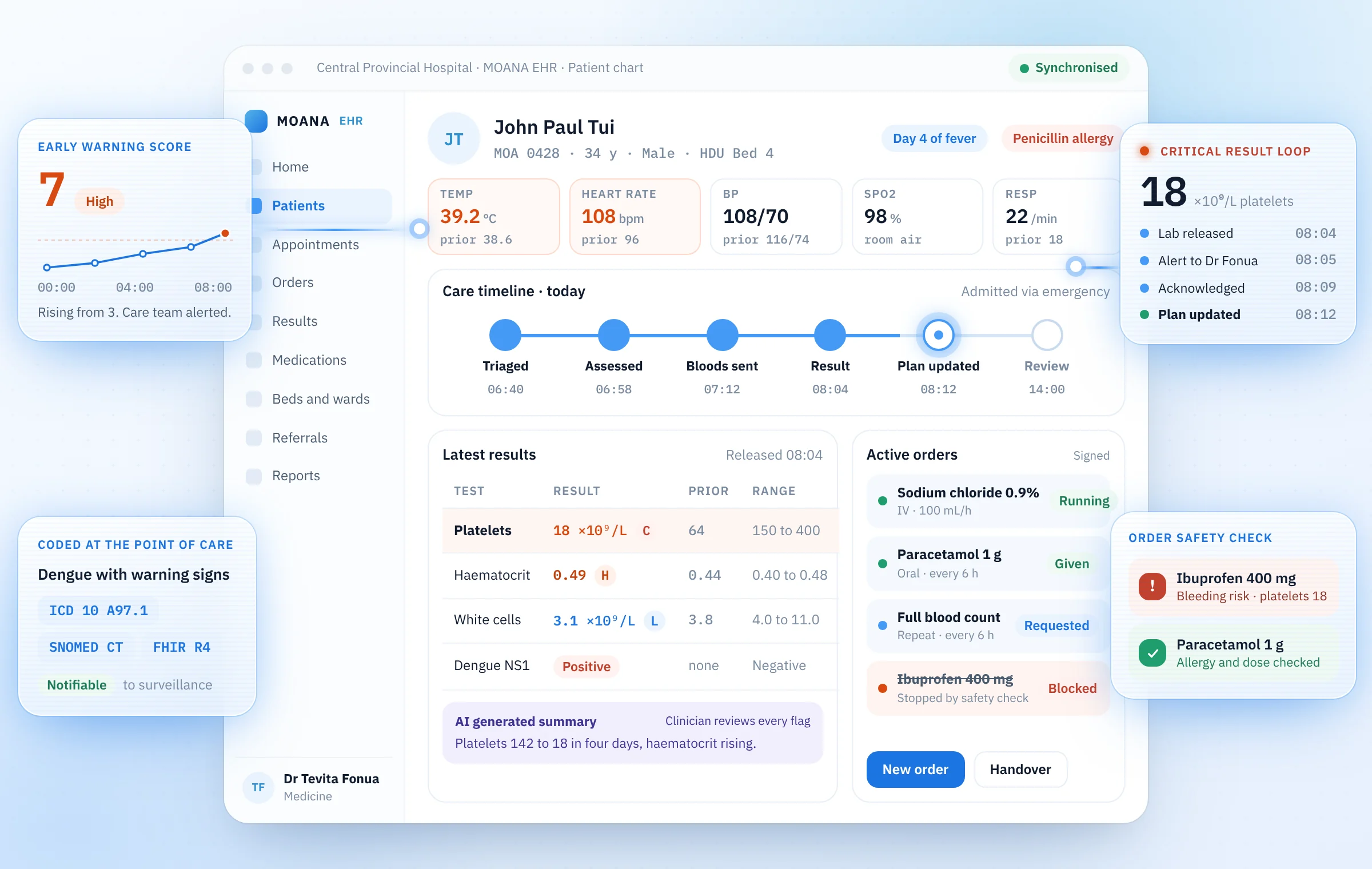
The functions the Institute of Medicine described are part of the platform rather than separate purchases. Prescribing runs through the Moana Pharmacy Management System, with interaction and allergy checks graded by severity and pharmacist verification before dispensing. Laboratory orders flow to MOANA LIS, which integrates with analysers and instruments and returns results, including critical value alerts with read back, to the ordering clinician. Clinical rules flag patients by severity and an AI generated summary supports the clinician; the clinician reviews every flag.
Moana is designed for unreliable connectivity. Work is saved on the device and synchronised when the connection returns, and the same platform performs equally on stable networks. Interoperability is based on FHIR R4, SMART on FHIR app launch, FHIR bulk export and HL7 v2, with ICD 10, ICD 11, SNOMED CT and LOINC, and reporting into DHIS2. Role based access, two factor authentication, audited break glass access, encryption and a full audit log protect the record, and the organisation that collects the data owns it.
Moana is live across clinics in Pakistan, clinics in the South Pacific and India. At ANGAU Memorial Provincial Hospital in Lae, Papua New Guinea, the regional referral hospital for the Momase region, every department has been mapped and configured with its Officer in Charge, the Consultation Clinic is already live in the Moana system, and hospital go live is expected in the coming weeks. The approach is described in the ANGAU case study.
Frequently asked questions
What is the difference between an EHR and an EMR?
An EMR holds the medical and treatment history of patients within one practice or facility. An EHR is designed to be shared beyond the organisation that created it, so that information follows the patient across providers [2].
What are the main components of an electronic health record?
The widely used reference is the eight core functions set out by the Institute of Medicine: health information, results management, order entry, decision support, electronic communication, patient support, administrative processes and reporting [3]. Modern systems add open interoperability standards, coded terminologies and security controls.
Do EHRs improve patient safety?
The strongest evidence concerns electronic prescribing. A meta analysis found a 48 per cent reduction in the likelihood of a medication error on orders processed through computerised order entry [4]. Safety gains depend on how decision support is configured and on clinicians reviewing alerts.
Can an EHR work where power and internet are unreliable?
Yes, if it is designed for those conditions. The system should save work on the device and synchronise when the connection returns, rather than assuming a permanent connection. Power and backup arrangements still need to be planned as part of the programme.
How does an EHR support national reporting?
When care is recorded in coded form at the point of care, aggregate indicators can be generated from the same data and sent to the national health management information system, rather than compiled by hand from paper registers.
Sources
- Health informatics: electronic health record definition, scope and context (ISO/TR 20514), International Organization for Standardization, listed by the Australian Digital Health Agency, 2005
- EMR vs EHR: what is the difference?, Office of the National Coordinator for Health Information Technology, 2011
- US Institute publishes core capabilities for EHRs, Digital Health, 2003
- Reduction in medication errors in hospitals due to adoption of computerized provider order entry systems, Journal of the American Medical Informatics Association, 2013
- Success criteria for electronic medical record implementations in low resource settings: a systematic review, Journal of the American Medical Informatics Association, 2015
- Adoption of electronic health record systems to enhance the quality of healthcare in low income countries: a systematic review, BMJ Health and Care Informatics, 2023
- Modeling return on investment for an electronic medical record system in Lilongwe, Malawi, Journal of the American Medical Informatics Association, 2013
- Global diffusion of eHealth: making universal health coverage achievable, World Health Organization, 2016
- Global strategy on digital health 2020 to 2025, World Health Organization, 2021
- World Health Assembly endorses extension of the global digital health strategy to 2027, World Health Organization, 2025
- FHIR R4 summary, HL7 International, 2019
- OpenHIE architecture specification: overview of the architecture, OpenHIE, 2024
- Classification of digital interventions, services and applications in health, second edition, World Health Organization, 2023