Maternal and newborn digital records: from labour ward to child health
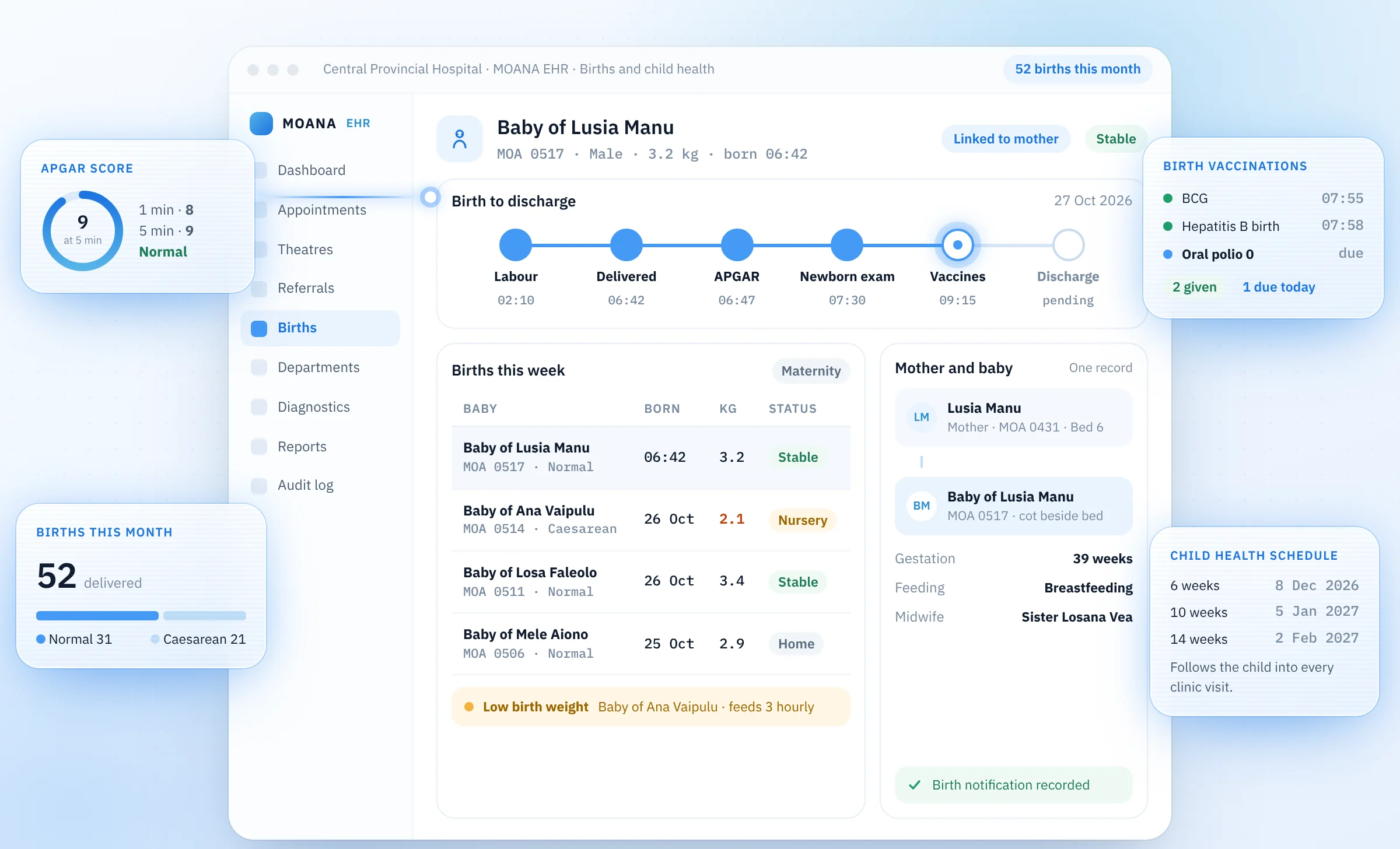
A digital maternal and newborn record follows a woman from antenatal care through delivery, and creates the baby's own record at birth, linked to the mother. Birth weight, APGAR scores and the first doses given are recorded once and carried forward to special care, child health and immunisation, and the same entry provides the individual level data a birth notification needs.
Maternity is where a hospital's records most often break. The antenatal card stays with the mother, the delivery is written in a labour ward register, the baby is admitted to the nursery under a new number, and the child health card starts again at the first clinic visit. This guide sets out the stages of the pathway, how mother and baby should be linked, what WHO recommends on birth notification and digital tracking, and how WHO content can be used rather than rebuilt.
Why the maternal and newborn record matters
The stakes are high. WHO estimates that about 260,000 women died during or after pregnancy and childbirth in 2023, a maternal death almost every two minutes, and that most of these deaths could have been prevented [1]. Just over 90 percent occurred in low and lower middle income countries, and severe bleeding, infections, high blood pressure in pregnancy, complications from delivery and unsafe abortion together account for around 75 percent [1].
For newborns, 2.3 million children died in the first 28 days of life in 2022, 47 percent of all deaths under five [2]. Three quarters of neonatal deaths occur in the first week, and about 1 million newborns die within 24 hours of birth [2]. The Lancet Global Health Commission on High Quality Health Systems estimated that high quality health systems could prevent more than one million newborn deaths every year across the 137 countries it studied [3].
A continuous record changes what the next health worker knows. A nursery nurse who can see the mother's antenatal history, the length of labour and the APGAR scores does not need to reconstruct them from a handwritten note. A child health nurse who can see the birth weight and the doses given at birth knows what is due next.
The pathway from antenatal care to child health
The pathway crosses several departments, each with its own paper register. The table shows what each stage should add.
| Stage | What is recorded | Carried forward to |
|---|---|---|
| Antenatal care | Visits, gestation, risk factors, tests, supplements, plan for delivery | Labour ward |
| Labour and delivery | Labour progress, mode of delivery, complications, outcome | Mother's record and the new baby's record |
| Birth | Birth weight, APGAR scores, first doses given at birth such as Vitamin K and hepatitis B | Nursery, postnatal ward, child health |
| Special care nursery | Admission reason, neonatal observations, treatment, transfers | Child health and discharge |
| Postnatal care | Mother and baby checks, feeding, danger signs | Child health |
| Child health | Immunisation, growth, development, illness visits | National immunisation and child health reporting |
The principle is simple: each stage adds to the same record, and nothing recorded earlier has to be recorded again.
The APGAR score
The APGAR score, designed by the anaesthetist Dr Virginia Apgar in 1952, rates five signs, colour, heart rate, reflexes, muscle tone and respiration, from 0 to 2 each, for a total out of 10 [4]. It is recorded at 1 and 5 minutes after birth and, if the 5 minute score is below 7, at 5 minute intervals up to 20 minutes [4]. A score of 7 to 10 is reassuring, 4 to 6 moderately abnormal and 0 to 3 low [4]. The score is not on its own evidence of asphyxia, and resuscitation comes before scoring [4]. A digital record should therefore hold each component and its time, not only the total, so that the nursery can see how the baby responded.
Linking mother and baby at birth
The single most important design decision in a maternal and newborn system is how the baby's record is created. On paper, the baby is often an annotation on the mother's delivery entry until the baby needs care of its own, at which point a new folder is opened, sometimes under a temporary name.
A sound design creates the baby's record at the point of care, from the delivery entry, with:
- A unique identifier of the baby's own, issued at birth and used in every department afterwards.
- A link to the mother's record and to the delivery, so that either can be found from the other.
- Birth details recorded once and visible from the baby's record without copying.
- Support for multiple births, so that twins and triplets each receive their own record linked to the same delivery.
The baby's identifier belongs in the same patient index as every other patient. Patient identity, matching and duplicates are covered in master patient index and unique health identifiers. The published literature on electronic records in low resource settings identifies the introduction of patient identity management as one of their recognised benefits [5].
Birth notification and civil registration
A birth recorded in a health facility is the starting point for the child's legal identity. Many countries require the health facility to notify the civil registration authority, and the health record is the natural source of that notification.
The gap remains large. UNICEF reports that 77 percent of children under five worldwide have had their births registered, up from 75 percent in 2019, but around 150 million remain unregistered [6]. Sub Saharan Africa, at 51 percent, holds more than half of the world's unregistered children, and over 50 million children whose births are recorded lack a birth certificate [6].
WHO's 2019 guideline on digital interventions for health system strengthening recommends birth notification via mobile devices under specific conditions: the notifications must provide individual level data to the health system or the civil registration and vital statistics system, and that system must be able to respond [7]. The supporting evidence on coverage and timeliness was judged to be of very low certainty, and the guideline's evidence review identified the conditions that matter in practice [8]:
- adequate numbers of local staff, with rigorous training and monitoring of quality and timeliness [8];
- legal frameworks for civil registration that may need to change to allow digital notification and new types of health worker to issue notifications [8];
- strong underlying civil registration infrastructure and political will [8].
The implication for a hospital system is that birth registration in the record should capture the individual level data a notification requires, in a structured form, while the route to the civil registration authority is set by national law and process.
What WHO evidence says about digital tracking
The same guideline recommends digital tracking of patients' health status and services, combined with decision support, where the health system can support the components in an integrated way and the tasks fall within the health worker's scope of practice [7]. For maternal, newborn and child health, the evidence review reported that this combination, compared with standard care in primary health care [8]:
- probably increases the number of women attending at least three antenatal visits, pregnant women taking at least 90 iron tablets, immediate breastfeeding and contraceptive use six months or more after birth (moderate certainty);
- probably makes no difference to child vaccination, facility births and women receiving at least two tetanus injections (moderate certainty);
- has uncertain effects on emergency visits and hospitalisation of children under five (very low certainty).
The qualitative evidence is equally instructive. Health workers valued faster recording, easier access to data and not having to carry paper registers, but they were concerned that digital systems could increase their workload, and some complained about maintaining both digital and paper systems [8]. Network connectivity, electricity, system integration, device usability and access to training were identified as key barriers [8]. A maternal record that runs alongside the existing paper registers indefinitely will lose the confidence of the midwives who maintain both.
Using WHO content rather than rebuilding it
Ministries do not need to write maternal and newborn content from first principles. WHO's SMART guidelines translate WHO recommendations into digital components that are standards based, machine readable, adaptive, requirements based and testable [9]. Digital adaptation kits have been published for antenatal care, postnatal care, immunisations, family planning, birth defects surveillance and self monitoring of blood pressure during pregnancy, among others [9].
Each kit is software neutral and sets out personas and user scenarios, business processes and workflows, core data elements mapped to standard terminology codes, decision support content, programme indicators and functional requirements [10][11].
For a ministry procuring a maternal and newborn system, the kits provide a ready specification. The question to ask a supplier is not whether they have designed an antenatal form, but whether their system can carry the data elements, schedules and indicators the kit defines, and report them in a standard form. Standards are discussed in FHIR R4 explained for ministries of health.
Special care, immunisation and growth
Special care nursery
Babies admitted to a special care nursery are among the sickest patients in a hospital. Their record should arrive with them: the mother's details, gestation, birth weight, APGAR scores and the doses already given. The nursery team then records neonatal observations throughout the stay, and changes that cross clinical thresholds should be flagged to staff. Admissions, transfers and discharges are added to the same record, so that the child health team sees the whole story.
Immunisation and growth
Immunisation is where the newborn record continues for years. The record should show which doses have been given, including those given at birth, which are due and which are overdue, so that each contact with the health system is an opportunity to catch up. Growth measurements recorded at each visit build the child's growth record without a separate card. Because these entries are structured, they also produce the immunisation and child health figures the ministry reports, a subject developed in traceable national health reporting.
Data quality and reporting
Maternal and newborn indicators are among the most scrutinised in any health system, and they are only as good as the registers they come from. A study of five Ethiopian hospitals found that only one met the standard for data accuracy over a 12 month document review, and only three met the standards for timeliness and completeness [12].
A record built on structured entries changes that. Deliveries, births, newborn admissions and doses given are counted from the events themselves, and aggregate figures can be submitted to the national platform. DHIS2, used by ministries of health in more than 80 countries, is commonly that platform [13]. In OpenHIE terms, the hospital record is a point of service system that can draw on national registries such as the client registry and contribute to a shared health record where one exists [14]. FHIR provides the resource model through which patients, encounters and observations can be exchanged [15].
Privacy and confidentiality
Maternal records include some of the most sensitive information a health system holds, from HIV status in pregnancy to the circumstances of a birth. WHO's evidence review found high confidence that clients with stigmatised health conditions may be particularly concerned about the confidentiality of digital health records [8]. Role based access, a full audit log and consent rules for sharing are therefore requirements, not options. Who can see a mother's history from the baby's record, and in what circumstances, should be agreed with the maternity and paediatric teams before configuration.
How Moana approaches this
Moana's maternal and child pathway runs on the same patient record as the rest of the hospital. A delivery is recorded against the mother's record, and that entry creates the baby's own record at the point of care, linked to the mother and to the delivery. Birth registration in Moana links each baby to the mother, and APGAR scores, birth weight and the first doses given at birth are recorded once and carried forward.
Babies who need additional support are admitted to newborn and special care with their record already started. The nursery team records observations throughout the stay; clinical rules flag newborns by severity, using the recorded APGAR scores and observations, and the clinician reviews every flag. Immunisation and growth continue on the same record through child health, and figures are reported into DHIS2. Interoperability uses FHIR R4 and HL7 v2, with ICD 10 and ICD 11 coding.
Facility service levels match features to each facility. A clinic that provides maternity care can turn on birth management to gain the inpatient and newborn features it needs, while an outpatient clinic without births does not see them.
At ANGAU Memorial Provincial Hospital in Lae, Papua New Guinea, the maternal and newborn pathway has been mapped and configured in Moana from the Labour Ward through the Special Care Nursery to the Children's Outpatient Department, with each department's Officer in Charge. Birth weight, APGAR scores, Vitamin K and hepatitis B are configured to carry over from the Labour Ward to the nursery. Go live at ANGAU is expected in the coming weeks; the work is described in the ANGAU case study.
Moana is designed for unreliable connectivity: a delivery recorded during an outage is saved on the device and synchronised when the connection returns. Role based access, two factor authentication, consent for sharing and an audit log protect the record.
Frequently asked questions
Should the baby have a separate record from the mother?
Yes. The baby needs a unique identifier and record of its own from birth, linked to the mother's record and the delivery, so that the child's care can continue independently while the link remains.
Can a hospital system register births with the civil registration authority?
The hospital record can hold the individual level data a birth notification needs. WHO recommends digital birth notification only where the receiving system can respond, and the route is set by national law [7][8].
Do we need to design our own antenatal and immunisation content?
Not from first principles. WHO's digital adaptation kits define workflows, data elements, decision support and indicators for antenatal care, postnatal care and immunisation that countries can localise [9][10].
Will a digital system increase midwives' workload?
It can, particularly if paper and digital records are kept in parallel [8]. Recording each item once, and retiring duplicate registers once the system is in use, is the main safeguard.
How is sensitive maternal information protected?
Through role based access, consent rules for sharing and a full audit log of who viewed or changed a record, agreed with the clinical teams before configuration.
Sources
- Maternal mortality fact sheet, World Health Organization, 2025
- Newborn mortality fact sheet, World Health Organization, 2024
- New Lancet report out: high quality health systems in the Sustainable Development Goals era, University of Bergen, 2018
- APGAR score, StatPearls Publishing, 2024
- Benefits and challenges of EMR implementations in low resource settings: a state of the art review, BMC Medical Informatics and Decision Making, 2016
- Birth registration steadily increases worldwide, but 150 million children still invisible, UNICEF, 2024
- WHO guideline: recommendations on digital interventions for health system strengthening, World Health Organization, 2019
- Recommendations on digital interventions for health system strengthening: evidence and recommendations, World Health Organization, 2019
- SMART guidelines, World Health Organization, accessed 2026
- WHO SMART guidelines: optimising country level use of guideline recommendations in the digital age, The Lancet Digital Health, 2021
- Digital adaptation kits equip countries in translating health guidelines into digital solutions, PATH, accessed 2026
- Implementation status of health management information system in hospitals of South West Shoa Zone, Oromia, Central Ethiopia, ClinicoEconomics and Outcomes Research, 2021
- DHIS2 and the World Health Organization, HISP Centre, University of Oslo, accessed 2026
- OpenHIE architecture specification: component specifications, OpenHIE, accessed 2026
- FHIR R4 overview, HL7 International, 2019