Digitising the emergency department: triage, registration and flow
Digitising an emergency department means recording three things reliably at the door: who the patient is, how urgent their condition is, and when each step of their care happened. Done well, it lets the department see every patient waiting, protects the sickest from delay, and produces the time and outcome data a hospital needs to improve emergency care.
The emergency department is usually the busiest entry point of a public hospital and the first place a new record is created. What is captured there, and how quickly, shapes every record that follows. This guide covers why emergency care is a health system priority, which triage scales are used and how accurate they are, how registration should work under pressure, which time stamps to collect, and what to ask a supplier.
Why emergency care is a health system priority
In 2019 the World Health Assembly adopted a resolution on emergency and trauma care, noting that over half of deaths in low and middle income countries stem from conditions that prehospital and emergency care could treat [1]. The resolution asks member states to assess their emergency care systems with WHO tools, develop clinical protocols based on the WHO Emergency Care Systems Framework, and train the health workers involved [1].
The burden is visible inside hospitals. A systematic review of emergency care in 59 low and middle income countries identified 195 reports from 192 facilities, with a median of 30,000 patients a year per facility [2]. Median mortality within the emergency department was 1.8 percent; it was 4.8 percent in paediatric facilities and 3.4 percent in sub Saharan Africa [2]. The authors concluded that a substantial proportion of all deaths may occur in emergency departments [2].
An older study from a Malawian referral hospital shows how those deaths happen. Of 47 children identified as needing emergency treatment under WHO's Emergency Triage Assessment and Treatment guidelines, 31 received no treatment and eight of them died; the main barriers were a lack of staff in the department and a lack of rapidly available blood [13]. Triage identified the children. The system around it could not act fast enough.
Triage scales and which one to digitise
Triage sorts patients by clinical urgency rather than order of arrival. A digital system should implement the scale the hospital and its national or professional bodies have adopted, not impose a new one. The scales most often encountered are summarised below.
| Scale | Structure | Typical setting |
|---|---|---|
| Australasian Triage Scale | Five categories, from immediate to 120 minutes [6] | Australia, New Zealand and adapting systems |
| Interagency Integrated Triage Tool | Three colour coded categories: red, yellow, green [4] | Facility based triage in resource limited settings |
| South African Triage Scale | Four urgency levels using signs, symptoms and a triage early warning score [3] | Emergency centres across Africa and beyond |
| Emergency Triage Assessment and Treatment | Three tier, paediatric focus [3] | Paediatric emergency care, widely studied in Africa |
| Emergency Severity Index | Five tier, used mainly in high income countries [3] | Large, well resourced departments |
The Interagency Integrated Triage Tool was developed jointly by WHO, the International Committee of the Red Cross and Médecins Sans Frontières to give an integrated set of protocols for routine triage of adults and children and for mass casualty situations [4]. It deliberately drops the early warning score used in the South African scale, which makes it faster to apply [3].
Waiting time standards
Where a scale defines maximum waiting times, the system should measure against them. The Australasian Triage Scale, for example, sets the following treatment acuity and performance thresholds [6]:
| Category | Maximum waiting time | Performance threshold |
|---|---|---|
| ATS 1 | Immediate | 100 percent |
| ATS 2 | 10 minutes | 80 percent |
| ATS 3 | 30 minutes | 75 percent |
| ATS 4 | 60 minutes | 70 percent |
| ATS 5 | 120 minutes | 70 percent |
These thresholds can only be reported if the time of triage and the time of first assessment are both recorded. On paper, the second time is the one most often missing.
What the evidence says about triage accuracy
Triage is a clinical judgement made quickly, and its accuracy varies with training, tool and setting. The evidence supports three conclusions that bear directly on system design.
Triage works when it is implemented. A review of 16 before and after studies in low and middle income countries found moderate quality evidence that triage implementation was associated with fewer deaths and shorter waiting times [3].
Simple tools can perform well in resource limited departments. In three Papua New Guinea emergency departments, the Interagency Integrated Triage Tool showed sensitivity for time critical illness of 70.0 to 77.8 percent, inter rater agreement above 0.8 and median triage times of 94 to 214 seconds [3]. In an earlier pilot at Gerehu General Hospital and Mount Hagen Provincial Hospital, every respondent said the tool helped identify and prioritise the most urgent patients [5].
Calculations are a common source of error. When prehospital providers in Cape Town applied the South African Triage Scale to 5,100 clinical vignettes, the final category was correct in 56.5 percent of responses and under triaged in 29.5 percent [7]. The triage early warning score itself was correct in only 42.6 percent and under calculated in 45.0 percent [7]. At Kenyatta National Hospital in Nairobi, introducing the scale reduced over triage from 70.9 to 62.3 percent, with sensitivity of 92.2 percent and specificity of 37.7 percent for admission, death or discharge from the emergency unit [8]. A multisite thesis concluded that the scale has reasonable reliability and good validity across lower resource emergency centres, with paediatric settings needing local adjustment [9].
The design implication is clear. Where a scale includes a score, the system should calculate it from the vital signs entered rather than ask a nurse to add it up under pressure, and it should display the resulting category for the nurse to confirm. The nurse remains responsible for the triage decision; the software removes the arithmetic. Early warning scores are discussed further in clinical decision support and early warning scores.
Registration at the door
Registration in an emergency department has to be fast without being careless. A patient who arrives unconscious, without documents or with a common name must still be triaged and treated immediately, and the record created for them must eventually join the rest of their history.
A sound design has four features:
- Triage before full registration. A minimal record, created in seconds, lets triage and treatment begin. Demographic detail is completed once the patient is stable.
- Search before create. Staff search the patient index by name, date of birth, identifier or phone number before creating a new record, and the system warns of probable duplicates.
- Temporary identity for unknown patients. An unidentified patient receives a temporary record that can be merged later, with the merge audited.
- One identifier for the whole hospital. The number issued in the emergency department is the one used on the ward, in the laboratory and at discharge.
Patient matching and duplicate management are covered in detail in master patient index and unique health identifiers.
Time stamps and patient flow
Emergency department performance is measured in intervals. The system should record each step automatically as staff work, rather than ask them to write times afterwards.
| Interval | Why it matters |
|---|---|
| Arrival to triage | Exposes patients waiting unassessed |
| Triage to first clinician assessment | Measures performance against the triage scale |
| Assessment to decision | Shows diagnostic delays, often laboratory or imaging |
| Decision to admit to departure | Measures access block caused by full wards |
| Total time in the department | The headline flow measure |
| Left before being seen | A safety signal and a marker of crowding |
The reason for this attention is that crowding harms patients. A systematic review of 11 studies concluded that emergency department crowding is a major patient safety concern associated with poor outcomes [10]. Studies in the review reported higher inpatient mortality during crowded periods, with a relative risk of 1.34 for 10 day mortality in one Australian study, and all five studies that examined it found that crowding increased the number of patients leaving before receiving care [10].
Much of that crowding begins outside the department. Patients who have been admitted but cannot reach a ward bed remain in the emergency department, occupying space and staff. This is why emergency flow cannot be managed without live bed information, a subject covered in bed management and ward visibility.
Data for quality improvement
Once arrival, triage, assessment and disposition are recorded consistently, the department can measure itself. WHO's Data Set for Emergency Care provides a standard set of variables covering all types of emergency presentation, combining injury variables with elements such as triage information and prehospital time, with 47 core and 31 extended elements [11]. Its purpose is to allow data to be aggregated and compared across hospitals, regions and countries [11].
WHO's International Registry for Trauma and Emergency Care uses such case level data to identify potentially preventable deaths and feed reports back to clinical teams for review and targeted education [12]. A digital emergency record that captures the data set as part of routine work allows a hospital to take part in this kind of review without a separate registry form.
Designing for the realities of a public emergency department
A public emergency department is not a quiet environment. A system that works there has to accept the following conditions:
- Shared devices. Several staff use the same workstation; sign in and sign out must be quick, and each entry must still be attributed to the right person.
- Interrupted connections. Triage cannot wait for a network. Entries should save on the device and synchronise when the connection returns.
- Surges. In a mass casualty event the department may need to switch to a simpler triage protocol, as the Interagency Integrated Triage Tool provides [4].
- Hand over. The ward should receive the emergency record, including triage category, observations and orders, without a separate written summary.
How Moana approaches this
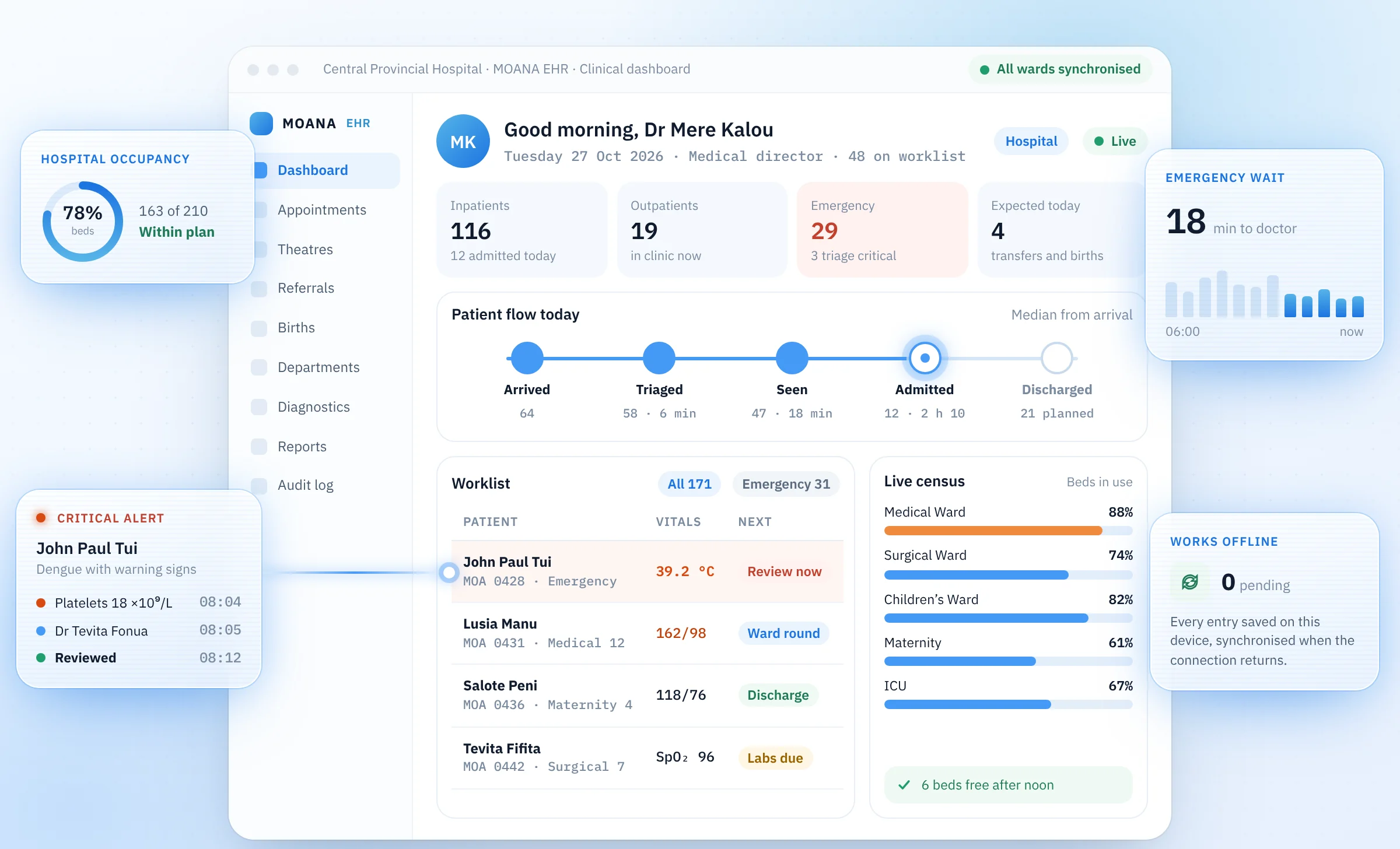
In Moana, the emergency department works on the same patient record as the rest of the hospital. A patient registered at the door keeps the same identifier through admission, the laboratory, the pharmacy and discharge, and the emergency encounter remains part of that record.
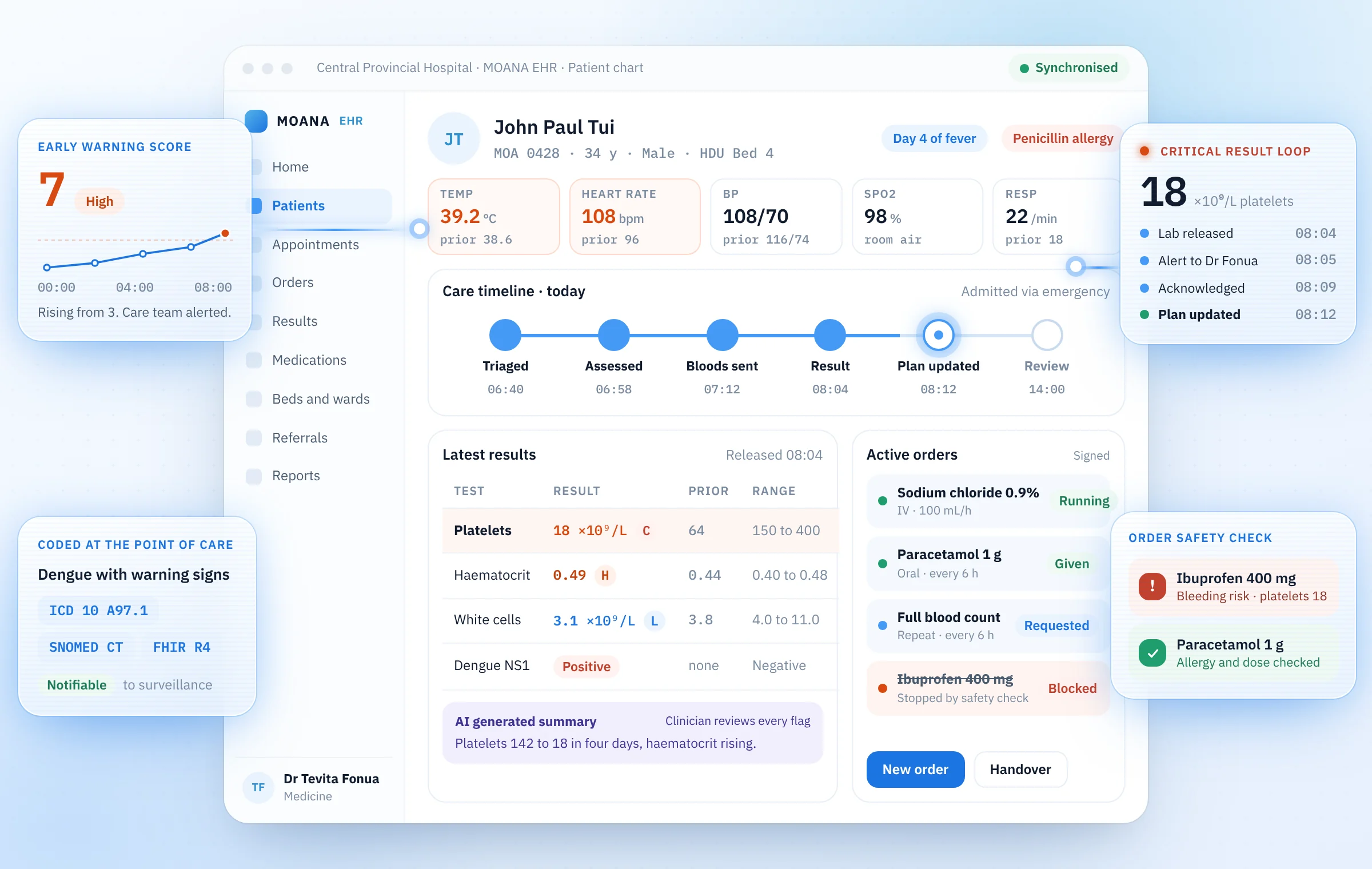
Registration uses the master patient index, with search before create, duplicate detection, validation and audit. Clinicians record observations, orders and notes in the electronic health record, and laboratory and imaging requests go directly to MOANA LIS and MOANA PACS, with results returned to the same record. Clinical rules flag patients by severity so that deterioration is visible to the team; the clinician reviews every flag. When the decision is to admit, the emergency team can see bed availability through hospital operations, and the ward receives the record rather than a paper summary. Patients may also be discharged directly from the emergency encounter with a summary and follow up instructions.
Moana is configured to the triage and registration instruments the hospital already uses rather than replacing them. At ANGAU Memorial Provincial Hospital in Lae, Papua New Guinea, the Emergency Department and Registration were the first clinical areas mapped, starting from the hospital's existing triage and registration instruments with the Officer in Charge and department teams. Both are mapped and configured in Moana, and go live is expected in the coming weeks. The method is described in the ANGAU case study.
Moana is designed for unreliable connectivity: work is saved on the device and synchronised when the connection returns, so a dropped link does not stop triage. Role based access, two factor authentication and audited break glass access protect the record, and every entry is attributed to the person who made it.
Key questions for procurement
Can the system implement our existing triage scale?
It should support the scale your hospital or national body has adopted, including colour coded three tier tools and five category scales, and calculate any score from the vital signs entered.
How quickly can an unknown patient be registered?
Ask to see a minimal record created and triaged in under a minute, then merged with an existing record later, with the merge recorded in the audit log.
Which time stamps are captured automatically?
Arrival, triage, first assessment, decision and departure should be recorded as staff work, so that waiting time performance can be reported without manual collection.
Can the emergency team see ward bed availability?
Access block is a major driver of crowding [10]. The emergency department should see which beds are free and which patients are awaiting a bed.
What happens when the connection drops during a surge?
Triage and treatment records should save on the device and synchronise later, with conflicts held for review rather than silently overwritten.
Can our data be compared with WHO emergency care standards?
Ask whether the fields captured map to WHO's Data Set for Emergency Care, so that the hospital can benchmark and take part in quality review [11].
Sources
- 72nd World Health Assembly adopts resolution on emergency and trauma care, World Health Organization, 2019
- Emergency care in 59 low and middle income countries: a systematic review, Bulletin of the World Health Organization, 2015
- Triage systems in low resource emergency care settings, Bulletin of the World Health Organization, 2025
- Interagency Integrated Triage Tool, World Health Organization, accessed 2026
- ACEM team pilots new WHO triage tool in Papua New Guinea, Australasian College for Emergency Medicine, 2020
- Policy on the Australasian Triage Scale, Australasian College for Emergency Medicine, accessed 2026
- Validity and reliability of the South African Triage Scale in prehospital providers, BMC Emergency Medicine, 2021
- Implementation and performance of the South African Triage Scale at Kenyatta National Hospital in Nairobi, Kenya, International Journal of Emergency Medicine, 2019
- Reliability and validity of the South African Triage Scale in low resource settings, University of Cape Town, 2018
- The relationship between emergency department crowding and patient outcomes: a systematic review, Journal of Nursing Scholarship, 2014
- WHO Data Set for Emergency Care, World Health Organization, 2026
- WHO International Registry for Trauma and Emergency Care, World Health Organization, accessed 2026
- Description of cause of serious illness and outcome in patients identified using ETAT guidelines in urban Malawi, Archives of Disease in Childhood, 2001