Hospital information systems for public hospitals: a complete guide
A hospital information system is the software that records and coordinates every patient's care across a hospital, from registration and triage through orders, results, medicines, beds and discharge, on one patient record. For a public or provincial hospital, the right system also feeds national reporting, works on unreliable connections and leaves the hospital in control of its own data.
Public hospitals carry a particular burden. They receive the referrals that smaller facilities cannot manage, they train the next generation of clinicians, and they are usually the main source of the data a ministry uses to plan. Most still run on paper registers, folders and handwritten request forms. This guide sets out what a hospital information system should cover, how it fits into a national architecture, what the published evidence says about implementation in low resource settings, and the questions a hospital executive or ministry should put to any supplier.
What a hospital information system is
The term is used loosely, so it helps to be precise. A hospital information system records individual patients and the work done for them inside one facility. It is patient level and operational: who arrived, what was found, what was ordered, what was given, where the patient is now and what happens next.
A health management information system, by contrast, is usually aggregate. It collects monthly counts from many facilities so that a district or ministry can monitor programmes. In most countries the national aggregate platform already exists. DHIS2, for example, is used by ministries of health in more than 80 countries to manage routine health data [11]. A well designed hospital information system does not replace that platform. It produces the numbers the platform needs, directly from the care that was delivered.
The distinction between an electronic health record, an electronic medical record and a hospital information system is covered in more detail in EHR vs EMR vs hospital information system. In practice, a modern hospital information system is built around an electronic health record, with clinical, diagnostic and operational modules that all read from and write to that same record.
Why public hospitals need one now
The case is not primarily about efficiency. It is about quality and safety. The Lancet Global Health Commission on High Quality Health Systems estimated that more than 8 million deaths in low and middle income countries in 2016 were linked to poor health system quality; of these, 5 million occurred among people who had reached the health system but received poor quality care, and 3.6 million were due to lack of access [3]. Much of that gap sits in the hand offs a paper system handles badly: a result that never reaches the clinician, a referral letter that is lost, a medicine given twice because the chart was in another ward.
Paper also limits what the hospital can learn about itself. A study of five public hospitals in Ethiopia found overall implementation of the health management information system at 58 percent, rated poor; none of the hospitals had a dedicated budget for it, and only one in five met the standard for data accuracy over a 12 month review [5]. Only 56 percent of respondents used the data for decisions [5]. When a hospital's own numbers are unreliable, so are the district and national figures built on them.
The WHO Global strategy on digital health 2020 to 2025 [1] frames the objective plainly: to improve health for everyone, everywhere, by accelerating the adoption of appropriate digital health solutions [2]. Its four strategic objectives cover global collaboration, national strategy implementation, governance, and a people centred health system enabled by digital health [2]. A hospital information system is where those objectives meet the ward.
The functional scope of a hospital information system
A complete system covers the clinical, diagnostic and operational work of the hospital. The table below sets out the domains a public hospital should expect and the users each one serves.
| Domain | What it covers | Primary users |
|---|---|---|
| Registration and identity | Patient search, unique identifier, duplicate detection, next of kin | Records, registration, emergency |
| Emergency and triage | Triage category, time to assessment, disposition | Emergency nurses and doctors |
| Outpatient care | Appointments, queues, consultations, follow up | Clinic staff |
| Inpatient care | Admission, ward rounds, observations, nursing notes, transfers, discharge | Ward teams |
| Orders and results | Laboratory, imaging and pharmacy orders with results returned to the record | Clinicians, laboratory, radiology |
| Medicines | Prescribing, interaction and allergy checks, dispensing, administration | Doctors, pharmacists, nurses |
| Maternal and newborn | Antenatal care, delivery, newborn record linked to mother, immunisation | Maternity, special care nursery |
| Hospital operations | Beds and wards, theatres, referrals, billing, stores | Management, finance, nursing administration |
| Reporting and analytics | Indicators, national returns, audit | Executive, ministry |
| Security and audit | Role based access, two factor authentication, audit log | Every user, information governance |
Two points matter more than the length of the list. First, every domain must write to the same patient record; a hospital that buys separate systems for the laboratory, pharmacy and wards reproduces the fragmentation of paper in software. Second, the scope should include services outside the clinical core. Catering, maintenance and stores generate the same repeated paperwork as the wards, and they are often where staff first see the value of a shared system.
How a hospital system fits a national architecture
A public hospital rarely acts alone. It sits inside a district or provincial network, receives referrals, sends patients back, and reports to the ministry. Its information system therefore has to fit a national architecture rather than define one.
The OpenHIE architecture specification describes the shared components that a national health information exchange typically provides: a client registry, a facility registry, a health worker registry, a terminology service, a shared health record and an interoperability layer, with point of service systems such as hospital records connecting to them [8]. A hospital system should be able to consume these services where they exist and operate on its own where they do not yet exist.
Standards make that possible. HL7 FHIR describes itself as "a standard for exchanging healthcare information electronically," built from modular resources that represent patients, encounters, observations and other content [10]. The WHO SMART guidelines approach goes further, translating WHO recommendations into components that are standards based, machine readable, adaptive, requirements based and testable, with digital adaptation kits already published for areas such as antenatal care, immunisation and postnatal care [12]. A hospital system that uses these standards can share data with national registries, report into DHIS2 and adopt WHO content without custom integration for each change. The standards themselves are explained in FHIR R4 explained for ministries of health.
What the evidence says about implementation in low resource settings
The published evidence is useful mainly as a list of what goes wrong. A state of the art review of electronic medical record implementations in low resource settings screened 749 articles and found only 32 suitable for full review, none of them controlled trials [4]. The benefits reported were real but mostly operational: one programme reported a 30 percent reduction in missed appointments, and the review noted improved patient identity management and faster reporting [4]. The barriers were consistent across settings:
- Organisational: staff turnover, low computer literacy, weak leadership and a lack of local technical support [4].
- Infrastructure: unreliable power and connectivity [4].
- Product: software defects and complex government mandated features that did not suit the workflow [4].
WHO's 2019 guideline on digital interventions for health system strengthening reaches a similar conclusion from a different direction. It recommends digital tracking of patients' health status and services combined with decision support only where the health system can support the components in an integrated way and the tasks fall within the health worker's scope of practice [6]. The condition is the point: a system bolted onto a hospital that cannot act on it does not improve care.
WHO's Digital Implementation Investment Guide, built on the Principles for Digital Development, makes the same argument for planning: investments should fit the local context, the health system and the existing digital architecture [7]. The principles themselves begin with understanding the existing ecosystem and designing with people, and end with using evidence to improve outcomes [9].
What this means for selection
Taken together, the evidence suggests four tests. The system should keep working when the connection or power drops. It should be configurable by department without custom development. It should be supported locally, with a clear plan for training and staff turnover. And it should report into existing national platforms rather than ask the ministry to adopt a new one. The connectivity question is treated in depth in designing health systems for unreliable connectivity.
Governance, security and data ownership
A public hospital holds some of the most sensitive data in the country. The governance model should be settled before the first record is entered.
- Ownership. The organisation that collects the data should own it, with hosting arrangements that comply with national policy.
- Access. Staff should see what their role requires. Access outside the care relationship, such as a doctor opening a patient assigned to a colleague, should be possible in an emergency but recorded and reviewed.
- Audit. Every view and change should be attributable to a named user and time.
- Consent. Sharing beyond the treating team should follow consent rules the hospital and ministry define.
The WHO strategy places governance among its four objectives for this reason [2]. A system that cannot demonstrate who saw a record and why will not keep the confidence of clinicians or patients.
Mapping the whole hospital before configuration
The most reliable predictor of a successful implementation is how well the system reflects the way the hospital actually works. That requires mapping every department with the people who run it, before configuration begins.
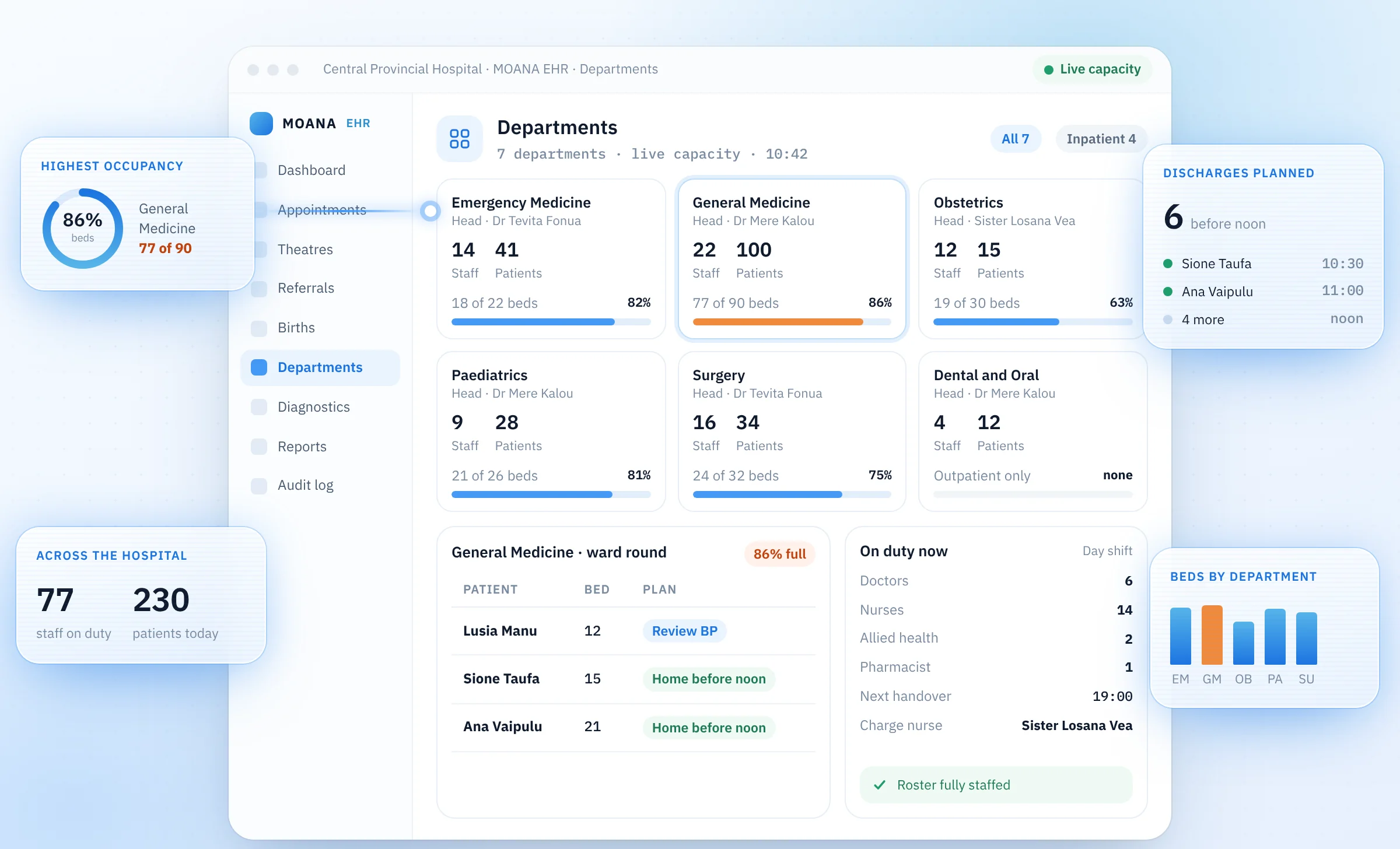
ANGAU Memorial Provincial Hospital in Lae, Papua New Guinea, the regional referral hospital for the Momase region with a catchment of about 2.8 million people, provides a reference example. Every department has been mapped and configured in Moana with its Officer in Charge, and go live is expected in the coming weeks; the Consultation Clinic is already live in the Moana system. The engagement began with Emergency, Registration and Admissions and extended to the wards, and then to services outside the original clinical scope, such as Catering and Maintenance, which asked to be included. The detail of that method is set out in implementing an EHR from workflow mapping to go live and in the ANGAU case study.
How Moana approaches this
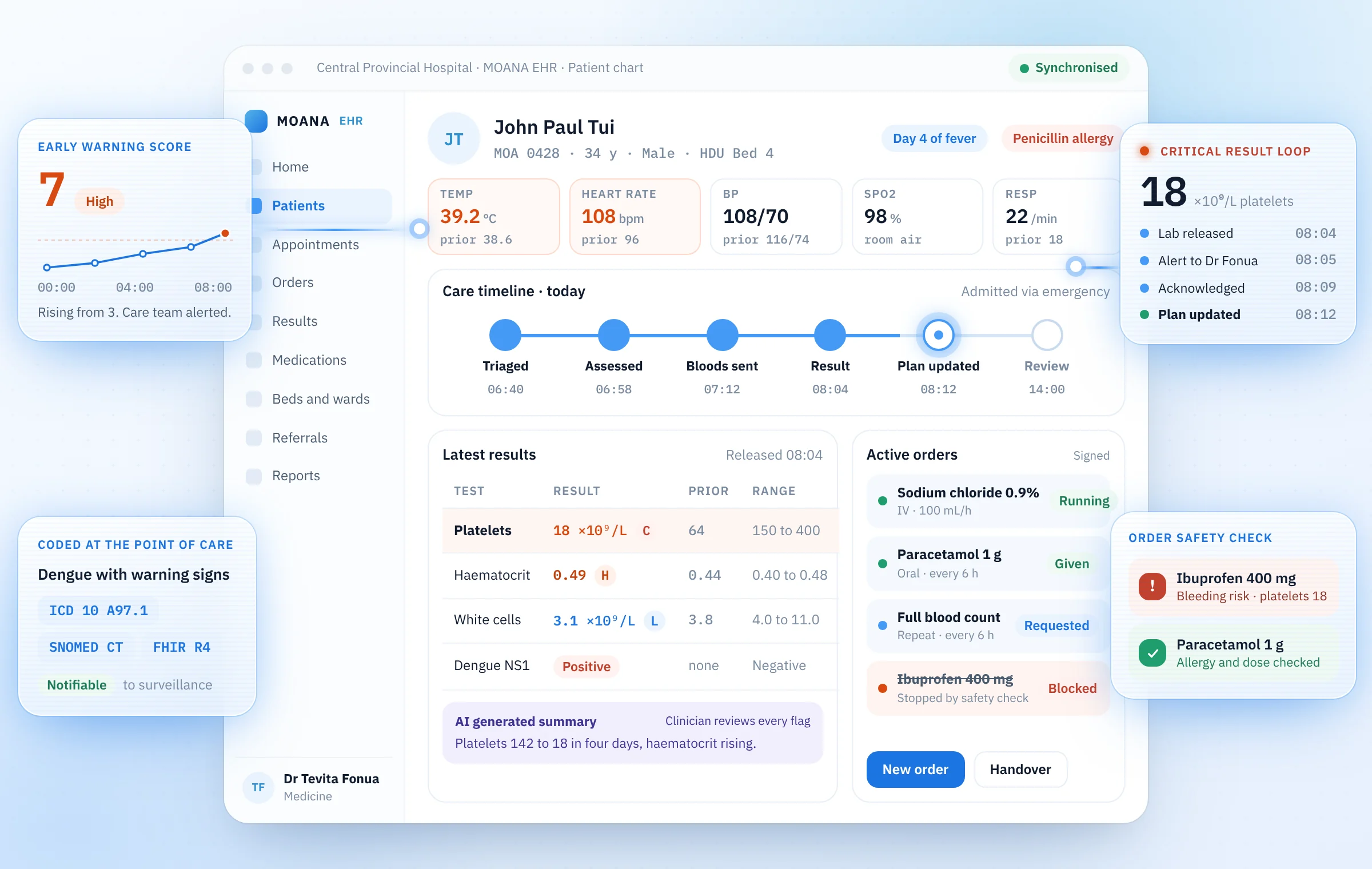
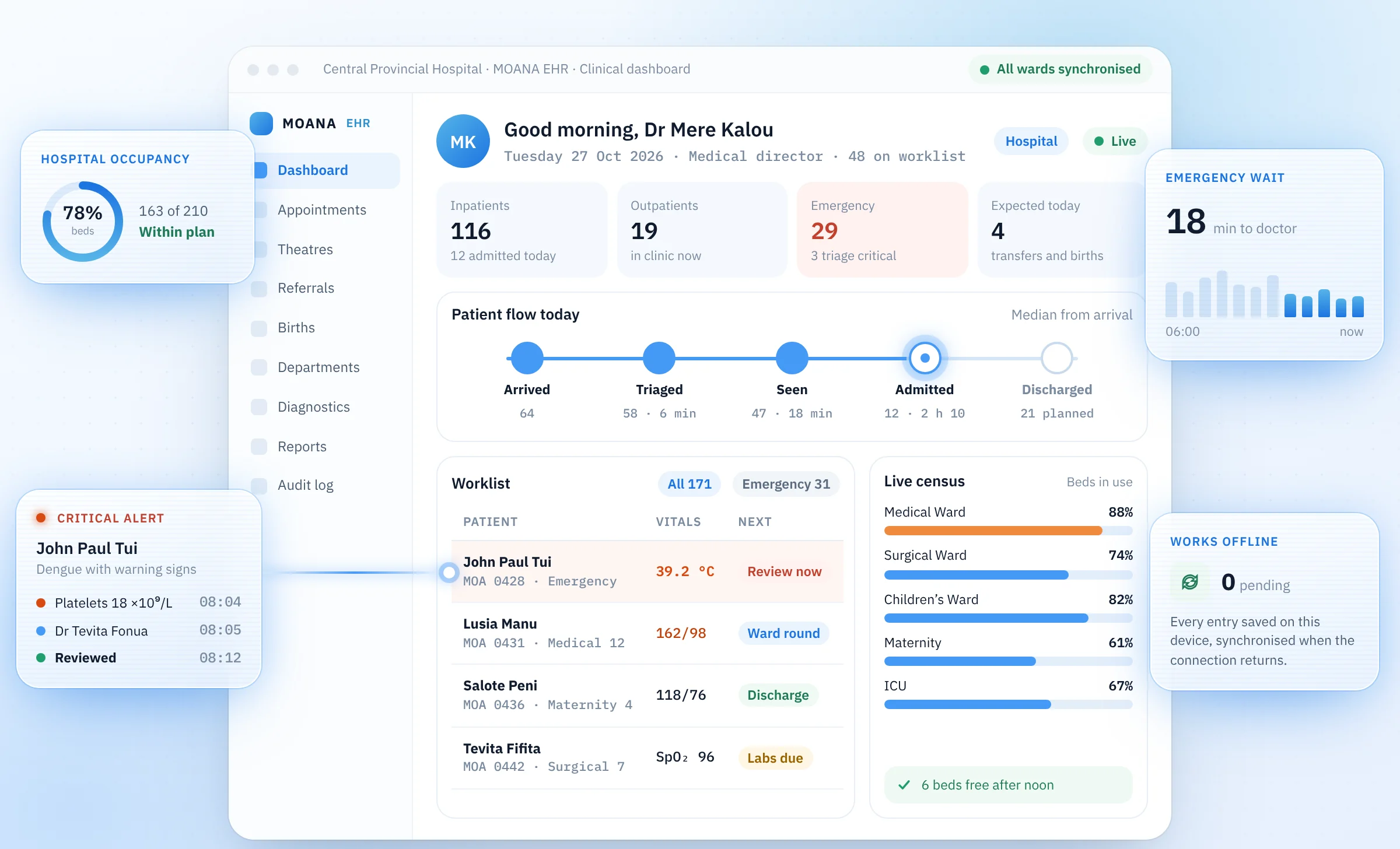
Moana is a hospital information system built on one patient record. Every department, from registration to the laboratory, pharmacy, radiology, wards and administration, reads from and writes to that record, so a result, a prescription or a transfer is visible to the next person who needs it without being recorded again.
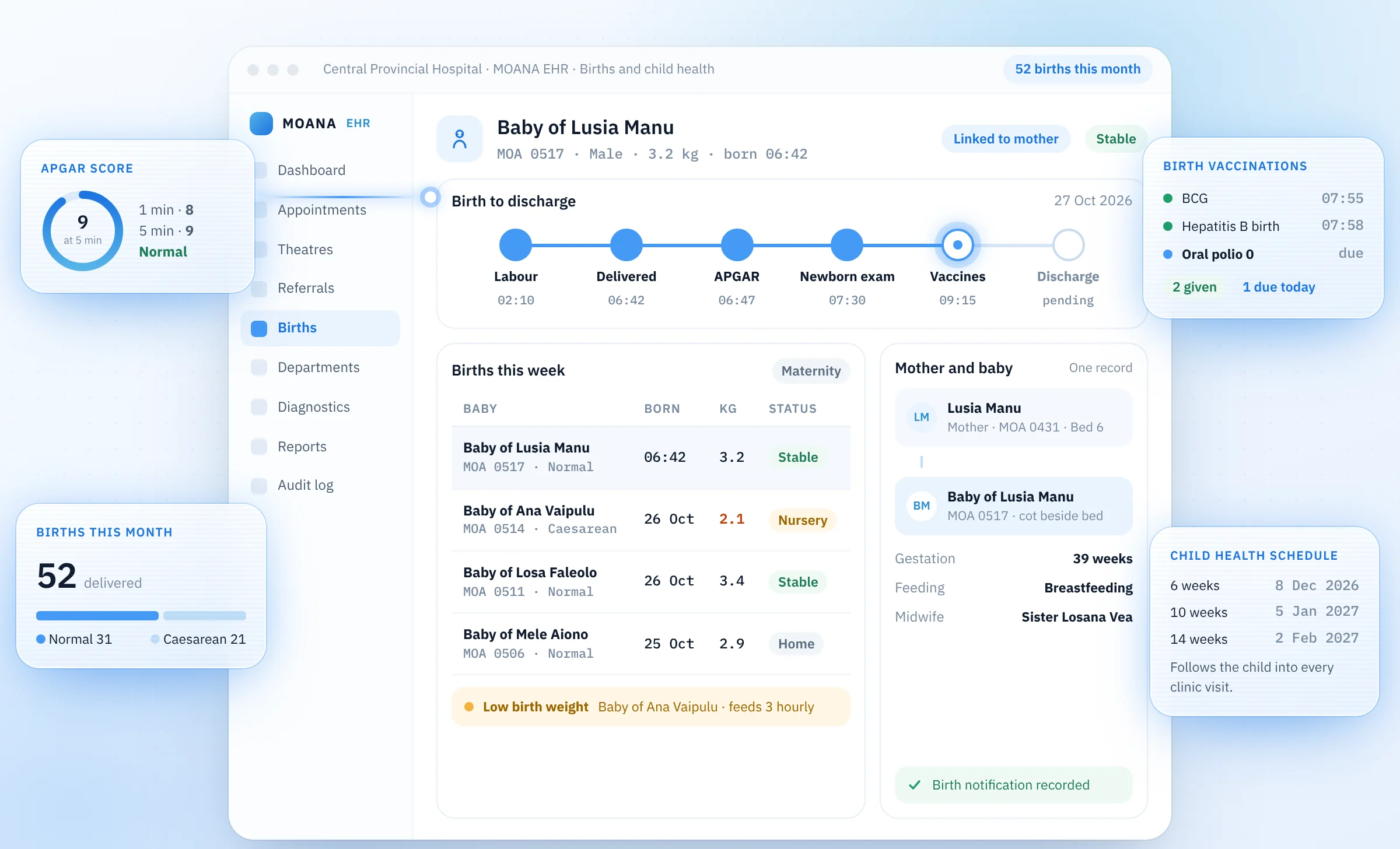
Clinical staff work in MOANA Desktop, which provides role based workspaces for doctors, nurses, pharmacy, laboratory, radiology and administration. The electronic health record holds visits, observations, orders, notes and alerts. Hospital operations covers beds and wards, theatres, appointments, referrals, billing and analytics. Diagnostic services run on MOANA LIS and MOANA PACS, and medicines on the Moana Pharmacy Management System, with interaction and allergy checks, pharmacist verification and batch and expiry tracking. The maternal and child pathway links each baby's record to the mother's at birth.
Facility service levels match the features available to the level of the facility, so a provincial hospital and a district clinic run the same platform with the scope each needs. Moana is designed for unreliable connectivity: work is saved on the device and synchronised when the connection returns, and the same platform performs equally on stable networks.
For national fit, Moana supports FHIR R4, SMART on FHIR app launch, FHIR bulk export and HL7 v2, with ICD 10, ICD 11, SNOMED CT and LOINC, and reports into DHIS2. Role based access, two factor authentication, audited break glass access, encryption, consent for sharing and a full audit log are standard, and the organisation that collects the data owns it.
Moana is live across clinics in Pakistan and in clinics in the South Pacific. Implementation starts with whole hospital workflow mapping, department by department, as described in how Moana works.
Key questions for procurement
Does every module share one patient record?
Ask the supplier to demonstrate a patient moving from emergency to the ward with a laboratory result and a prescription, and check that nothing is entered twice. Separate databases joined by interfaces are a warning sign.
How does the system behave when the network or power fails?
Ask to see a ward continue recording while disconnected, and how the records synchronise and resolve conflicts afterwards. The evidence identifies unreliable power and connectivity as a consistent barrier [4].
Can departments be configured without custom development?
The hospital's own forms and workflows, including national registry forms, should be configurable. Complex features that do not fit the workflow are a documented cause of failure [4].
How does the system report to the ministry?
National returns should be generated from recorded encounters and submitted to the existing aggregate platform, so that facility figures can be traced back to patients.
Who owns the data and where is it hosted?
The contract should state that the hospital or ministry owns the data, and hosting should comply with national policy.
What is the plan for training and staff turnover?
Ask for the training model, the role of super users and how new staff are brought on. Staff turnover and low computer literacy are among the most frequently reported barriers [4].
Sources
- Global strategy on digital health 2020 to 2025, World Health Organization, 2021
- Global strategy on digital health 2020 to 2025: summary, World Health Organization, 2021
- New Lancet report out: high quality health systems in the Sustainable Development Goals era, University of Bergen, 2018
- Benefits and challenges of EMR implementations in low resource settings: a state of the art review, BMC Medical Informatics and Decision Making, 2016
- Implementation status of health management information system in hospitals of South West Shoa Zone, Oromia, Central Ethiopia, ClinicoEconomics and Outcomes Research, 2021
- WHO guideline: recommendations on digital interventions for health system strengthening, World Health Organization, 2019
- Investment in digital health needs careful planning: new WHO guide explains how to do it well, World Health Organization, 2020
- OpenHIE architecture specification: component specifications, OpenHIE, accessed 2026
- Principles for Digital Development, Principles for Digital Development, 2024
- FHIR R4 overview, HL7 International, 2019
- DHIS2 and the World Health Organization, HISP Centre, University of Oslo, accessed 2026
- SMART guidelines, World Health Organization, accessed 2026