EHR vs EMR vs HIS vs HMIS: which system should a ministry procure?
An EMR is the digital chart of one practice. An EHR is a patient record designed to be shared across providers. A hospital information system (HIS) runs the clinical, administrative and financial operations of a hospital around that record. A health management information system (HMIS) holds aggregate indicators for planning and reporting. Most ministries need all four layers, and the order in which they procure them determines whether the layers connect.
The acronyms are used loosely in tenders, vendor brochures and donor reports, and that looseness causes real procurement failures. A ministry that buys an HMIS expecting it to hold patient records, or a hospital that buys an EMR expecting it to run admissions and billing, ends up with a gap that is expensive to close later. This guide sets out what each term means, where it sits in a national architecture, and how to decide what to buy.
The four terms at a glance
| System | Unit of data | Primary users | Main purpose |
|---|---|---|---|
| Electronic medical record (EMR) | Individual patient, one practice | Clinicians in one facility | Replace the paper chart |
| Electronic health record (EHR) | Individual patient, across providers | Clinicians, laboratories, pharmacies, patients | Follow the patient across care |
| Hospital information system (HIS) | Patients, beds, staff, stock, finances | Clinical, administrative and management staff | Run the hospital |
| Health management information system (HMIS) | Aggregate counts and indicators | District, provincial and national managers | Plan, monitor and report |
The first three operate on individual patients. The fourth operates on totals. That distinction is the most important one in this guide.
EMR: the digital chart of one practice
The Office of the National Coordinator for Health Information Technology in the United States describes the EMR as a digital version of the paper chart, containing the medical and treatment history of the patients in one practice [1]. An EMR improves legibility, retrieval and some forms of tracking within that practice. Its limitation is that information does not easily leave it. When a patient is referred, the history is printed, faxed or summarised by hand.
An EMR is a reasonable purchase for a single private clinic with no need to exchange information. It is rarely the right purpose for public funding, because public health systems depend on information moving between facilities.
EHR: the record that follows the patient
The same ONC guidance describes EHRs as designed to reach beyond the organisation that originally collects and compiles the information [1]. In practice this means the record is shared with laboratories, specialists, other hospitals and the patient, and that it is built on standards that allow exchange.
The functional scope of an EHR is usually described using the eight core functions set out by the Institute of Medicine in 2003: health information and data, results management, order entry, decision support, electronic communication, patient support, administrative processes, and reporting for safety and surveillance [2]. The WHO classification of digital health interventions files these functions under person centred health records, including longitudinal tracking, structured clinical records and unstructured records such as notes and images [3]. A full definition and the evidence on benefits are set out in what is an electronic health record.
Hospital information system: running the hospital
A hospital information system extends beyond the clinical record to the operations of the institution: admissions and discharges, beds and wards, theatres, appointments, referrals, pharmacy stock, laboratory workflow, billing and management reporting. There is no single international standard definition of an HIS. The second edition of the WHO classification, published in 2023 to give the sector a shared language for digital health [12], has no single category for it; instead it spreads hospital functions across referral coordination, scheduling of provider activities, provider financial transactions, laboratory and diagnostics management, and prescription and medication management, alongside the health record categories [3].
That is the practical definition a ministry should use. An HIS is the set of clinical and operational functions a hospital needs, working from the same patient record. When those functions are bought separately, as a laboratory system from one supplier, a pharmacy system from another and billing from a third, the hospital pays for interfaces between them and staff re enter the same patient details several times.
Departmental systems inside the hospital
Within an HIS, several departmental systems have their own established definitions:
- Laboratory information system (LIS): transmitting and tracking diagnostic orders, tracking specimens, capturing results from devices and returning results to providers [3].
- Pharmacy information system: transmitting and tracking prescriptions, tracking medication use and reporting adverse drug effects [3].
- Radiology information system and PACS: imaging orders, worklists, image storage under the DICOM standard and reporting.
- Logistics: inventory and distribution of commodities, stock level notification and procurement [3].
A hospital can run these as modules of one platform or as separate products connected by standards. What matters is that they share the patient record and the patient identifier. Whole hospital systems for public and provincial hospitals are covered in the hospital information system guide for public hospitals.
HMIS: the national aggregate layer
The Health Metrics Network framework, published with WHO in 2008, describes a country health information system in six components: resources, indicators, data sources, data management, information products, and dissemination and use [4][5]. It divides data sources into population based sources, such as censuses, civil registration and surveys, and institution based sources, namely individual records, service records and resource records [5].
The HMIS is the system that holds routine institution based data in aggregate form. The OpenHIE architecture describes it as a system that facilitates the collection of periodic health service delivery and public health indicators from a variety of information systems, with the goal of effective use of information at facility, district and higher levels [6]. It validates and stores aggregate data and supports further aggregation, for example producing an annual report from monthly figures [6].
DHIS2 is the most widely used HMIS platform. Its developers report national scale use in more than 70 countries, representing key health data for more than 40 per cent of the world's population [7].
The essential point for procurement is that an HMIS does not replace a patient record. It holds counts of malaria cases, antenatal visits or deliveries, not the clinical history of the patient behind each count. Where those counts are compiled by hand from paper registers, data quality depends on the tally sheet. Where they are generated from patient records, they can be traced back to the encounters that produced them.
How the layers fit in a national architecture
The OpenHIE architecture sets out how these systems relate [8]:
| OpenHIE component | Role |
|---|---|
| Point of care systems | Applications clinicians use to access and update patient records |
| Interoperability layer | Coordinates messages between external systems and shared components |
| Client registry | Manages the unique identities of people receiving care |
| Facility registry | Uniquely identifies every place services are delivered |
| Health worker registry | Maintains the unique identities of health providers |
| Terminology service | Holds clinical terms mapped to standards such as ICD 10, LOINC and SNOMED |
| Shared health record | Person centred repository of records validated against the registries |
| HMIS | Stores routinely collected aggregate data for analysis |
| Logistics management information system | Commodity visibility across the supply chain |
In this model, the EMR, EHR and HIS are all point of care systems. They create the data. The registries, shared health record and HMIS are shared national services that receive it. The WHO and ITU Digital Health Platform Handbook calls this shared layer the underlying infrastructure for an interoperable and integrated national digital health system [9].
The architecture only works if point of care systems speak the same standards. A systematic review of EHR adoption in low income countries listed lack of standards and absence of interoperability among the barriers reported [10].
Which system should a ministry procure first?
The answer depends on where data is being lost today.
- If national reporting is weak but facilities still use paper, an HMIS improves aggregation and dashboards quickly, but data quality will remain limited by the paper registers beneath it.
- If hospitals cannot see a patient's results, medications or history, the priority is a point of care record covering the departments that generate those data: registration, outpatients, wards, laboratory, pharmacy and radiology.
- If the aim is both, procure point of care systems that generate national indicators from the record and report into the existing HMIS, rather than adding a parallel reporting tool.
WHO's Global strategy on digital health asks countries to adapt digital health strategies to their own health priorities and resources [11]. In practice, most ministries in low and middle income countries already operate an HMIS and lack patient level records at facility level. For them, the next investment is usually a patient record that runs the hospital and feeds the HMIS they already have.
A structured scorecard for comparing point of care systems is set out in how to choose an EHR for low and middle income countries.
How Moana covers the record, the hospital and the national layer
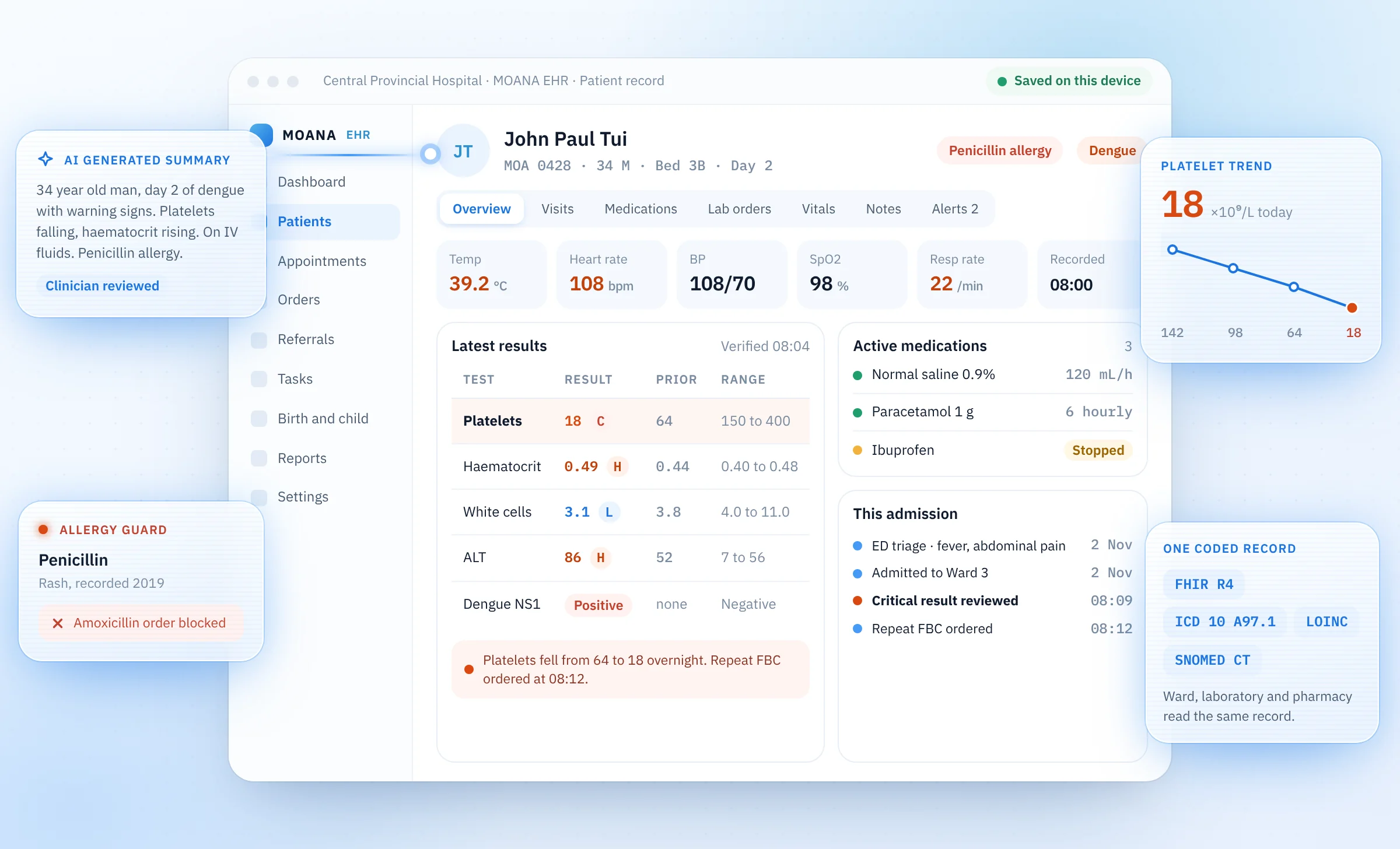
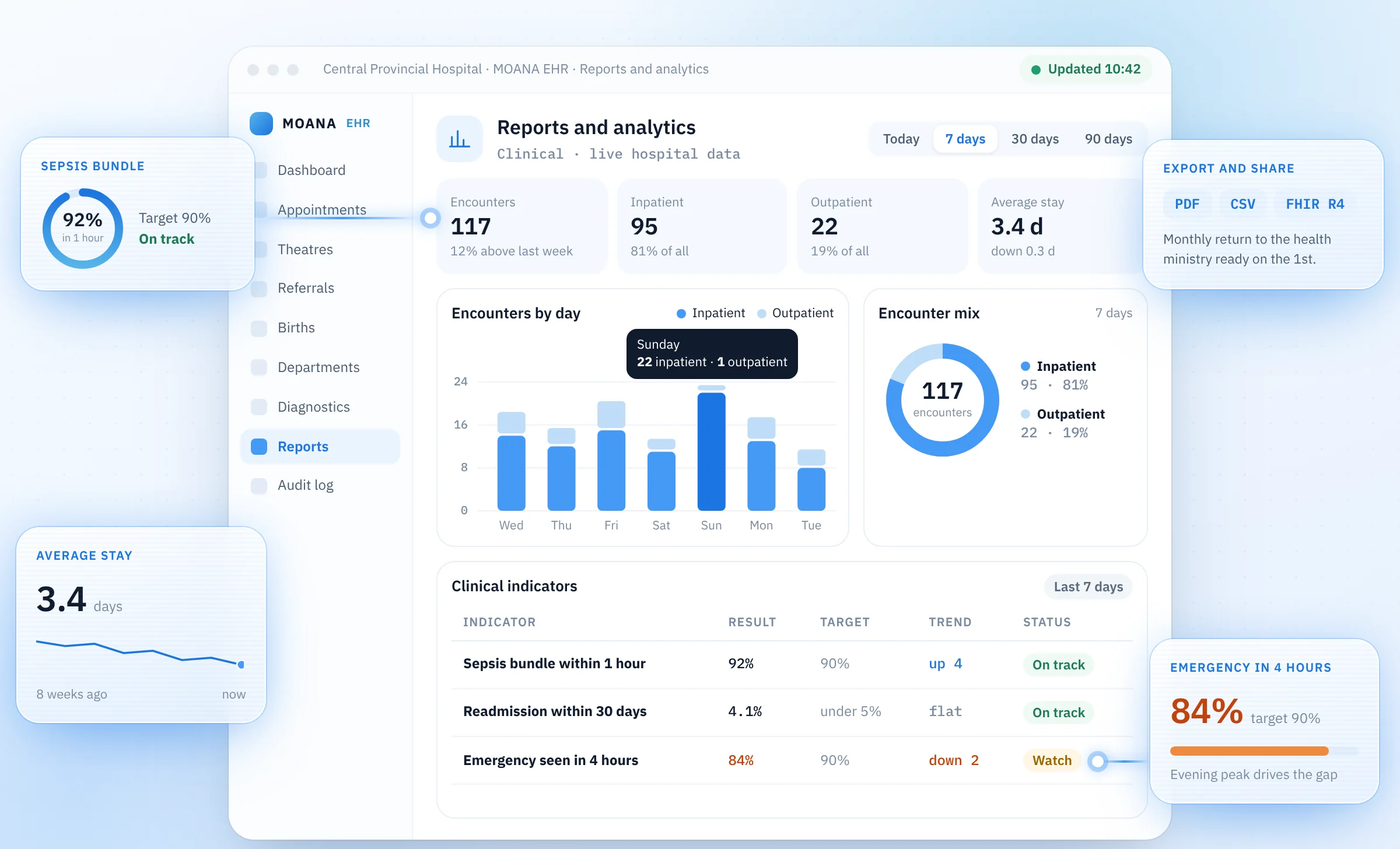
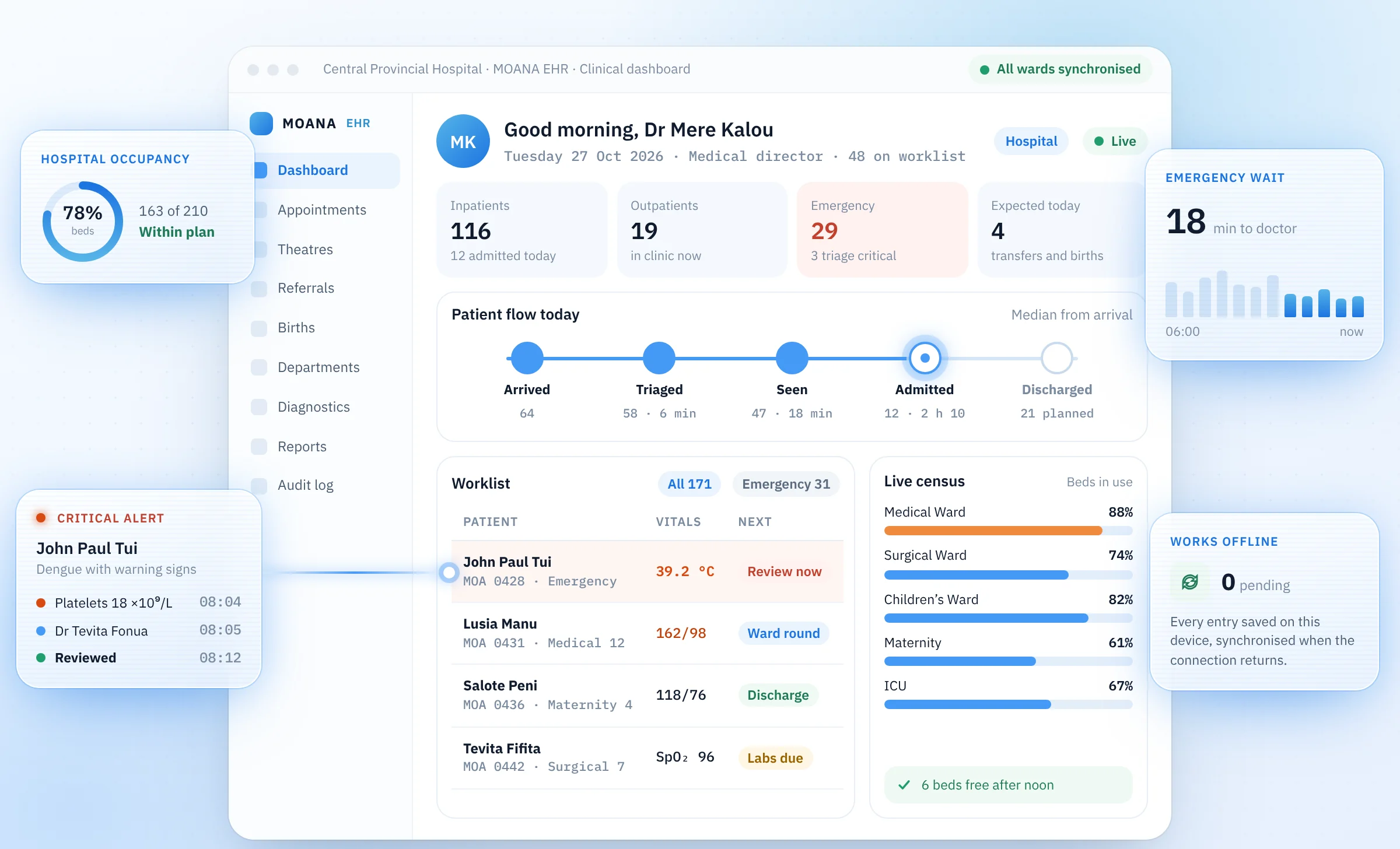
Moana is a single platform that spans the patient record and the hospital, and reports into the national layer. The Moana EHR holds one longitudinal record per patient. MOANA Desktop gives doctors, nurses, pharmacy, laboratory, radiology and administration role based workspaces on that record. Hospital operations covers beds and wards, theatres, appointments, referrals, billing and analytics, so the hospital information system functions work from the same patient rather than from copies.
The departmental systems are part of the same platform. MOANA LIS handles barcoded sample collection, Westgard quality control and analyser integration. The Moana Pharmacy Management System handles prescription verification, interaction and allergy checks, batch and expiry tracking and the controlled drug register. MOANA PACS stores and displays DICOM studies and can integrate with an existing hospital PACS. MOANA LIS and the Moana Pharmacy Management System are also available standalone for independent laboratories and pharmacies.
At the national layer, Moana generates reporting from the record and reports into DHIS2, so aggregate indicators trace back to encounters. National systems built on the same data include MOANA Surveillance, with notifiable events coded at source, and the Moana Medical Supply System for warehouse to facility stock. Interoperability is based on FHIR R4, HL7 v2, DICOM, ICD 10, ICD 11, SNOMED CT and LOINC.
Facility service levels match features to each facility, so a health centre and a referral hospital run the same platform at the scope each needs. At ANGAU Memorial Provincial Hospital in Lae, Papua New Guinea, every department has been mapped and configured with its Officer in Charge, the Consultation Clinic is already live in the Moana system, and hospital go live is expected in the coming weeks.
Key questions for procurement
Is an HMIS the same as an EHR?
No. An HMIS stores aggregate indicators for planning and reporting [6]. An EHR stores the clinical record of individual patients. A national system needs both, connected so that the indicators are generated from the records.
Is a hospital information system the same as an EHR?
Not exactly. The EHR is the patient record. A hospital information system adds the operational functions of the hospital, such as beds, theatres, billing and stock, built around that record. In a well designed platform they are the same system.
Should laboratory and pharmacy systems be bought separately?
They can be, provided they share the patient identifier and exchange data through standards. Separate purchases increase interface and support costs, and every interface is another point where data can be lost.
Can a new EHR report into our existing DHIS2?
It should. The procurement specification should require that aggregate indicators are generated from the record and submitted to the national HMIS, so that facilities do not compile the same figures twice.
Which standards should the tender specify?
At minimum FHIR R4 and HL7 v2 for exchange, DICOM for imaging, ICD 10 or ICD 11 for diagnoses, LOINC for laboratory tests, and a defined route for reporting into the national HMIS.
Sources
- EMR vs EHR: what is the difference?, Office of the National Coordinator for Health Information Technology, 2011
- US Institute publishes core capabilities for EHRs, Digital Health, 2003
- Classification of digital interventions, services and applications in health, second edition, World Health Organization, 2023
- Framework and standards for country health information systems, second edition, Health Metrics Network and World Health Organization, 2008
- Framework and standards for country health information systems, full text, Health Metrics Network and World Health Organization, 2008
- OpenHIE health management information system component, OpenHIE, 2024
- DHIS2: the world's largest HMIS, HISP Centre, University of Oslo, 2025
- OpenHIE architecture specification: overview of the architecture, OpenHIE, 2024
- Digital health platform handbook: building a digital information infrastructure for health, World Health Organization and International Telecommunication Union, 2020
- Adoption of electronic health record systems to enhance the quality of healthcare in low income countries: a systematic review, BMJ Health and Care Informatics, 2023
- Global strategy on digital health 2020 to 2025: summary, World Health Organization, 2021
- WHO publishes the second edition of the Classification of digital interventions, services and applications in health, World Health Organization, 2023