Critical Value Reporting in the Laboratory: Closing the Loop
A critical value is a laboratory result that indicates an immediate threat to the patient's life and must be communicated to a responsible clinician without delay. Closing the loop means the laboratory flags the result, reaches a named clinician within an agreed time, confirms the message by read back, escalates when no one answers, and records every step so the process can be audited.
The concept dates to the work of George Lundberg, after which laboratories accepted responsibility for alerting physicians so that timely action is possible; failing to notify is now treated as a medical error [5]. Yet the gap between a result appearing in the laboratory and a clinician acting on it remains one of the most persistent safety problems in hospital care. This guide sets out what a critical results policy must contain, what the evidence says about notification, and how a laboratory information system makes the process reliable.
Why critical results go missing
A systematic review in BMJ Quality and Safety examined twelve studies of test result follow up for hospital patients. The lack of follow up ranged from 20.04% to 61.6% of tests for inpatients and from 1.0% to 75% for emergency department patients [3]. The authors identified two areas where the problem was particularly evident: critical test results, and results for patients moving between care settings [3]. One included study found that hospital physicians were unaware of 61.6% of results returned after discharge, and that 37.1% of those were actionable [3].
The picture in low and middle income countries is less well documented, but the available studies point the same way.
- A nationwide survey of 134 clinical laboratories in Nigeria found that only 51.5% practised critical value notification, and only 33.3% of those had a written policy. Physical dispatch of the report was more common than a telephone call [6].
- A study at a tertiary hospital in Kenya, published as a preprint, found that 331 of 5,500 results (6.1%) were critical, but only 71 (21%) were documented as communicated, and clinicians were unaware of 29.6% of those [7].
Neither finding reflects carelessness. Both reflect processes that depend on a telephone, a paper register and the memory of a busy scientist on night duty.
What a critical results policy must define
The Joint Commission's National Patient Safety Goal NPSG.02.03.01 requires organisations to "report critical results of tests and diagnostic procedures on a timely basis" [4]. Its elements of performance require written procedures, developed with organisational leaders, that address three things [4]:
- the definition of critical results
- by whom and to whom critical results are reported
- the acceptable length of time between the availability and reporting of critical results
A further element requires the organisation to evaluate the timeliness of reporting [4].
WHO's laboratory quality handbook makes the same point from the laboratory side. Each standard operating procedure should state the ranges "that are life threatening (sometimes called panic values)" and the instructions for dealing with an urgent report [10]. When a result is telephoned, a record must be kept with the date, time and, wherever possible, the recipient's name, and the call must be followed by a written report [10].
CLSI GP47, Management of Critical and Significant Risk Results, provides recommendations for policies, job descriptions, reporting methods, escalation procedures and monitoring tools [9]. ISO 15189, the international standard for medical laboratory quality and competence, already required a protocol for critical results and its periodic review in its 2012 edition [8]. The 2022 edition of ISO 15189 is now the version accredited under the ILAC Arrangement [11].
Setting the critical limits
There is no single international list of critical limits. A comparison of Italian and United States practice found wide variation between laboratories, especially for high potassium, low calcium, magnesium and some haematology analytes, and argued that critical values should be limited to life threatening situations or results that require a clinical decision [5]. In Nigeria, 62.3% of laboratories practising notification used the same critical values for adults and children [6].
Good practice is consistent across these sources:
- Agree the list between laboratory and medical staff. In the College of American Pathologists Q Probes study of 121 institutions, medical staff approved the critical values list in 89% of institutions [1].
- Keep the list short. In the same study, the median share of results meeting the laboratory's critical criteria was 2% [1]. A list that generates too many calls dilutes attention.
- Set separate paediatric and neonatal limits where physiology differs.
- Review the list periodically against outcomes and against published consensus lists.
Notification, read back and escalation
Who calls and who receives
In the Q Probes study, 89% of critical results were first called to a licensed caregiver, and 96% of notification calls included read back [1]. By comparison, documented read back was reported by 62.2% of Italian laboratories surveyed, which the authors noted was still an improvement on earlier Italian data [5]. Read back means the receiver repeats the patient identity, the test and the value, and the caller confirms it. It catches transcription errors at the moment they occur.
How fast
The Q Probes study reported a median of 4 minutes from result availability to notification, and 56 minutes from collection to notification [1]. Half of laboratories called critical results before releasing them in the LIS, which saved an average of 11 minutes [1]. Using CLSI GP47, one tertiary hospital classified notification under 15 minutes as timely, 15 to 60 minutes as acceptable and over 60 minutes as inappropriate [8]. The Kenyan authors recommended communication within one hour of availability [7].
When no one answers
Escalation is where policies often fail. One tertiary hospital reduced unsuccessful notifications, particularly for outpatients, by escalating to the emergency health service when the requesting physician could not be reached, and achieved an overall unsuccessful notification rate of 0.1% [8]. A policy should name a second and third contact for every location and every hour of the day.
| Element | Minimum standard | Evidence |
|---|---|---|
| Critical list | Agreed with medical staff and reviewed periodically | Approved by medical staff in 89% of Q Probes institutions [1] |
| Receiver | A licensed caregiver responsible for the patient | 89% of calls made to a licensed caregiver [1] |
| Read back | Patient, test and value repeated and confirmed | Included in 96% of Q Probes calls [1] |
| Timeframe | Defined in policy, typically within 15 to 60 minutes | CLSI GP47 timeliness bands [8] |
| Escalation | Named alternates for every location and shift | Unsuccessful notifications reduced to 0.1% [8] |
| Documentation | Caller, receiver, date and time recorded against the result | Required by WHO guidance [10] |
What technology adds
The Centers for Disease Control and Prevention's Laboratory Medicine Best Practices review assessed practices for timely critical value reporting [2]. It recommended call centres as an evidence based practice in inpatient settings, and found that automated notification systems significantly improved timeliness in pooled studies, although the evidence was not yet sufficient for a formal recommendation [2]. The review listed the benefits of automated notification as electronic audit trails for monitoring and a prompt to re examine critical results policies, and the risks as disrupted communication, alert overload and privacy breaches [2]. It called for two way acknowledgement, escalation routes and staff competence in manual backup [2].
The lesson for system design is that automation should not replace the conversation for the most dangerous results. It should make the conversation happen sooner, make it easier to record, and make it impossible to forget. In the Q Probes study only one institution used an automated system that verified the provider had been contacted [1].
The systematic review of follow up came to a similar conclusion: evidence for electronic test management alone was limited, and the authors recommended interventions such as online endorsement of results, where the clinician acknowledges each result in the system [3].
Measuring the process
A laboratory that cannot measure notification cannot improve it. The indicators below can be produced from the LIS when every step is recorded.
- Proportion of critical results with documented notification
- Median and 90th percentile time from result verification to notification
- Proportion of notifications with documented read back
- Proportion of notifications that required escalation, and unsuccessful notifications
- Critical results by location, shift and test, to target training
The Italian survey authors called specifically for indicators such as unsuccessful notification rates and time spent on calls [5]. These indicators also give the quality manager evidence for accreditation audits, discussed in the guide on what a laboratory information system should do.
How Moana closes the loop
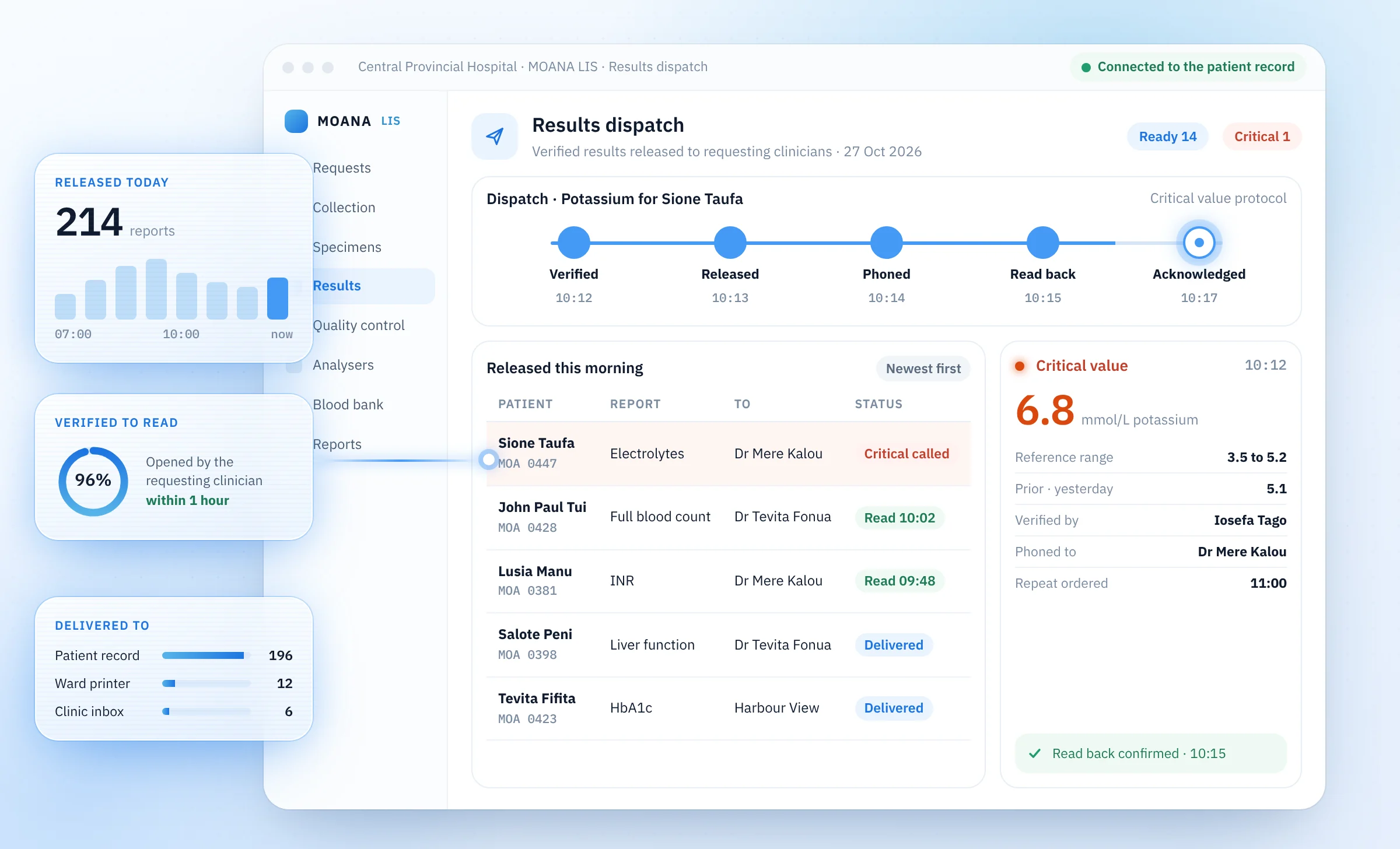
MOANA LIS treats a critical result as a task that is not complete until a clinician has received it, rather than a value that is simply printed in red.
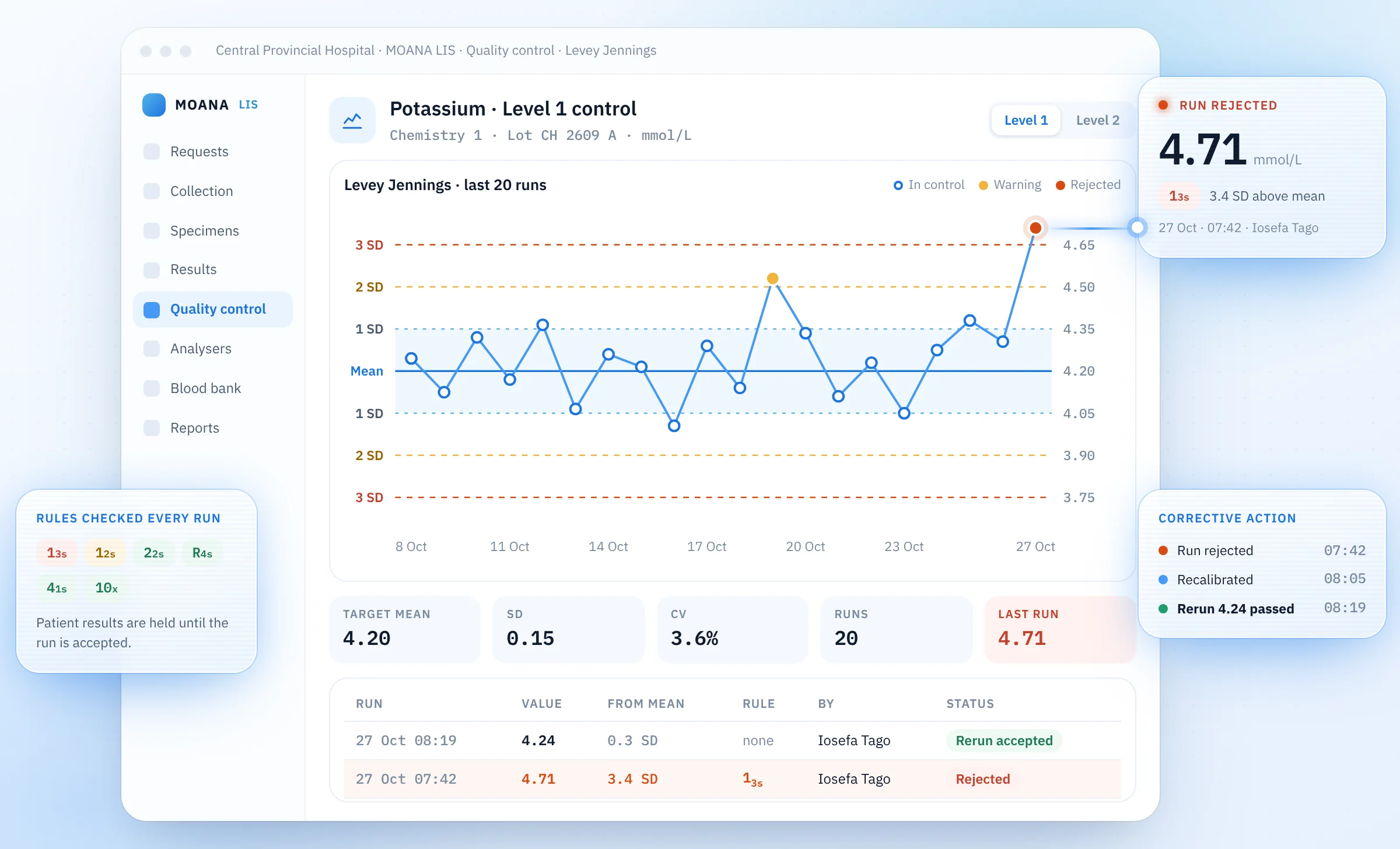
When a result breaches a critical limit, MOANA LIS raises a critical value alert. The critical limits are configured by the laboratory, so the list agreed with medical staff is the list the system applies. The flagged result is held on the results dispatch screen for notification.
The scientist records who was contacted, the time, and that read back was completed. Because the laboratory and the clinician share one patient record across the Moana platform, the verified result is also visible in the patient chart on MOANA Desktop, so the clinician sees it when they next open the record.
Every action is written to the audit log with the user and time, which gives the quality manager the evidence needed for the indicators listed above without a separate register.
MOANA LIS is designed for unreliable connectivity. If the network drops during a night shift, the notification record is saved on the device and synchronised when the connection returns, so the record of the call is not lost. On stable networks it performs the same way.
At ANGAU Memorial Provincial Hospital in Lae, Papua New Guinea, Pathology has been mapped from specimen receipt to result dispatch and configured on MOANA LIS, with go live expected in the coming weeks. Critical laboratory values are also among the triggers discussed in the guide on clinical decision support and early warning scores. The laboratories solution sets out how Moana configures this with each laboratory.
Frequently asked questions
What is the difference between a critical value and an abnormal result?
An abnormal result falls outside the reference range. A critical value falls so far outside it that it signals a high risk of imminent death or major harm and needs immediate medical action [8]. Every critical value is abnormal; very few abnormal results are critical.
Should critical values be telephoned if the result is already in the electronic record?
For true critical values, yes. The CDC review found that automated notification improves timeliness but stressed two way acknowledgement and manual backup [2]. A direct call with read back confirms that a responsible person has received the result. The electronic record then holds the documentation.
How quickly should a critical value be reported?
The timeframe should be defined in policy, as NPSG.02.03.01 requires [4]. Bands derived from CLSI GP47 treat under 15 minutes as timely and over 60 minutes as inappropriate [8].
Who should receive a critical result?
A licensed caregiver who can act on it, usually the requesting clinician or the clinician responsible for the patient at that time. The policy should name alternates for each location and shift.
How can a ministry improve critical value reporting across a laboratory network?
Publish a national consensus list with paediatric limits, require written policies as part of laboratory accreditation, and require laboratory information systems to record notification and produce timeliness indicators. Survey evidence from Nigeria shows that the absence of national recommendations contributes to variation in practice [6].
Sources
- Good news on critical values, says Q Probes audit: study findings in brief, CAP Today, College of American Pathologists, 2008
- Effective practices for the timely and accurate reporting of laboratory critical values, Centers for Disease Control and Prevention, 2012
- The safety implications of missed test results for hospitalised patients: a systematic review, BMJ Quality and Safety, 2011
- National Patient Safety Goals, Laboratory Services Program, The Joint Commission, 2024
- Assessment of critical values policies in Italian institutions: comparison with the US situation, Clinical Chemistry and Laboratory Medicine, 2010
- Critical values notification: a nationwide survey of practices among clinical laboratories across Nigeria, African Journal of Laboratory Medicine, 2023
- Do panic values cause panic? Reporting of critical laboratory results in a tertiary hospital in Kenya, medRxiv preprint, 2022
- Assessment of a laboratory critical risk result notification protocol in a tertiary care hospital and their use in clinical decision making, Biochemia Medica, 2019
- CLSI publishes a new document on management of critical and significant risk results, Lab Medicine Blog, 2015
- Laboratory quality management system: handbook, World Health Organization, 2011
- ISO 15189:2022 for medical labs published, International Laboratory Accreditation Cooperation, 2022