How to choose an EHR for low and middle income countries: a scorecard
Choosing an EHR for a low or middle income country means testing a system against the conditions it will actually face: intermittent power and connectivity, a stretched workforce, a national reporting obligation and a budget that must cover years of operation, not only the purchase. The most reliable method is a weighted scorecard covering clinical fit, resilience, interoperability, governance, implementation approach and total cost, scored through demonstrations on the buyer's own workflows.
Most failed EHR programmes in low resource settings did not fail because the software lacked features. They failed because the system did not fit the departments, could not cope with the infrastructure, did not exchange data with national systems, or could not be sustained once the initial funding ended. This guide sets out the criteria that matter, the evidence behind them, and a scorecard that a ministry or hospital board can adapt.
Start with the health system, not the software
WHO's Digital Implementation Investment Guide sets out a process for planning digital health investment that begins well before product selection: forming the team and establishing goals, identifying health system challenges and needs, determining appropriate digital interventions, planning the implementation, linking it to the enterprise architecture, developing a budget, and monitoring the implementation [1]. The guide's stated aim is investment that is needs based and produces effective, interoperable systems aligned with national architecture and country readiness [1].
The Principles for Digital Development express the same discipline in nine principles, beginning with "understand the existing ecosystem" and including "design with people", "build for sustainability" and "establish people first data practices" [2]. For an EHR procurement, these translate into three questions that should be answered before any vendor is invited:
- Which departments and facility levels are in scope, and what does each actually do today?
- Which national systems must the EHR exchange data with: the HMIS, registries, laboratory networks, insurance?
- What will it cost to operate for five years, and who pays after the first funding cycle?
What the evidence says determines success
A systematic review of 47 studies on EMR implementations in low resource settings extracted 381 success criteria and grouped them into seven categories: ethical, financial, functionality, organisational, political, technical and training [3]. Functionality was cited most often, followed by organisational issues and technical infrastructure [3].
A 2023 systematic review of EHR adoption in low income countries found the most commonly reported barriers were lack of training, poor infrastructure, lack of standards and lack of management commitment, and noted that most countries in the review remained at the pre implementation or pilot stage [4].
The infrastructure constraint is measurable. WHO and partners report that close to one billion people are served by health facilities with unreliable electricity or none at all, that more than one in ten facilities in South Asia and sub Saharan Africa have no electricity, and that half of facilities in sub Saharan Africa have unreliable power [5]. The International Telecommunication Union reports that 2.2 billion people remained offline in 2025, 96 per cent of them in low and middle income countries, and that only 23 per cent of people in low income countries use the internet [6].
Any scorecard that does not test performance under these conditions is testing a different environment from the one the system will run in.
The ten selection criteria
1. Clinical and departmental fit
The system should cover the departments in scope on one patient record: registration, outpatients, emergency, wards, maternity, laboratory, pharmacy, radiology and administration. Ask vendors to demonstrate your workflows, not their standard script. Departments outside the clinical scope, such as catering, maintenance or medical records, often reveal whether the system serves the whole facility.
2. Resilience to unreliable connectivity and power
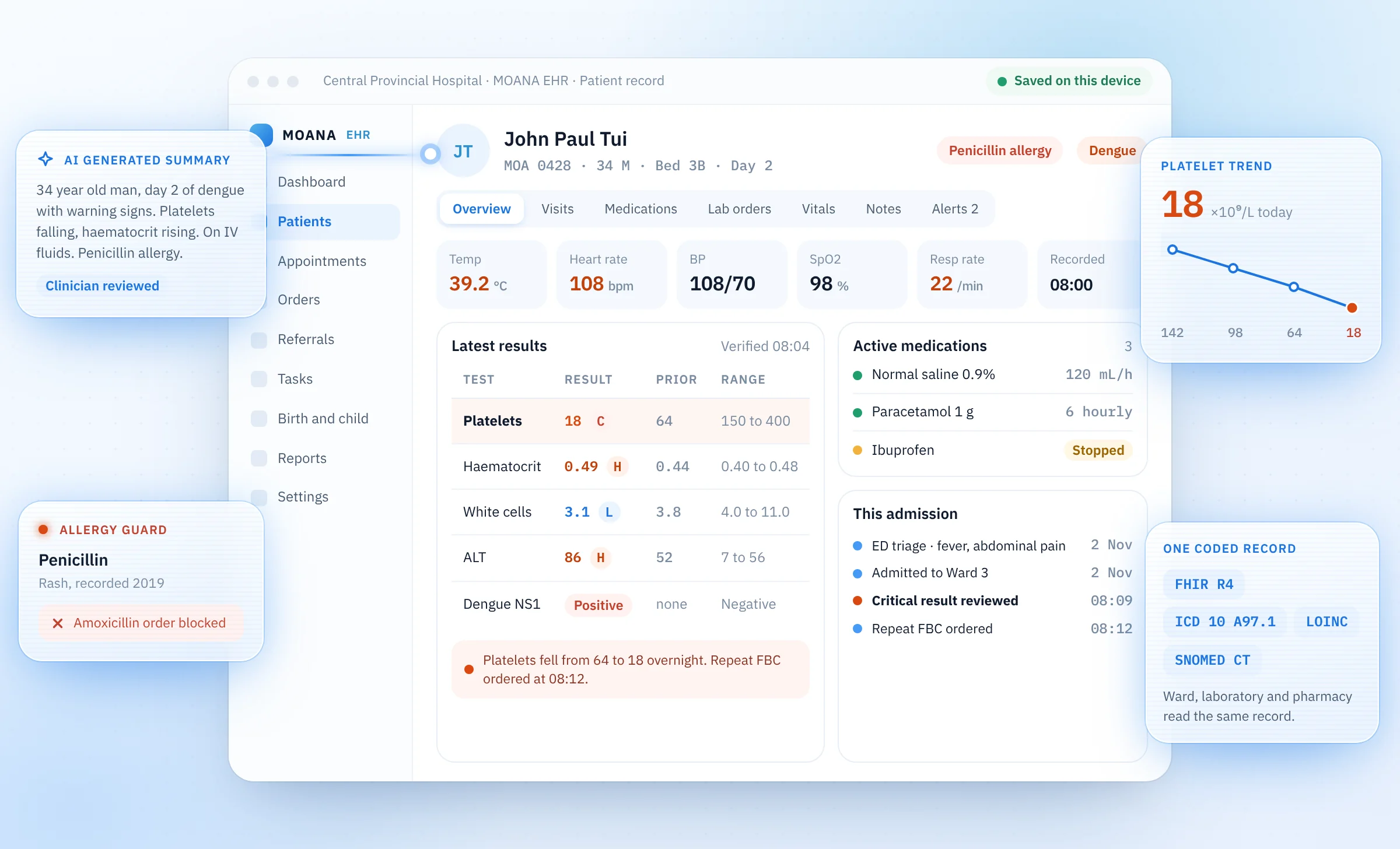
The system should save work on the device and synchronise when the connection returns, with clear handling of conflicts when two users change the same record. Test it: disconnect the network during a demonstration and continue recording. Ask what happens to queued work if a device loses power.
3. Interoperability with national systems
HL7 FHIR is the current standards framework for exchange, combining the strengths of earlier HL7 standards with modern web standards [7]. The OpenHIE architecture assumes point of care systems exchange data with a client registry, facility registry, terminology service, shared health record and HMIS [8]. Require FHIR R4, HL7 v2 for existing laboratory and hospital interfaces, and a defined route for aggregate reporting into the national HMIS.
4. Alignment with WHO guidelines
WHO SMART guidelines, which are standards based, machine readable, adaptive, requirements based and testable, provide digital adaptation kits that turn WHO recommendations for antenatal care, immunisation, HIV, tuberculosis and other programmes into operational requirements for digital systems [9]. A system that can be configured to these requirements reduces the work of aligning with national programme guidelines.
5. Clinical safety
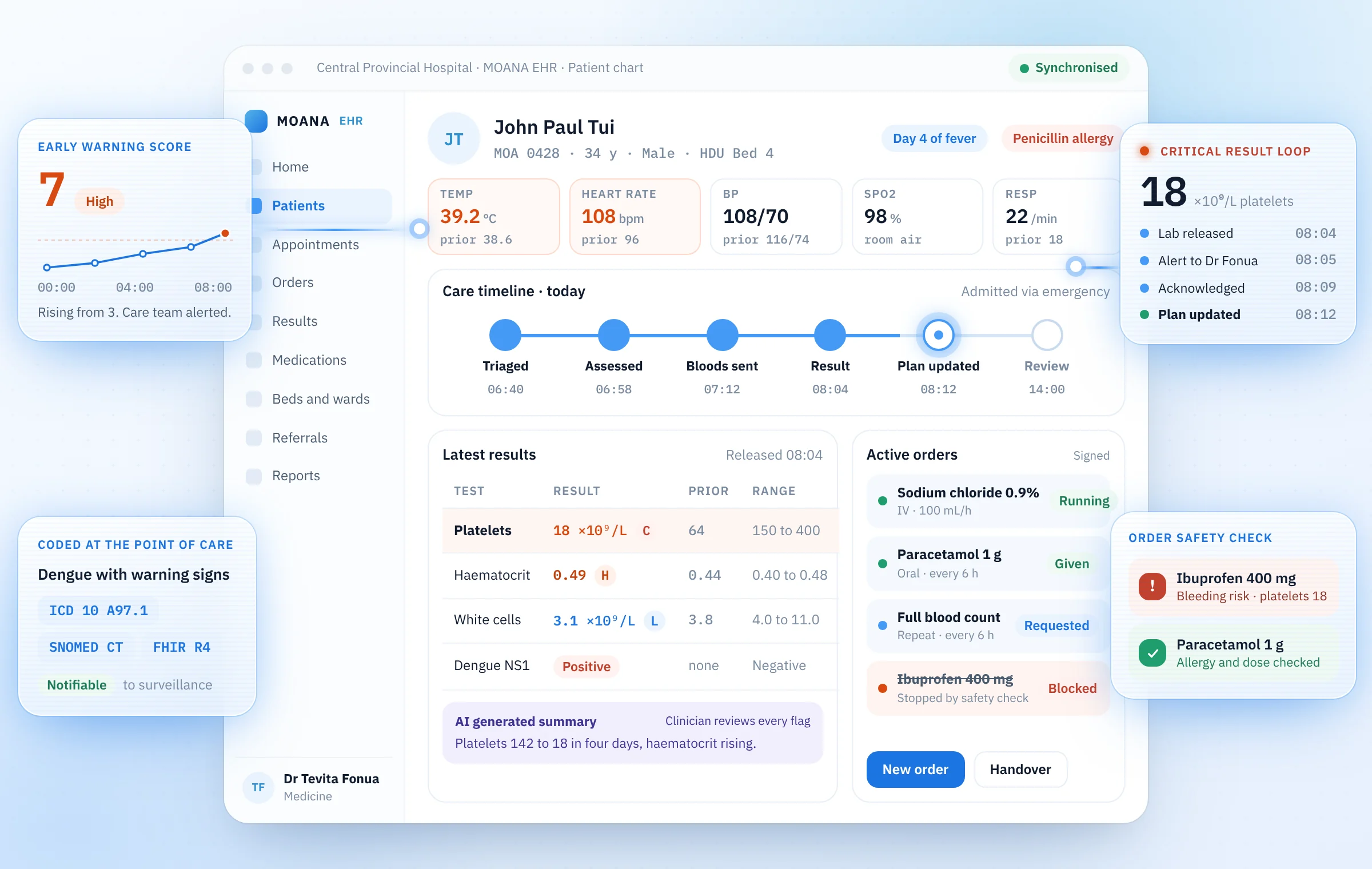
Look for interaction and allergy checking graded by severity, pharmacist verification, critical result alerts that require acknowledgement, and early warning flags. Decision support should support the clinician, not replace clinical judgement, and every alert should be reviewable.
6. Security, privacy and data ownership
WHO's third global survey on eHealth found that only 54 per cent of responding countries had legislation protecting the privacy of electronically held patient data [10]. Where national law is still developing, the contract must carry the protection: role based access, two factor authentication, audited emergency access, encryption, consent for sharing, a complete audit log and a clear statement that the health system owns its data.
7. Configurability to facility level
A national rollout spans health centres, district hospitals and referral hospitals. The same platform should configure to each level, so that a small facility is not burdened with modules it does not use and a referral hospital is not limited to primary care functions.
8. Implementation approach
Ask how the vendor maps workflows, who configures each department, how training is delivered and how go live is phased. The success criteria review found that training and skilled personnel featured in only about 10 per cent of the papers reviewed [3], yet lack of training was the most frequently reported barrier in low income countries [4]. A vendor's implementation method deserves as much weight as its software.
9. Total cost of ownership
Budget the full lifecycle. Digital Square's analysis of costed national digital health roadmaps found that operations costs were largely missing from the roadmaps, and estimated that ongoing operations make up roughly half of total cost [11]. Costs are covered in detail in the total cost of ownership of an EHR.
10. Evidence of operation in comparable settings
Ask where the system is live, in what kind of facilities, and on what connectivity. Visit or call a reference site. Distinguish clearly between live sites, configured sites and pilots.
A weighted evaluation scorecard
The weights below are a starting point. A ministry focused on national reporting may raise interoperability; a hospital board may raise clinical fit. Score each criterion from 0 to 5 through scripted demonstrations and reference checks, then multiply by the weight.
| Criterion | Weight | What a score of 5 looks like |
|---|---|---|
| Clinical and departmental fit | 20 | All in scope departments demonstrated on one record using the buyer's workflows |
| Resilience to connectivity and power | 15 | Work continues during a live disconnection and synchronises without loss |
| Interoperability | 15 | FHIR R4, HL7 v2 and HMIS reporting demonstrated, not only listed |
| Clinical safety | 10 | Severity graded checks, critical result acknowledgement, auditable alerts |
| Security and data ownership | 10 | Role based access, two factor authentication, audit log, ownership in contract |
| Implementation approach | 10 | Documented workflow mapping, department level configuration, training plan |
| Total cost of ownership | 10 | Five year cost with operations, support and training itemised |
| Configurability to facility level | 5 | Features switch by facility level without separate products |
| WHO guideline alignment | 3 | Configurable to relevant digital adaptation kits |
| Comparable live sites | 2 | Verifiable live sites in similar settings |
| Total | 100 |
Two practical rules improve the reliability of the score. First, score only what is demonstrated; a feature on a slide scores zero. Second, include clinicians, nurses, laboratory and pharmacy staff on the evaluation panel, because they will find the gaps a procurement officer cannot.
Aligning the choice with national strategy
The WHO Global Digital Health Monitor, built on the WHO and ITU National eHealth Strategy Toolkit, assesses national digital health across seven pillars: leadership and governance, strategy and investment, legislation, policy and compliance, services and applications, infrastructure, standards and interoperability, and workforce [12][13]. An EHR selection touches all seven. Before tendering, check the country's current assessment and make sure the chosen system strengthens the weak pillars rather than depending on them. For example, where infrastructure scores low, resilience to unreliable connectivity should carry more weight.
Where a ministry is also deciding between record types and national systems, EHR vs EMR vs hospital information system sets out how the layers fit together.
How Moana answers the scorecard
Moana is designed to be evaluated on the buyer's own workflows. Implementation begins with mapping every department in scope with the people who do the work, then configuring each department before moving to the next. At ANGAU Memorial Provincial Hospital in Lae, Papua New Guinea, the regional referral hospital for the Momase region with a catchment of about 2.8 million people, every department has been mapped and configured with its Officer in Charge, including services outside the original clinical scope. The Consultation Clinic is already live in the Moana system and hospital go live is expected in the coming weeks. The method is set out in how Moana works and the ANGAU case study.
On clinical fit, the Moana EHR holds one record per patient across outpatients, emergency, wards, maternity, laboratory, pharmacy and radiology, with hospital operations for beds, theatres, appointments, referrals and billing. On resilience, Moana is designed for unreliable connectivity: work is saved on the device and synchronised when the connection returns, conflicts are held for review, and the platform performs equally on stable networks. This is described on how Moana works everywhere.
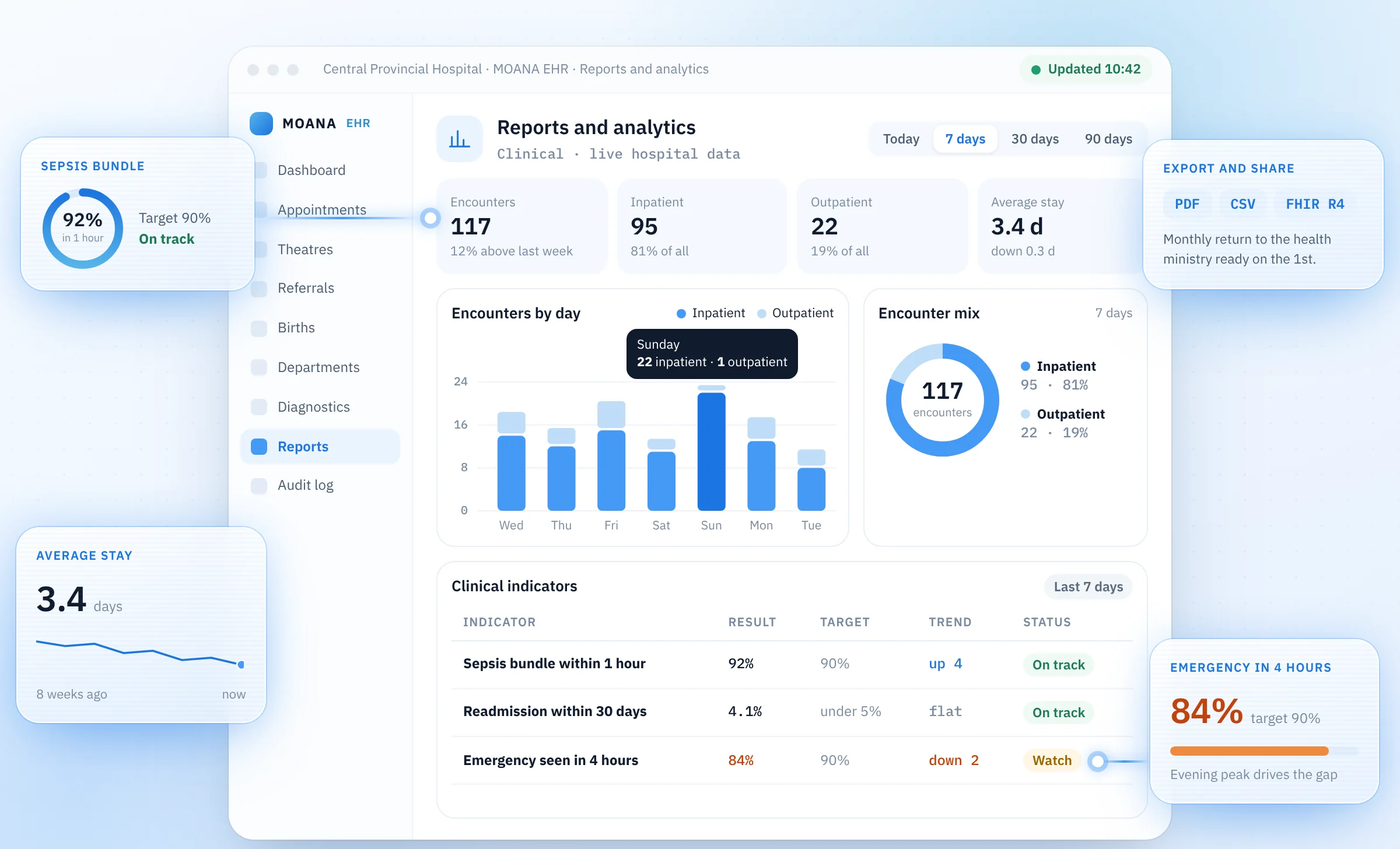
On interoperability, Moana supports FHIR R4, SMART on FHIR app launch, FHIR bulk export, HL7 v2 and DICOM, with ICD 10, ICD 11, SNOMED CT and LOINC, and reports into DHIS2. On safety, prescribing includes interaction and allergy checks graded by severity and pharmacist verification; MOANA LIS raises critical value alerts with read back; clinical rules flag patients by severity and an AI generated summary supports the clinician, who reviews every flag. On security, Moana provides role based access, two factor authentication, audited break glass access, encryption, consent for sharing and a full audit log, and the organisation that collects the data owns it, as set out on the trust page. Facility service levels match features to each facility's level.
Moana is live across clinics in Pakistan, clinics in the South Pacific and India.
Key questions for procurement
What are the most important criteria when choosing an EHR in a low income setting?
Clinical fit across departments on one record, resilience to unreliable connectivity, interoperability with national systems and a realistic total cost of ownership. The evidence shows functionality, organisation and infrastructure are the most frequently cited success factors [3].
How should we test performance on poor connectivity?
Disconnect the network during the demonstration and continue registering patients, recording vitals and placing orders. Then reconnect and confirm that every entry synchronised, and ask how conflicting edits are handled.
Should we require FHIR?
Yes. FHIR R4 is the basis for modern exchange and for national architectures such as OpenHIE. Also require HL7 v2 where existing laboratory or hospital systems use it, and a defined route into the national HMIS.
How many vendors should be shortlisted for demonstration?
Enough to compare approaches, usually three to five. Each should receive the same scripted scenarios drawn from your own departments, and the same evaluation panel should score all of them.
How do we avoid choosing a system that cannot be sustained?
Require a five year cost covering operations, support, training and hardware replacement, and confirm who funds each line after the first funding cycle. Operations account for roughly half of total cost in published estimates [11].
What should a reference check cover?
Whether the system is live or in pilot, which departments use it daily, how it performs on the site's connectivity, how support requests are handled and how long go live took.
Sources
- Digital implementation investment guide: integrating digital interventions into health programmes, World Health Organization, 2020
- Principles for Digital Development, Principles for Digital Development, 2024
- Success criteria for electronic medical record implementations in low resource settings: a systematic review, Journal of the American Medical Informatics Association, 2015
- Adoption of electronic health record systems to enhance the quality of healthcare in low income countries: a systematic review, BMJ Health and Care Informatics, 2023
- Close to one billion people globally are served by health care facilities with no electricity access or with unreliable electricity, World Health Organization, 2023
- Facts and Figures 2025, International Telecommunication Union, 2025
- FHIR R4 summary, HL7 International, 2019
- OpenHIE architecture specification: overview of the architecture, OpenHIE, 2024
- SMART guidelines, World Health Organization, 2024
- Global diffusion of eHealth: making universal health coverage achievable, World Health Organization, 2016
- Calculating the cost of digital health transformation, Digital Square at PATH, 2023
- Global Digital Health Monitor, World Health Organization, 2024
- National eHealth strategy toolkit, World Health Organization and International Telecommunication Union, 2012