ICD 10, ICD 11, SNOMED CT and LOINC: roles and licensing explained
ICD is the WHO classification used to count and report diseases and causes of death. SNOMED CT is a detailed clinical terminology for recording what clinicians observe and do. LOINC identifies laboratory tests and other clinical observations. A well designed record uses all three, and their licences differ: ICD 11 and LOINC are free to use under published conditions, while SNOMED CT is free in its member countries and requires an affiliate licence, and in some cases fees, elsewhere.
Most debates about health data quality end at the same place: the data was captured, but not coded in a way that another system, or the ministry, could use. Two hospitals may both record "malaria". One means a clinical suspicion, the other a positive rapid test, and neither used a code. The terminologies in this guide exist to remove that ambiguity. Each was designed for a different job, and choosing between them is usually a mistake. The useful question is which terminology belongs at which point in the record.
Classification, terminology and observation codes
The three code systems answer different questions.
| ICD 10 and ICD 11 | SNOMED CT | LOINC | |
|---|---|---|---|
| Type | Statistical classification | Clinical terminology | Observation identifiers |
| Question it answers | How many cases of each disease, and of what cause of death? | What exactly did the clinician find or do? | Which test or measurement was performed? |
| Owner | World Health Organization | SNOMED International | Regenstrief Institute |
| Typical place in the record | Discharge diagnosis, mortality, national returns | Problem list, findings, procedures, allergies | Laboratory orders and results, clinical measurements |
| Scale | About 17,000 unique codes in ICD 11 [1] | More than 360,000 concepts [5] | More than 100,000 concepts [11] |
A classification groups conditions into categories so that they can be counted consistently across countries and years. A terminology aims to represent clinical meaning at the level of detail a clinician needs. Observation codes identify what was measured so that a result from one laboratory can be compared with a result from another. The exchange standards that carry these codes are described in HL7 v2, FHIR, DICOM and IHE: which standard does what.
ICD 10 and ICD 11
The International Classification of Diseases is the basis of international mortality and morbidity statistics. The 72nd World Health Assembly adopted ICD 11 in May 2019, and it came into effect on 1 January 2022 [3][2]. WHO's 2022 release describes ICD 11 as containing around 17,000 unique codes and more than 120,000 codable terms, and as entirely digital [1]. At that release 35 countries were already using it [1].
ICD 11 was designed for electronic systems. WHO provides a coding tool, a multilingual API, offline functionality and the option to deploy the ICD API locally [1]. WHO also states that ICD 11 does not need any additional terminology in order to be used [2].
The transition from ICD 10
WHO stopped maintaining ICD 10 in 2018, and future enhancements will be made only in ICD 11 [2]. Countries can continue to use ICD 10 for as long as necessary, although prompt adoption of ICD 11 is encouraged [2]. Two points matter for planning:
- Mapping tables are not a migration. WHO publishes mapping tables to help compare data across revisions, but states that they are not intended for directly converting data, and that relying on them instead of full implementation will likely result in data gaps and inaccuracies [2].
- Systems should hold both. A country moving from ICD 10 to ICD 11 will have years of historical data in ICD 10 and new data in ICD 11. The record and the reporting layer should store which revision each code came from.
ICD licensing
WHO provides free access to ICD 11 for all users, subject to its licence [2]. The classifications are licensed under Creative Commons Attribution NoDerivs 3.0 IGO, which permits commercial and non commercial use provided the codes are not adapted and the work is cited; access to the codes through the API requires registration [4]. Translations require written agreements with WHO, and translation rights are granted to governments [4].
SNOMED CT
SNOMED International describes SNOMED CT as the most comprehensive multilingual clinical healthcare terminology in the world, covering diagnoses, signs, symptoms, procedures, body structures, organisms and substances [5]. It contains more than 360,000 concepts [5]. Each concept has a unique numeric identifier of up to 18 digits, human readable descriptions (a fully specified name and synonyms), and relationships to other concepts [5]. Concepts are arranged from general to specific, and because a concept can have more than one parent, the structure is a polyhierarchy [5].
That structure is what makes SNOMED CT valuable in a record. A query for all patients with any form of pneumonia can find every more specific concept beneath it, without a list of codes being maintained by hand.
SNOMED International is the not for profit organisation that owns and administers SNOMED CT [9]. Its Members are national government agencies or bodies endorsed by a national government. Each pays a fee based on national wealth and holds a seat on the General Assembly, and in each country a National Release Centre coordinates use of SNOMED CT [9].
How SNOMED CT is licensed
Licensing is where SNOMED CT differs most from the other terminologies, and where procurement documents most often go wrong.
- Member countries. SNOMED International does not charge for licensed use of SNOMED CT in Member countries; Members may charge within their country only for cost recovery [6]. The Members page lists 54 Members: 9 in the Americas, 33 in Europe, the Middle East and Africa, and 12 in Asia Pacific [7].
- Non member territories. Use in a territory that is not a Member incurs fees that depend on the wealth of the country where SNOMED CT is used, and intended use must be reported before it begins through the Member Licensing and Distribution Service [6]. Fee waivers may apply to limited use in approved research and public good initiatives [6].
- Affiliates and sublicences. Organisations that develop or distribute SNOMED CT enabled products must be SNOMED International Affiliates. Every organisation that uses SNOMED CT must be either an Affiliate or a sublicensee of one, and Affiliates must issue and report sublicences [6].
- Low income countries. Countries classified by the World Bank as low income can request implementation support. SNOMED International reported in 2021 that it had provided four licences for low income countries: two to Ethiopia, one to Rwanda and one to Yemen [8].
- Free subsets. The Global Patient Set, a managed collection of SNOMED CT reference sets published every September, is free [8]. Agreements with DICOM in 2016 and HL7 in 2019 provide further free content, including a set of more than 8,000 terms for the International Patient Summary [8].
The 12 Asia Pacific Members listed are Australia, Brunei, Hong Kong China, India, Indonesia, Malaysia, Mongolia, New Zealand, the Republic of Korea, Singapore, Thailand and Uzbekistan [7]. No Pacific Island country appears on the list. A Pacific ministry planning to use SNOMED CT in production should therefore plan for an affiliate licence and the associated reporting from the outset, or consider membership.
LOINC
LOINC (Logical Observation Identifiers Names and Codes) is the international terminology standard for identifying health observations, providing universal codes and names for laboratory and clinical observations [11]. It contains more than 100,000 concepts [11]. Its first release, LOINC 1.0, contained more than 6,000 laboratory test results; the 100,000th code was released with version 2.75 [12].
A LOINC code identifies the test, not the answer. A haemoglobin measurement in blood has a LOINC code; the value and unit are recorded alongside it. When two laboratories use the same LOINC code, their results can be trended together in the record, combined in surveillance and compared in quality programmes.
LOINC is free. Its licence permits use, copying and distribution for any commercial or non commercial purpose without licence fees or royalties [10]. The conditions are that LOINC must not be used to create a competing standard, the contents of its core fields must not be changed, and products that include LOINC content must carry the published attribution notice [10].
LOINC and SNOMED CT together
In March 2025 SNOMED International and Regenstrief renewed their collaboration agreement and announced the LOINC Ontology, an extension of SNOMED CT's ontological framework that creates SNOMED CT and LOINC codes for shared concepts [13]. The first release covers quantitative laboratory tests with more than 35,000 concepts, with releases planned twice a year [13]. In the announcement's words, SNOMED CT provides the computable framework and LOINC provides laboratory and pathology content [13].
How the three work together in one encounter
Consider a child brought to an outpatient clinic with fever.
| Point in the record | What is recorded | Code system |
|---|---|---|
| Presenting complaint and findings | Fever, rigors, pallor | SNOMED CT |
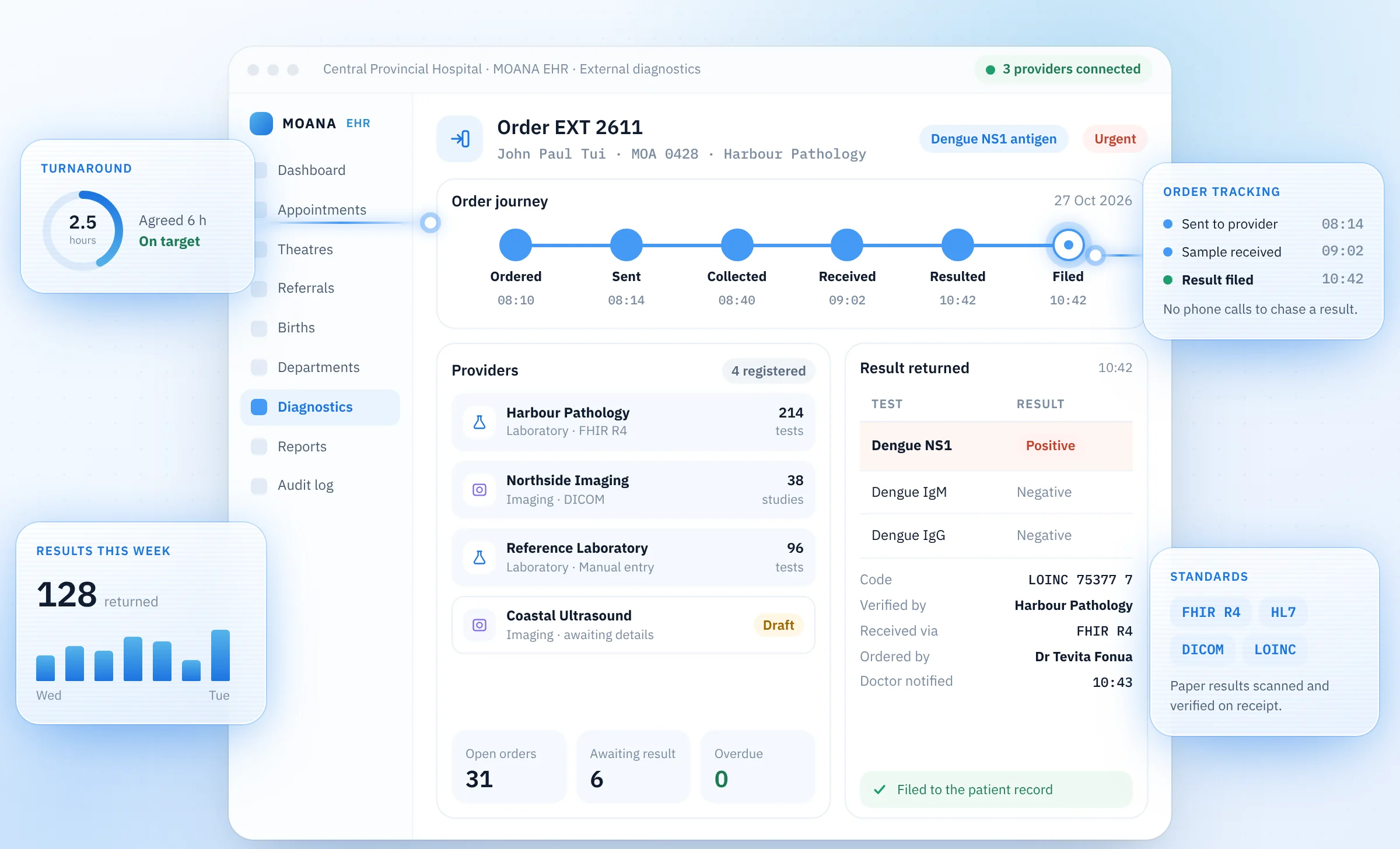
| Test ordered | Malaria rapid diagnostic test, blood film, haemoglobin | LOINC |
| Result interpretation | Organism identified | SNOMED CT |
| Final diagnosis for reporting | Malaria due to the identified species | ICD 10 or ICD 11 |
| National return | Count of confirmed malaria cases by facility | ICD categories aggregated |
The clinician should not have to choose codes from three lists. A good system captures clinical meaning once and derives the reporting code from it, so the national return is a by product of care rather than a second act of data entry. This principle is developed further in traceable national health reporting.
WHO's collaboration agreement with HL7 includes supporting the WHO Family of International Classifications within the FHIR community [14], which is how ICD codes travel between systems in a modern architecture.
Setting a national terminology strategy
A ministry can settle most terminology questions with five decisions:
- Reporting classification. Confirm whether national returns and mortality reporting will use ICD 10 or ICD 11, and the date of any transition.
- Laboratory codes. Adopt LOINC for laboratory orders and results, starting with the tests on the national essential diagnostics list.
- Clinical terminology. Decide whether SNOMED CT will be used, and if so whether through national membership or affiliate licensing, and which subsets will be used first.
- Local lists. Maintain national lists, such as essential medicines, facility codes and programme indicators, and map them to the international systems.
- Governance. Assign an owner for terminology releases, mapping and change control. Every code system publishes updates; someone must decide when they enter national systems.
How Moana approaches clinical terminology
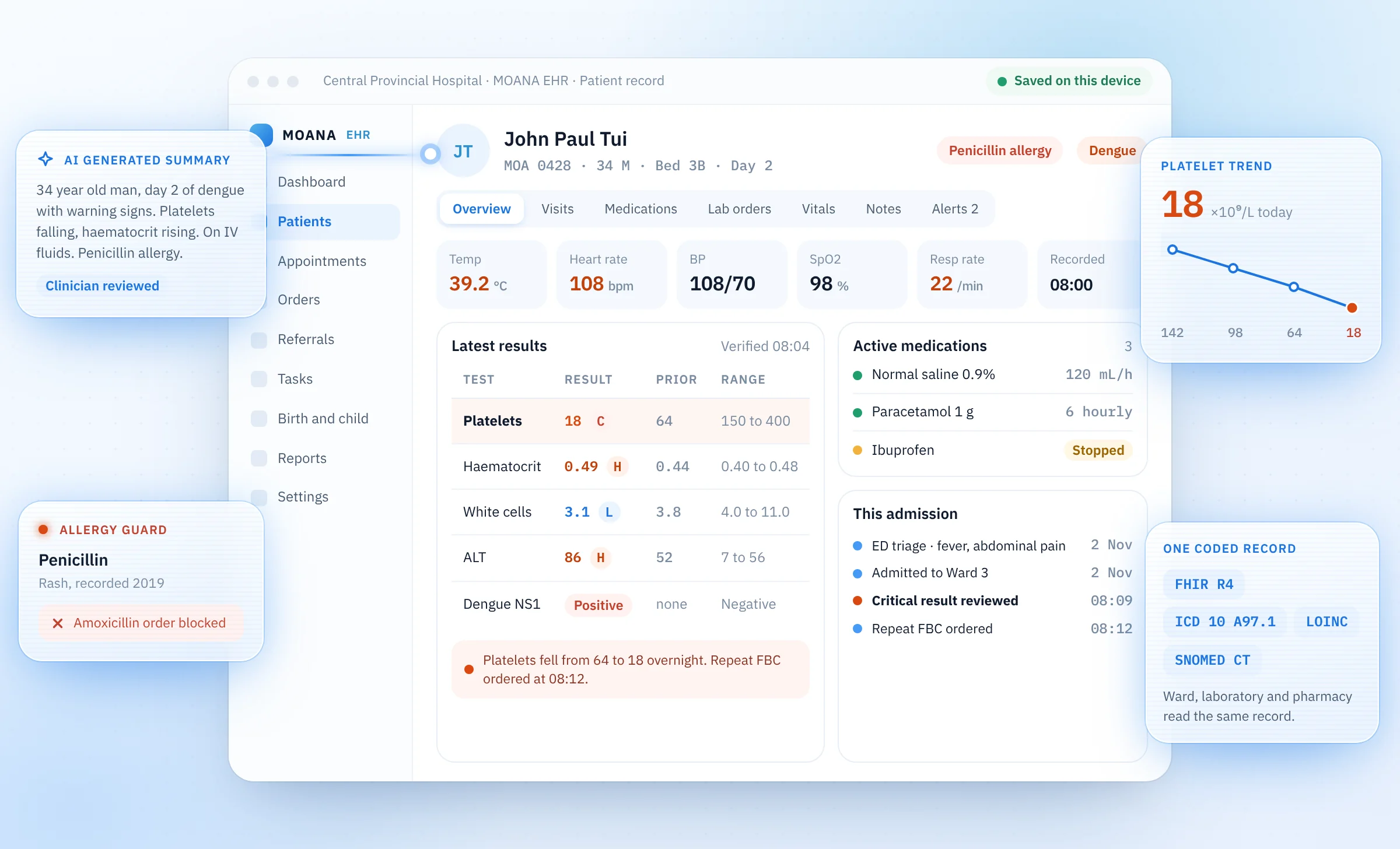
Moana records clinical data once, coded at the point of care, in one patient record shared across the Moana EHR, MOANA Desktop, MOANA Mobile and the patient portal.
- ICD 10 and ICD 11. Diagnoses can be coded in either revision, so a country can continue national reporting in ICD 10 while preparing for ICD 11.
- SNOMED CT. SNOMED CT is supported for clinical findings, problems and procedures. Production use in a country requires that country's affiliate licence, and the licensing route is settled with each customer before go live rather than after.
- LOINC. MOANA LIS uses LOINC for laboratory tests, so results from integrated analysers and instruments carry codes that other systems recognise.
- Reporting from the record. Because encounters are coded at source, MOANA Surveillance can classify notifiable events and national indicators can be reported into DHIS2 without recoding.
- Exchange. Codes travel with the data through FHIR R4 resources and HL7 v2 messages, described on the interoperability page.
The approach is deliberately conservative: use the international code systems where they exist, keep national lists mapped to them, and never require a clinician to code the same fact twice.
Frequently asked questions
Is SNOMED CT a replacement for ICD?
No. SNOMED CT records clinical detail; ICD classifies conditions for statistics. WHO states that ICD 11 can be used without any additional terminology, and that WHO and SNOMED International mapping work is still under discussion and not guaranteed [2]. Most countries that use SNOMED CT continue to report in ICD.
Should a country move straight to ICD 11?
That depends on national reporting obligations, training capacity and the systems in use. WHO allows continued use of ICD 10 for as long as necessary [2]. The practical requirement is that any new system supports both revisions, so the transition does not require another procurement.
Is ICD 11 free to use in commercial software?
WHO provides free access to ICD 11 [2], and its Creative Commons Attribution NoDerivs licence permits commercial and non commercial use provided the codes are not adapted and the work is cited [4].
Does a hospital need its own SNOMED CT licence?
In a Member country, use is covered through the national arrangements [6]. In a non member territory, every user organisation must be an Affiliate or a sublicensee of one, and use must be reported before it begins [6]. Suppliers can hold the affiliate licence and issue sublicences, but the obligations remain.
Is LOINC only for laboratories?
No. LOINC provides codes for clinical observations as well as laboratory tests [11]. Laboratories are simply where its value is most immediate.
Sources
- ICD 11 2022 release, World Health Organization, 2022
- ICD 11 implementation, frequently asked questions, World Health Organization, accessed 2026
- The 72nd World Health Assembly resolution for ICD 11 adoption, World Health Organization, 2019
- Copyright, licensing and permissions, World Health Organization, accessed 2026
- Introduction to SNOMED CT, vendor introduction, SNOMED International, accessed 2026
- Licensing, vendor introduction to SNOMED CT, SNOMED International, accessed 2026
- SNOMED International Members, SNOMED International, accessed 2026
- Not a member? SNOMED International provides barrier free access to many resources, SNOMED International, 2021
- The organisation behind SNOMED CT, starter guide, SNOMED International, accessed 2026
- LOINC licence, Regenstrief Institute, accessed 2026
- What is LOINC?, SNOMED International and Regenstrief Institute, accessed 2026
- Timeline of LOINC history, Regenstrief Institute, accessed 2026
- SNOMED International and LOINC announce renewed collaboration agreement and upcoming production release of the LOINC Ontology, SNOMED International, 2025
- WHO and HL7 collaborate to support adoption of open interoperability standards, World Health Organization, 2023