Clinical trial recruitment from routine health records
Recruiting from routine health records means screening the clinical record against a trial's inclusion and exclusion criteria, so that eligible patients are identified when they present rather than after a coordinator searches files by hand. Published reviews report that record based screening roughly doubled enrolment in several studies and reduced screening time substantially [2][3], provided the record is coded, governance is clear and identities are protected until a study is approved.
This guide covers why recruitment fails, what the evidence says about record based recruitment, the opportunity for hospitals and research units in low and middle income countries, how the process works from feasibility to enrolment, and the ethical and privacy safeguards that ethics committees expect.
Why trial recruitment fails
In cardiovascular research, poor recruitment is the most common single reason trials stop early. An analysis of 13,729 cardiovascular interventional trials registered on ClinicalTrials.gov that started between 2006 and 2015, published in BMJ Open in 2017, found that about 11% of closed trials were terminated early, and that poor accrual was the most common reason, accounting for 41% of terminations [1].
The cost of those failures falls on patients as well as sponsors. Trials terminated for poor accrual in that analysis had enrolled 18,808 patients across 2,319 facilities [1]. Participants accepted the burden of research in studies that could not answer their question.
Poor accrual was also more common in trials run on a single continent (44% of terminations) than in intercontinental trials (28%) [1]. A trial that can reach eligible patients across more sites, and identify them reliably at each, is more likely to finish.
Most hospitals still recruit in the same way. A coordinator circulates the criteria, relies on busy clinicians to remember them, and reviews files by hand. Eligible patients are missed, and those who are found are often found late.
What the evidence says about record based recruitment
Two systematic reviews summarise the evidence.
A 2014 review in the Journal of Medical Internet Research identified 101 papers describing 79 computer based recruitment support systems [2]. Only a handful measured outcomes rigorously, but those that did reported substantial effects:
- Physician enrolment rates roughly doubled, from 3 to 6 per month.
- In a time critical intensive care setting, monthly enrolment rose from 37 to 68.
- Screening time per eligible patient fell by 66%, from 18 to 6 minutes.
- Gains in efficiency depended largely on how specific the screening was [2].
A 2019 review in Clinical Trials examined 13 studies of recruitment using electronic medical records [3]. Eight of the 11 studies reporting recruitment data found more participants were identified or recruited when the record was used.
| Study in the 2019 review [3] | Finding |
|---|---|
| Rollman and colleagues | 4.86% of record screened patients enrolled, against 2.38% with manual screening |
| Cardozo and colleagues | Recruitment yield rose from 6% to 86% with record alerts |
| Herasevich and colleagues | Monthly enrolment doubled after alerts were introduced |
| Schmickl and colleagues | Automated screening saved about 40 minutes a day, 76% of prescreening workload |
| Schroy and colleagues | Cost per enrolled patient of US$99 for an automated approach, against US$1,967 by letter |
The reviews are also candid about limits. None of the studies in the 2019 review was a randomised controlled trial, and one included study found that only about 35% of record data was suitable for recruitment [3]. Record based recruitment works when the data that defines eligibility is structured and coded, which is a design question for the health record, not for the trial.
The opportunity for hospitals in low and middle income countries
Global policy now points toward building trial capacity where disease burden is highest. In 2022 the World Health Assembly adopted resolution WHA75.8 on strengthening clinical trials to provide high quality evidence on health interventions. WHO's Guidance for best practices for clinical trials, published on 25 September 2024 in response, aims to improve research efficiency, reduce research waste and support trials for endemic conditions that can adapt during emergencies [4].
In the Western Pacific, a regional consultation on implementing WHA75.8 identified three priorities: equity in building local research ecosystems, data governance, and research integrity [5]. WHO frames the clinical trial ecosystem around four pillars: governance and policy, regulatory systems, ethical oversight, and research infrastructure, including trained personnel [5].
Routine health records are part of that infrastructure, but only where they exist. In Pacific Island countries, for example, a 2025 scan found electronic health record coverage of 46% of tertiary hospitals and 1.5% of primary care facilities [6]. Referral hospitals with a full clinical record are therefore the natural starting point for record based recruitment in most low and middle income systems, with other sites added as coverage grows.
How record based recruitment works
Recruitment from the record is a sequence of stages, each with its own data and its own controls.
| Stage | What happens | Identity visible? |
|---|---|---|
| Feasibility | Criteria are run across one or more sites to count eligible patients | No; counts only, with small counts suppressed |
| Prescreening | Study staff review candidates for an approved study | Yes, to authorised study roles only |
| Clinician alert | The treating clinician is told a patient in clinic may be eligible | Yes, to the treating clinician |
| Contact | The study team approaches the patient, if research contact is permitted | Yes |
| Consent | Consent recorded against the approved form version and language | Yes |
| Enrolment and follow up | Status tracked against the protocol, with withdrawals respected | Yes |
Feasibility before identity
Sponsors and investigators first need to know whether a site has enough eligible patients. A cohort query built from diagnosis codes, laboratory values, medicines and age ranges answers that with a count. Because small counts can reveal individuals in small populations, they should be suppressed before they leave the system.
Alerts that respect the consultation
A trial alert to the treating clinician is the most effective point of contact, because the patient is present. It must not interrupt care: alerts should never block a consultation, never appear in emergency or triage settings, and never appear for a patient who has declined research contact.
Criteria expressed in standard codes
Criteria defined in ICD, LOINC and SNOMED CT mean the same thing at every site, which is what makes multi site feasibility credible. The roles of each are covered in clinical terminologies: ICD, SNOMED CT and LOINC.
Ethics, privacy and governance
Ethics committees typically ask the same questions of a record based approach: who can see what, on what authority, and how it is recorded.
- Purpose limitation. Identities are revealed only for an approved study and only to roles authorised by that approval.
- Patient choice. A research contact preference, recorded once at registration, should apply everywhere in the system, and a withdrawal should be respected in every later search.
- Consent integrity. Consent is linked to the approved form version and language, with the method recorded: signature on screen, on paper, or thumbprint with a witness.
- Minimum data leaving the system. Research datasets are exported with identifiers removed and with the approval of the principal investigator.
- Audit. Every query, identity view, contact and consent is logged and available to the ethics committee or an inspector.
These controls align with the Principles for Digital Development, which include establishing people first data practices and anticipating and mitigating harms [8], and with the data domain of WHO's Regional action framework on digital health in the Western Pacific [7]. The WHO Global strategy on digital health asks countries to place people at the centre of digital health [9]. The wider questions of ownership and hosting are covered in health data sovereignty and health data security and privacy.
What the record needs before recruitment can work
The finding that only about 35% of record data was suitable for recruitment in one study [3] is the central practical lesson. Before a hospital can recruit from its record:
- Diagnoses must be coded, not only written as free text.
- Laboratory results must arrive in the record as structured, coded values from the laboratory system.
- Medicines must be recorded from prescribing and dispensing, not reconstructed from notes.
- Patients must have one record across departments, so criteria are not split across systems.
These are the same foundations that national reporting and surveillance depend on, as set out in building a national health information system on routine care.
How Moana supports research recruitment
MOANA Clinical Research is a standalone system on the Moana platform that identifies eligible study participants from the clinical record. A hospital, research unit or ministry can add it without maintaining a second database.
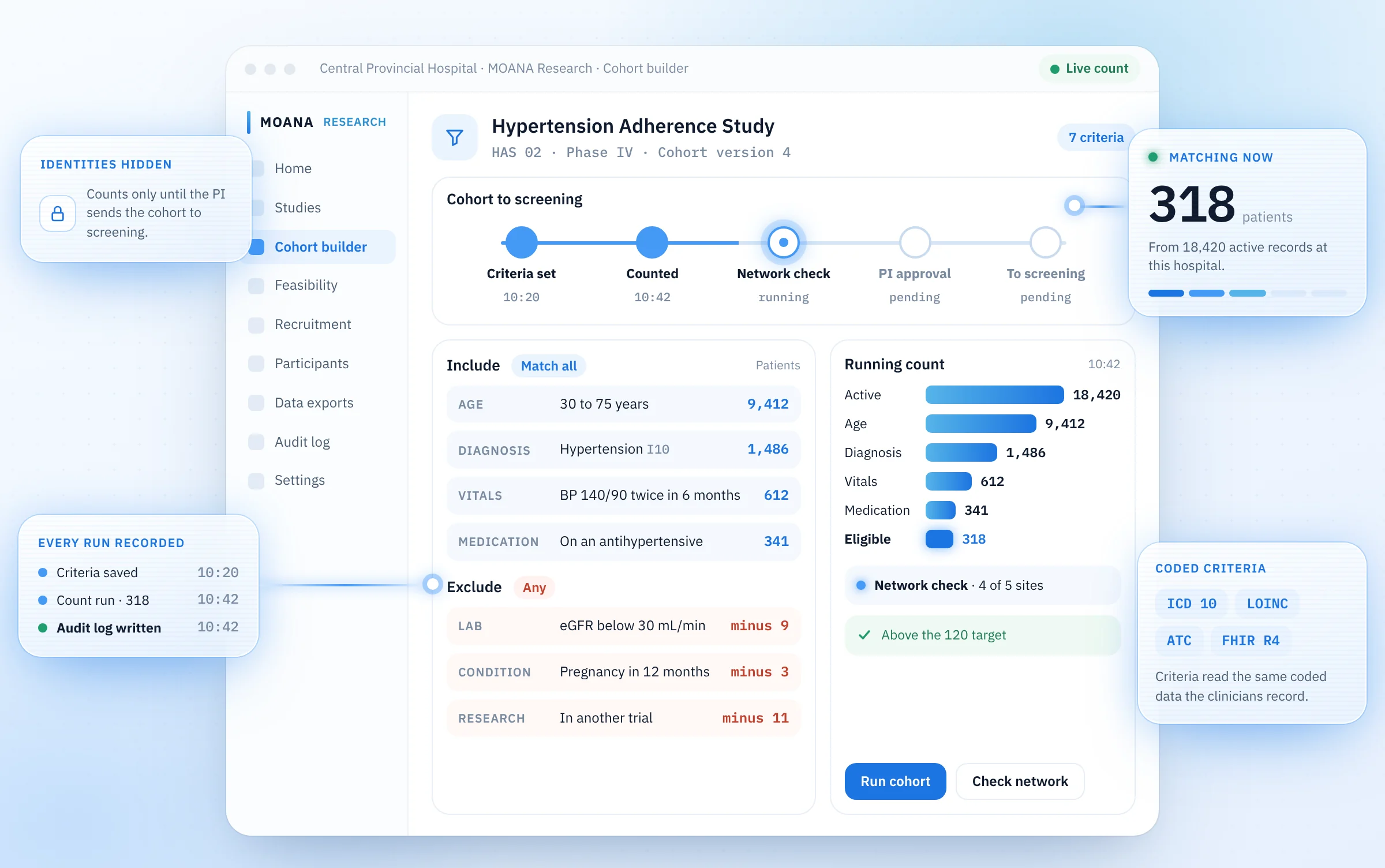
- Cohort discovery. A research coordinator builds a cohort from inclusion and exclusion criteria, such as a diagnosis, a laboratory value, a medicine or an age range, and sees a live count criterion by criterion before any identity is revealed.
- Feasibility across sites. The same criteria run across connected facilities return counts for each site, with small counts suppressed.
- Identities protected. Identities are shown only to authorised roles, only for an approved study, and every identity view is logged.
- Clinician trial alerts. When a patient in clinic matches an open trial, the treating doctor sees the matching values in the chart and can notify the study coordinator in one step. The alert never blocks the consultation, never appears in emergency or triage, and never appears for a patient who has declined research contact.
- Consent and recruitment pipeline. Screening, contact, consent and enrolment are recorded against each candidate, consent is tied to the approved form version and language, and withdrawals are respected in every later search.
- Audit and export. Datasets leave the system only with identifiers removed and with principal investigator approval, and the audit log is available to an ethics committee or inspector.
- Standards. Criteria and exports use ICD 10, SNOMED CT, LOINC and FHIR R4.
The criteria run against the same record clinicians use every day in MOANA EHR, MOANA LIS and the Moana Pharmacy Management System, so eligibility reflects current care. See Moana for research.
Key questions for procurement
Does record based screening actually improve enrolment?
The evidence is positive but not from randomised trials. Reviews report enrolment roughly doubling in several studies and large reductions in screening time [2][3].
Can feasibility counts be shared with sponsors without exposing patients?
Yes, if only counts leave the system and small counts are suppressed. Identities should be revealed only for an approved study.
How should patients' wishes about research contact be handled?
Ask once at registration, record the answer, apply it across the system and respect withdrawals in every subsequent search.
What should an ethics committee be able to review?
The study approval, the criteria used, every query run, every identity view, and each candidate's contact and consent history.
Does this replace the study coordinator?
No. It replaces manual file searching. Coordinators still verify eligibility, approach patients and take consent.
Sources
- Early termination of cardiovascular trials as a consequence of poor accrual: analysis of ClinicalTrials.gov 2006 to 2015, BMJ Open (Baldi, Lanera, Berchialla, Gregori), 2017
- Employing Computers for the Recruitment into Clinical Trials: A Comprehensive Systematic Review, Journal of Medical Internet Research (Köpcke, Prokosch), 2014
- A review of the impact of utilising electronic medical records for clinical research recruitment, Clinical Trials (Lai, Afseth), 2019
- Guidance for best practices for clinical trials, World Health Organization, 2024
- A starting point, not an endpoint: WHO's new clinical trials guidance set the foundation for public health research, WHO Regional Office for the Western Pacific, 2024
- National Electronic Health Record Coverage in Pacific Island Countries and Territories: Environmental Scan, Journal of Medical Internet Research (Porrello and colleagues), 2025
- WHO publishes Regional action framework on digital health in the Western Pacific, WHO Regional Office for the Western Pacific, 2025
- Principles for Digital Development, Principles for Digital Development, 2024
- Global strategy on digital health 2020 to 2025: summary, World Health Organization, 2021